


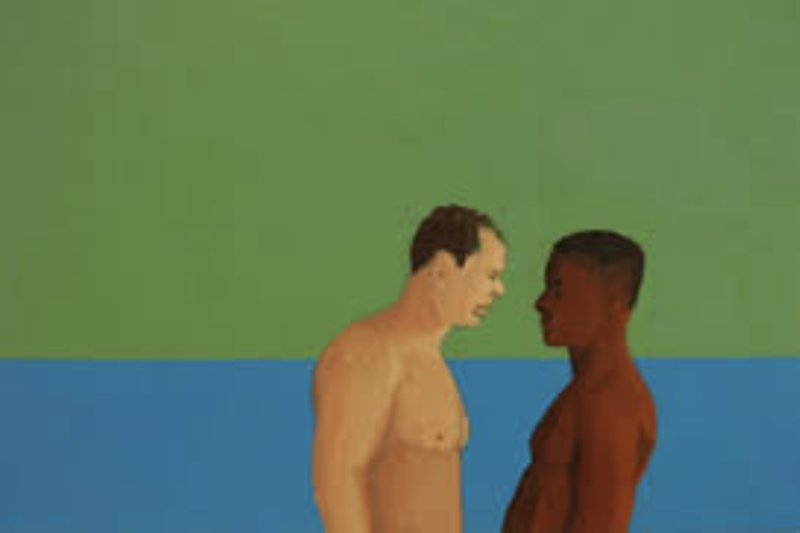
Tom Matlack asked his friend Steve Locke to write for us about race. He declined. Here’s why.
—-
—
Dear Tom,
Thanks so much for asking me to contribute something to GMP. It has been exciting to see how this project has gone from an idea to a reality.
As much as I enjoy reading GMP and as much as I’d love to be a part of it, I don’t think I am able to write about race.
It’s not that I don’t know anything about it. I was on a social media site and I was looking at the post one of my friends shared. He was lamenting the fact that PSYCHOLOGY TODAY had printed an article saying that black women are “objectively” less attractive than other women. Others of his friends posted on his “wall,” saying that attractiveness was relative and that it was based on symmetry of features and the like. I posted a “sigh” and said that it was sickmaking, in 2011, that someone would even create a study to investigate humans in such a way, that the creation of the study was evidence of a bias, and the notion that peoples’ “tastes” and “preferences” are not affected by 300+ years of racialized bias was ignorant. Also, I have been told that black people are somehow deficient for most of my 48 years and that PSYCHOLOGY TODAY was passing this crap off as research was sad.
A poster responded that he didn’t see any racism in the research and that it was like comparing apples and oranges. He also told me that too many people say things are about race when they aren’t, and that maybe I was upset to be on the “losing” side of the article. He wanted me to explain why I thought the article was racist.
I told him that it is not my job to educate him about the experience of race in his own country, although as his darker countryman, I am called on to do just that. I told him that like most ostensibly white people his age, he wanted to locate a reason for thing in his own experience, probably so he would not have to have bad feelings about history, or have to acknowledge the privileges and benefits that he has received for nothing that he has done.
I am a college professor, however, so I gave him some texts that to read that would take him from Reconstruction to the current moment in culture and history. I told him that these would help him develop an understanding of how the caste system of the United States is racialized, and that the understanding of the American experience is structured through the creation, implementation, and sustenance of the racial boundaries through policy and culture.
Here’s the list:
W.E.B. DuBois BLACK RECONSTRUCTION
Ronald Takaki A DIFFERENT MIRROR
Eric Lott LOVE AND THEFT
Noel Ignatiev HOW THE IRISH BECAME WHITE
Ward Churchill and Jim Vander Wall AGENTS OF REPRESSION: The FBI’s Secret Wars Against the Black Panther Party and the American Indian Movement
Alexander Saxton THE RISE AND FALL OF THE WHITE REPUBLIC
(B)ell hooks BLACK LOOKS
Douglas A. Blackmon SLAVERY BY ANOTHER NAME
Andrew Hacker TWO NATIONS: BLACK AND WHITE, SEPARATE, HOSTILE, UNEQUAL
The poster advised me that I was being racist by saying “most ostensibly white people.” I advised that I was going solely by his phenotype, which is what people do with me. I also told him to look up “ostensibly” and “racist.”
So you see, it’s not that I don’t know anything about the subject.
Tom, I don’t want to talk about race because it gives weight to a fiction that was created to oppress. It has no basis in biology and is a social construction in this country that was engineered to maintain access to free labor. The fiction created by race distorts the reality in which we live.
Plus, as a black person, I am called on often to speak for my “race.” I can never give an opinion without it being assumed to be that of a multitude. So when a white person asks me my opinion about an issue that can be related to race, I suspect that there is going to be a moment later when that white person is going to say, “Well, I have a black friend, Steve, who says…” And that will be the black authority on the subject.
Black people can’t talk to white people about race anymore. There’s really nothing left to say. There are libraries full of books, interviews, essays, lectures, and symposia. If people want to learn about their own country and its history, it is not incumbent on black people to talk to them about it. It is not our responsibility to educate them about it. Plus whenever white people want to talk about race, they never want to talk about themselves. There needs to be discussion among people who think of themselves as white. They need to unpack that language, that history, that social position and see what it really offers them, and what it takes away from them. As James Baldwin said, “As long as you think that you are white, there is no hope for you.”
When you went to Africa, you said “you were the minority for the first time in your life.” That’s not true. You have been the only adult in a room full of children, the only man in room full of women, the only non-incarcerated person in a jail. In America if you were a minority at a hip-hop concert in Compton, you would still have the privilege that accrues unbidden to persons designated as white, with all of the political, social, and economic access that comes with it.
What you experienced in Africa, Tom, was that the apparatus that supports the dominance of white skin was absent. It has nothing to do with being a minority someplace, you were free of the prison that is whiteness in America. You could have brought all that privilege with you and manifested it when you saw Cole with Protus, but you didn’t. Letting go of that allowed you to show Cole that he can connect with another person independent of the color of their skin.
Do you remember how Clinton was vilified for wanting to have a national conversation on race? People thought it was unnecessary, that he was a “race traitor,'” that it would lead to reparations for slavery, that it would make white people feel bad for things that were not their fault. White people don’t want to hear about race because the don’t want to be called “racists” or they cannot see how they are responsible for something they didn’t do. That report talks a lot about white privilege. It was no surprise to me that it was not widely read and discussed.
Whiteness to me is oppression. And it oppresses not just black people, but people who think it offers them something other than dominance over their fellow man. Poor white people have been sold a bill of goods that offers them white supremacy and takes away jobs and economic growth.
Tom, I have never, not once, thought of you as white. I think of you as a father, a husband, a brilliant businessman, a feminist, a Quaker, and most of all as a friend. You have never treated me as whiteness demands that you treat me. I don’t want to talk about race because if I do, I stop being an artist, an educator, a godfather, a gay man, and most of all, human.
So I appreciate the offer, Tom, I really do. I just don’t think I can write about it. I can write about art if you like. I know a lot about that.
Love to Elena and the kids, and to you, my man.
Steve
Reprinted with permission
—
Join The Good Men Project Community
The $50 Platinum Level is an ALL-ACCESS PASS—join as many calls, groups and classes as you want for the entire year. The $25 Gold Level gives you access to any ONE Social Interest Group and ONE Class–and other benefits listed below the form. Or…for $15, join as a Bronze Member and support our mission while viewing the site with no ads.
Register New Account
Please note: If you are already a writer/contributor at The Good Men Project, log in here before registering. (Request new password if needed).
◊♦◊
ANNUAL PLATINUM membership ($50 per year) includes:
1. AN ALL ACCESS PASS — Join ANY and ALL of our weekly calls, Social Interest Groups, classes, workshops and private Facebook groups. We have at least one group phone call or online class every day of the week.
2. See the website with no ads when logged in!
3. PLATINUM MEMBER commenting badge and listing on our “Friends of The Good Men Project” page.
***
ANNUAL GOLD membership ($25 per year) includes all the benefits above — but only ONE Weekly Social Interest Group and ONE class.
***
ANNUAL BRONZE membership ($12 per year) is great if you are not ready to join the full conversation but want to support our mission anyway. You’ll still get a BRONZE commenting badge, a listing on our Friends page, and you can pop into any of our weekly Friday Calls with the Publisher when you have time. This is for people who believe—like we do—that this conversation about men and changing roles and goodness in the 21st century is one of the most important conversations you can have today.
♦◊♦
We have calls about these topics 7 days a week! Join us by becoming a Platinum or Gold member. (Click on the graphic for more information about the calls and to RSVP for them.)
♦◊♦
More articles On Race:
White Boy in a Black Land
Black Boy in a White Land
‘Why I Don’t Want to Talk About Race’
Eating While Black
Facing Mecca
Beautiful on All Sides
Race is Always a Parenting Issue
The Race Walk
Poetry In Motion: A Story of Hardship and Hope in Crow Country, Montana
How Travel Made Me Confront White Privilege
I Prefer My Racism Straight Up, Thank You.
Whiteness Is Not the Absence of Racial Identity Any More Than Maleness Is the Absence of Gender Identity
I Ain’t No Whiteboy: A Reflection on Hip-Hop, Misogyny, and Racial Identity
Why We Need to Talk About Race
When Do I Get To Stop Apologizing for Being White?
Tourism Black and Blues
How Basketball Helped Me Realize I’m Not White
I Talk About Race Because I Don’t Know How Not To
♦◊♦
Image credit:
“the neverending story” 2007
oil and acrylic on panel
12 x 16 inches
Private Collection.


Conservative white dude trying to figure this out a bit more. This was a helpful read. Two days ago I posted on social media asking my friends to stop advocating so forcefully for the confederate flag, my reasoning: you may love your heritage but that flag absolutely offends a large segment of our population, and with good reason. So why fly it? (A good application of love your neighbor as yourself.) I also mentioned Robert E. Lee somewhere in there too. And then, I disagreed with a friend’s meme about the confederate flag, and before long its, “You need to… Read more »
Professor Locke, I saved your list of good books to read about black history. Not a single one of these authors — not even W.E.B. DuBois — is listed in the e-Book online site of our public library. Also, now that I come to realize this — if there are any librarians other than white ones in the library building itself, they are not very visible. I generally scope out a workplace or place where I go or trade, and I would have been aware of the any racial or ethnic minorities working as librarians in our public library. I… Read more »
So unfair and tiresome that people of color are constantly subjected to hurtful ignorance. They shouldn’t have to stand up and fight every time a white person says something stupid. White people – time to stand up and fight it and educate ourselves and our children and stop acting like racism is “over” – it is not over because we *feel* like it is over.
Yes, I would love to read what Steve has to say about art. Please ask him to write about that!
huh. I’m going to assume you had his permission to publish this letter about race that specifically states he didn’t want to publish anything about race..
I have a few other things to say. But it’s 8 am. So give me a few hours.
Never mind. Clearly I totally missed who published this article… 8am. I will absolutely contribute something of value in a few hours.
“Black people can’t talk to white people about race anymore. There’s really nothing left to say.” Yet, somehow, you manage. Whites can’t help the color of their skin anymore than blacks can. They are born that way. Is it right to make them feel ashamed of who they are? By the way, I am neither white or black but Indian (“dot, not feather” to clarify). Once, my daughter’s teacher told she was “safe” because she was Indian. The same teacher told the white children they were evil and racist. This black/white racism gets really old. How can we evolve when… Read more »
At no point in this article does anybody, in any way, attempt to make whites feel bad for being white. That is your perception, and perhaps you should examine why that is your reaction, and acknowledge how counterproductive that is. Oh and by the way, I am white. Not that you should need to hear this from a white person.
In my job I’ve learned, as I suspected, that while it’s true that experience is valuable, it’s far from being the only criterion for expertise. In fact, it can be a detriment. The best indication that someone will do a good job is intelligence and attitude. I think it’s the same for issues of social justice. What I think you may have not considered is a common human fallibility: that is that people feel the need to justify their own value and importance by contrasting themselves with others. If that justification fails, they will use any reason to justify their… Read more »
Being biracial, I would love to talk about race. I get to marginalize everyone. How much does the job pay?
It is easy for white men to say such opinions are silly, because honestly, they don’t have to deal with it.
While I’m not black, I am a woman (a group who has been oppressed in almost every race for thousands of years)
Women are also constantly told we are “deficient”, often times because it was “ordained by God”
It is tiresome, and one grows tired of defending why they, as a human, are just as human as the person they are talking too.
Okay, here’s the problem I have with this article. I am half white and half hispanic but i only look “white” to most people. I was raised in San Francisco, where many racism issues have been more or less resolved, and where they are not, there are thousands of people out there trying to fix them. It is so that I have not really encountered much of racism until I started going to college in Santa Cruz. I have since been faced with people being prejudiced towards me because I look predominantly “white”. People have called me “rich white girl”…… Read more »
READ WHITE BY RICHARD DYER, I THINK THATS WHAT WAS MISSING FROM THE LIST
I have never been race biased, unless if they dont use languages which i dont understands & getz bullied for no reasons, why not ppl speakz in english ? we all understand n can improve our grammars time 2 time
GREAT post! Thank you! There is a BIGGER ISSUE here. We are all under-privileged unless we are Brad Pitt and Angelina Jolie (white, hot, rich, talented, healthy and famous). But I tell ya, I bet even they don’t have full freedom. People probably bug them everywhere they go and ask for money. Most people probably treat them with the agenda of what they can “gain” from being around them. I am NOT comparing their “discomfort” to racism. The little I understand about oppression is this: people not being given or allowed the same opportunities, respect and kindness due to their… Read more »
“I told him that it is not my job to educate him about the experience of race in his own country, although as his darker countryman, I am called on to do just that. I told him that like most ostensibly white people his age, he wanted to locate a reason for thing in his own experience, probably so he would not have to have bad feelings about history, or have to acknowledge the privileges and benefits that he has received for nothing that he has done.” Steve Locke, I hope that you also reminded your student that your personal… Read more »
@Misha I couldn’t help myself,i had to comment..In the mashup of ideas over racism,responses like yours,however intellectual,are profound excuses. One doesn’t always need to prove something scientifically in order to legitimize its’ existance.Motherwit has its place in the discussion.I think it is fair and correct to extrapolate, based solely on relative human experience, that if one group or person-regardless of race- abuses another for a long enough period of time,dysfunction in that relationship and persons will likely occur.Its just common sense, backed by history, that doesn’t require statistical analysis to prove.
I had a long post agreeing with you Misha but it completely disappeared as I was writing. Thank you for this. Briefly, many black people I’ve known have been upset by Korean store owners following them around the store. I would nod my head because it was obviously racist. Then I moved to Korea for several years. I learned that this is the way businesses are run. The store owner greets you & follows you around in case you have a question or need something. It wasn’t racism in most cases, it was cultural misunderstanding. While I was there I… Read more »
@ Hai True but you gotta admit Asians don’t make much noise.The market place of ideas is a warzone.
Brilliant Article.
To those who have and are experiencing the historical truths of this ‘construct’, we are no doubt in an Advanced class of Racism 401. I urge you all to read the books on the list at the bottom of the article … this will at least get you more deeply imbedded in the ‘curriculum’ and framework. To be fair, many ‘Black’ people should read them as well.
Then lets meet in the classroom … and talk.
You might think race is a social construct, but I’m glad that people doing the organ transplants don’t.
http://www.musc.edu/humanvalues/pdf/Transplantation-the-organ-gap-and-race.pdf
“A variety of factors contribute to differences among races: biological, medical, social, and
personal.”
No one ever talk about the asians… lol. We don’t even appear on the statistics. White, black, hispanic, native american indians. Lol, it’s as if we don’t even fucking exist.
some good points and perspective “…my black friend steve…” for example.
this one though…”Plus whenever white people want to talk about race, they never want to talk about themselves.” eh…i am truly sorry if your experiences with white males has led you to such an incorrect conclusion.
bravo, steve! love you,
The Good Men Project leads the way in men addressing issues of sexism (along with many other important topics – you’re multi-dimensional). Men schooling other men on when they’re being creepy sexist dirtbags carries more weight than women calling it out. It’s too easy for men to dismiss the women’s voices; harder to ignore when your bros tell you you’re being an asshole. How great would it be if the GMP also led the way by asking a white guy who is studying white privilege to write about race instead of a man of color. Get someone who is trying… Read more »
Beautiful, thank you.
Race, well when I was 19 years of age I ventured from a eastern province in Canada to the heart of our country Ottawa in Ontario. I remember how scared I was when I got off the Greyhound bus in Ottawa, I felt surrounded by Black people and yes I was scared. Now for some more information, I went to school with a population of 300 or so and one black kid. I had no black neibours in my area of hicland. So being in such a diverse enviornment freaked me out but why? My grandmother married a black man… Read more »
I have been engaging people in dialogue about race for 7 years join the discussion color Struck s a powerful play that opens people u to discuss what we need to discuss. how we can move forward ite
I completely agree with Steve’s decision to not talk about race but I believe acknowledging race in any form is racist. To identify a person because of color gives an inherent ranking to race. I appreciate the non-discussion view of a racial discussion but the true non-discussion of race would simply be a colorblind discussion of humanity.
That is a very slippery slope. The “hierarchy” of race has already been established and deeply ingrained in society. While “a colorblind discussion of humanity” sounds all well and good, it often leads to the continued dismissal and ignorance of people of color. Often, ignoring race includes ignoring a person’s present struggles and history and is just code for “people of color, just assimilate to our ways and THEN race will no longer matter!” I, for one, am angry that I was robbed of my history, both good and bad, growing up in typical public schools all over the country.… Read more »