


 Middle age is reportedly the happiest time of life for most Americans. So, why are middle-aged men at such high risk for suicide?

I belong to a group that has an unusually high rate of dying by suicide. No, I don’t belong to a cell of terrorists in training. I’m not a soldier or veteran with multiple deployments to Iraq or Afghanistan. I’m not a prison or jail inmate. And I’m not a doctor (physicians have easy access to drugs and understand their lethality). What high-risk group do I belong to? I am a middle-aged white man.
Men have long had higher rates of suicide than women, and whites in the United States are more likely to kill themselves than are African, Hispanic, or Asian Americans. But it’s only in recent years that the middle-aged have overtaken older people as the ones most likely to die by suicide.
In 2007 (the latest year for which statistics are available), people aged forty-five to fifty-four had the highest suicide rate of any age group: 17.7 per 100,000. (The national average was 11.5 per 100,000.) And the rate for fifty-five to sixty-four-year-olds showed the greatest increase from the previous year.
Researchers don’t yet know why midlifers are becoming more vulnerable to suicide, especially since studies have found that middle age is generally the happiest time of life for most Americans. As a forty-five-year-old white guy, I was curious to know what makes my demographic group so self-destructive. After talking with experts, here’s what I learned.
♦♦♦
“Women seek help—men die.” This quote from a 1990 medical journal article is an overgeneralization, of course. There are plenty of women who don’t seek help for their emotional distress. After all, women in the United States are three times more likely to attempt suicide than men. But “men tend to hold their own counsel,” says psychiatrist Yeates Conwell, co-director of the Center for the Study and Prevention of Suicide at the University of Rochester. “They often don’t build supportive networks that allow them to share their concerns with others.”
Men are also more likely to drink heavily when feeling distraught, and to reach for guns in order to kill themselves. Nearly sixty percent of suicides among males occur by firearms, while the most common method among women is overdose/poisoning. Guns tend to be more lethal than pills, and this helps explain why there are four male suicides for every female suicide. (Some ninety percent of all people who die by suicide have a diagnosable mental illness or substance use disorder.)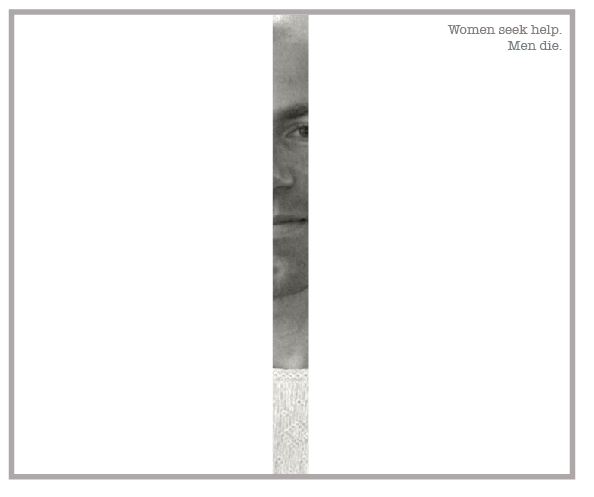
There’s even evidence that men are more likely than women to feel there is a stigma attached to a “failed” suicide attempt. So men may use more lethal methods to avoid being seen as unmanly—even as they’re planning their own death.
Changes in gender roles may also be affecting men, suggests Sally Spencer-Thomas, executive director of the Colorado-based Carson J Spencer Foundation, whose Working Minds program promotes suicide prevention in the workplace. As more women become family breadwinners and attain leadership positions once denied them, Spencer-Thomas says that “more men are asking themselves, ‘Am I a provider or not? Am I a leader or not?’ Their sense of purpose may become unclear.”
♦♦♦
Whites could use a little faith. Whites are more than twice as likely to die by suicide as blacks, although whites in general are better off economically. In fact, the suicide rate for white men aged forty-five to fifty-four (29.3 per 100,000) is 14 times greater than the rate for black women of the same age (2.1 per 100,000). Some researchers suggest that blacks may be less prone to suicide because they are more religious. They tend to outpace whites in the United States on measures such as frequency of church attendance and prayer, closeness to God, and self-ratings of spirituality. Being part of a church community can also be a powerful source of social support, another protective factor.
♦♦♦
Midlife can be a minefield. For many people, the peak earning years of midlife offer a sense of competence and mastery. But for others, the middle years may be times of disillusionment and regret about stalled careers and stale marriages. This time of life can also be filled with anxieties about mounting debt, while putting kids through school and caring for aging parents. Plus, men at midlife discover that their own bodies aren’t what they used to be. As natural medicine expert Andrew Weil, M.D., writes, “The man at fifty or sixty looks at his sagging muscles, thinning hairline, bigger belly, and uncooperative penis and wonders, ‘Whose body is this?’”
But these challenges aren’t new to midlife. What could account for the rising suicide rates? (Remember, the latest statistics are for 2007, before the economic meltdown of 2008 brought widespread job cuts and home foreclosures.) Dr. Conwell says that even before the recession, concerns about the stability of employment could have set the stage for other factors—such as substance misuse, more difficult access to health care, and less-stable social support—that can increase the risk of suicide.
Sally Spencer-Thomas also suspects that fraying social ties may play a role. She notes a 2006 study showing that Americans’ circle of confidants shrank by one-third in the previous two decades. And the number of people who said they have no one with whom to discuss important matters more than doubled in that time, to nearly twenty-five percent.
Thomas Joiner, a psychologist at Florida State University and author of Myths about Suicide (2010), speculates that the mainstreaming of gore may even be having an effect. When the people now in their mid-40s were in their teens (from the mid-1970s to the early 1980s), they were starting to get exposed to gory movies like Halloween and Friday the 13th. He believes that one of the most important factors that contributes to suicide is a “learned fearlessness” about physical pain, physical injury, and death. (Other factors, he says, include the idea that you are a burden on other people, and the feeling that you are hopelessly alienated from them.) As people develop an increasing tolerance to gore, perhaps they are more likely—when in extreme distress—to do themselves harm.
“I hope that I’m wrong about this,” says Joiner. “If it’s true, that’s ominous.” Children and teens today are exposed to far more graphic violence in movies and computer games than were their counterparts of thirty years ago.
Other theories about why midlife suicide rates are on the rise include easier access to guns and prescription drugs, and a potentially higher incidence of depression among baby boomers.
♦♦♦
Lowering risk. When I asked these experts for practical advice on what middle-aged white men can do to reduce their risk of suicide, they stressed that you should see your doctor if you suspect you’re suffering from depression or another mental health problem. While depression often includes feeling sad or losing interest in things that typically give you pleasure, it can also be expressed in other ways: sleep problems, frequent headaches or stomach pain, risk taking (such as reckless driving and casual sex), and anger. If you are suicidal, call the National Suicide Prevention Lifeline at 1-800-273-TALK (8255).
The experts also advise all men to develop support networks, and to stay engaged with family and friends. “Do everything you can to resist the urge to isolate,” says Phillip Smith, Ph.D., a psychologist at the University of Rochester. Reaching out can feel uncomfortable, he admits. But sharing your worries can make you feel less alone, and other people may offer valuable perspectives on what you’re going through.
Dr. Conwell also encourages men to take good care of themselves. That means eating right, being physically active, managing your stress levels, getting enough sleep, and not drinking too much alcohol.
And don’t forget to look out for each other, says Spencer-Thomas. Notice if a family member, friend, or co-worker doesn’t seem himself, and ask him how he’s doing. Remind him that depression is a treatable medical condition, not a sign of weakness. If he’s talking about death and suicide, and you suspect that he might harm himself, offer to take him to the emergency room or call 911.
♦♦♦
A personal perspective. I am no stranger to depression, as it has affected me to varying degrees since my teens. It took me a long time to get help—first from psychotherapy, then medication, and now both. The idea of suicide once had a seductive pull on me, but it has lost its power.
Although suicide used to seem like a way out of my struggles, now I can see more options to get through them. I’ve also met several people who have lost loved ones to suicide, and now I firmly believe that any option is better than killing myself.
 These survivors of suicide loss have been through a veritable hell of grief and guilt (“What could I have done to prevent this?”). If you ever get to the point that you think you’ll be doing others a favor by doing yourself in, you are wrong.
To me, the essence of suicidal thinking is a kind of tunnel vision in which self-annihilation seems like the only solution to emotional pain. Perhaps this is why I’ve found comfort in environments that provide a sense of spaciousness and openness. Sitting beneath the vaulted ceiling of my church, or walking though the woods and coming upon a sunlit clearing, seems to take me out of my head and my concerns.
In his book Man’s Search for Meaning, Victor Frankl describes a moment not long after he had been liberated from a Nazi concentration camp. He is walking through the countryside past flowering meadows. Larks rise to the sky and sing joyously. He stops, looks around, and then drops to his knees. Frankl, an Austrian Jew, repeats to himself a line from Psalm 118: “I called to the Lord from my narrow prison and He answered me in the freedom of space.”
I think it’s possible for anyone to experience this freedom of space, regardless of religious affiliation or spiritual beliefs. And I share Frankl’s sense of gratitude. I find myself released from many of the constraints that depression once placed on me and from the lure of suicidal thoughts, and I can see possibilities all around me.
—Dan Fields
Thanks to Elana Premack Sandler at the Suicide Prevention Resource Center for help with statistics.


The brutal reality of midlife is that it sucks. I think back on the days when I could ride my bike 100 miles, drink a six pack, then get up the next day and do it again. I would go out on Friday night and get laid, then sometimes go back out on Saturday and do it again. Now, I’m lucky to get very mediocre sex once a week, and part of it is my fault because my knees hurt when I try to change positions. I haven’t had a threesome in at least 25 years. Then, Monday comes around,… Read more »
I’m 55. I do the same thing every day…get up,go to work,come home,eat, watch some tv and repeat. On my days off I’m too tired to do anything but nap. The realization that this will be repeated over and over for the next 10 years at least is unappealing to me. Retirement does not look any better. I think a better question is why NOT kill yourself? What are you going to miss?
I lost my wife of 15 yrs, marriage was rocky anyhow, I am 51. Just had back surgery back in march. And I am thinking I am hooked on oxy, valuim. I own my own home, in new relationship that all we do is fight and I’m so feed up on being in pain, and I just ready to die.
I’ve read that suicide is a permanent solution to a temporary problem but the depression is permanent. I’ve sent out signals but my family has let it be apparent that whatever I do is my choice. I’ve been isolated for a couple of years, have no close friends and keep to myself. I’m 57 and just tired. Don’t see the future. Reading that those left will think what could they have done to prevent it? Nothing.
Many people have hit the nail right on the head, so to speak. For those that still don’t get it, maybe my two cents will help. At 40 years of age, I have nothing to show for my life except a nagging wife who meanders through University and quits when the classes get too hard. I have two teenage children who care more about clothes and video games than getting out and seeing something of the world. My life is utterly conventional, and I’m trapped in a job (the Army) that I can’t just quit. I’m in a prison and… Read more »
So sad. I am female, but just as confused about life as any of the men here. We are brought up to believe in fairness, truth, a Higher Power. I’m not sure what’s going on in this world. So much feels just plain wrong. I breathe a sigh of relief when something/ someone doesn’t feel that way. Let’s stop looking to the sky for an answer and turn to each other. I wish everyone could stop pretending and start talking about what’s real. But it won’t be that way because most are propelled by ego and competition. I am tired… Read more »
Thanks for the honesty shown here! My husband killed himself (gunshot) near the beginning of this year and I’ve been craving honesty on this subject. My husband of 14 years never drank or smoked, worked hard and earned well for myself and our 2 children. He did suffer from depression but I never knew how much. I accept he had to go as I accept that many of us could kill ourselves at varying junctions in life. I just try to trust in God. He knows, he has reasons, everything would be perfect if we could see the whole picture.… Read more »
Aw, this was an incredibly good post. Taking the time and actual effot to generate a really good article… butt what can I say… I put things
off a whole lot and never seem to get anything done.
I find this discussion fairly farcical. Men, although thank god women are able have the same opportunities that men do these days (for the most part, although there is significant room for improvement), are highly vulnerable to mid-life layoffs. That, given our deep-felt responsibility as providers for our spouses and families, leads to despair when we cannot do that. And (not to engage in idiotic partisan politics), the fact that government policies (i.e. especially business-hostile decisions like Obama has done) directly lead to layoffs, is a contributor to male suicide. But of course we will continue our “puzzlement” at the… Read more »
I’m 52 years old. I’m a white man with a high school education. In 2009 my 401k worth plummeted (I lost more than $10,000). I panicked and closed the account before it went to ZERO. Of course, by doing so I lost 1/3 of what was left to taxes and fees. Anyway, my body is beginning to fail (bad back, high blood pressure, etc.). I’m a driver and only make $17.00 per hour which is peanuts in today’s inflated economy. My wife doesn’t work due to medical reasons so I barely make it from check to check. Under our current… Read more »
Life is a funny little random kick in the genitals is it not. They cut my salary so much I had to pretty much accept the layoff. The money is almost gone. And I do not give a darn. The messed up thing is all of a sudden a lady friend of mine of 17 years confesses her love for me and my nieces and nephews sort of want to connect more with me now because my brother died and I was around most of the tykes while they were growing up. If I were a cold hearted schmuck I… Read more »
I have considered suicide a few times and even at this moment I don’t know if I will die of natural causes or by suicide. The reason why is just one thing and nothing hard to understand. I am a caring and giving guy who has always loved women and hoped they were capable of the same—I have never met a woman capable of love. I have learned that 100% of them only “love” large bank accounts, superficial things like that or how well you can impress celebrities, the size of your package, …. but woman don’t have human feelings… Read more »
I’m curious to know where you live.. I’m asking because I live in south Florida, a VERY party/money-hungry/looks-driven type of place. I am a beautiful 30-year-old woman with a lot of intelligence and drive, but also super compassionate, and I’ve NEVER dated a guy for “money, celebrities, sex” etc (which it seems most people down here do). Friends have even told me I am “dating down”- I don’t care what they say, I care about the man’s heart and personality, nothing more..So kind women do exist. It just depends where you are looking, and honestly, what it is about you… Read more »
Kind women are one in a million to a man in his fifties who is ugly and makes little money, no matter how big his heart is and how honest, kind and sincere he is. No matter how much he would worship a woman (whatever her age). A woman on the other hand will let a man treat like shit if he is handsome. I read all the time that this is bullshit but it’s true. If you’re ugly, women (even if they’re not attractive either) won’t have anything to do with you. They pick Mr. Jerk Off every time.… Read more »
Men are under attack.. and for good reason. We are not needed. Science will quickly discover means of igniting the egg-fertilization process, and men will no longer be necessary. Women have proven the ability to be as ruthless and self-protective as necessary. There is no inherent difference in the pysche that can’t be overcome by evolutionary processes in the human brain. Men aren’t needed to defend women as they can kill others as effectively as men can. I am a middle-aged man who has been coming to terms with his redundancy for many years. The only thing that has prevented… Read more »
My beloved brother commited suicide July 25, 2012. Not a sign that I could see, until of course, I looked back in the most sorrowful, broken time of my life and saw a couple of things I missed. Might not seem like much to some, but i knew him well soooo… He called me the night before and we talked about soem things that were going on and before we hung up, he told me he loved me, he had also told me that about a week prior on the phone. Way out of character. I KNEW he loved me.… Read more »
pills are NOT the answer for one people in poverty CANNOT AFFORD THEM and the warning labels on the pills SAY THE PILLS WILL CAUSE YOU TO COMMIT SUICIDE , no who the hell is going to risk taking those damned pills if they are going to prompt you to do the very thing you are trying to avoid
You’re absolutely right that some pills can in a lot of causes make depression worse. In addition these pills can also cause severe weight gain, increase your chances of having diabetes later in live, and many other side effects. Unfortunately, medical professionals will prescribe these pills and discount your concerns until you tell them you gained 50 lbs of weight or have even more severe depression. Given the possible side effects (I’ve had one that caused a 50 lb weight gain and another that caused dizziness) it simply isn’t worth the risk of taking these pills for a depression unless… Read more »
consider those who have NEVER had anything their entire life, no friends no girl no kids no love no hope nothing, i put up with being treated like garbage four looooong years of high school constantly being told how much of a worthless failure i am every day for eternity, their is NO HOPE when the only people you ever loved are in heaven, my parents loved and understood me, but who is there now to talk to, there is NO HELP for those who live in poverty , who can talk to a expert when they have no insurance… Read more »
Amen brother. People do not understand that for some of us, our entire lives have been one loss after another. And even through our best efforts we still achieve little or nothing because of how things work. And being a man you are not allowed to talk about your dissatisfaction as much as women do. So why is it when you decide enough is enough then people want to come in and try to convince you not to? Especially when they are not going to help you find a better job, help you get an education without drowning in loans,… Read more »
Unfortunately not all men have had a great life. Thanks to a Aspergers I have had troubles making friends my entire life and am considered different. For a lot of men, turning 40 is a great time in life but for us single men who never got married it is pure hell! We constantly wish there was someone who loved us, we wish we could have been a dad, we wish for a lot of things that other men take for granted. You finally realize that you wasted your time looking for love and you will be lonely for the… Read more »
I know where you are coming from
Life is short….eternity is long. I too have felt like many of you, but in the end I would rather let God decide when it is my time to go. True, a meaningless life is not worth living, but life is only meaningless outside of a relationship with God. Why not surrender your own way? ‘ The cords of the grave coiled around me; the snares of death confronted me. In my distress I called to the Lord; I cried to my God for help. From His temple He heard my voice; my cry came befoe Him and into His… Read more »
If your god and philosophies work for you then so be it.
As an atheist and a rational I know that life has no intrinsic meaning.
Which means there is no real reason for me to hold on to it ipast a certain point.
I just wish they had legal suicide clinics here so we could just go, sign some papers and go to sleep instead of having to jump off a bridge or shoot ourselves.
‘The fool has said in his heart, ‘there is no God’
You cannot know that God isn’t, but you can know that He is. Look at Jesus.
There is no solid proof either way.
And I’ve never met or seen Jesus so for all I know him and other historical figures could be either totally nonexistent or changed from who they really were to make people think a certain way.
Sorry if I cannot let some being who cannot even give measurable proof they exist control over my life. Especially when that supposed being lets people go through suffering for its own sadistic purposes.
My friends………..https://www.youtube.com/watch?v=0kT5w27YxyI
Sometimes one is just tired of going through the daily motions. If I wanted marriage and kids I could have had that. Would not have satisfied me. No issues with being lonely or any other emotional situations. Sort have always been immune to those. Just that getting up every day is not fun anymore. The drudgery of a crap job and being older means you are less likely to get hired elsewhere even if you get loans for additional education. I am thankful for my job but I was not thankful having to take a damned thirty percent pay cut.… Read more »
I get where your at..! The daily routine of life can become very redundant & some mornings we wake up & say “fucking shit another day of the same crap”… In my 30 years of life I have lost over a dozen friends many very close to me; at one point I had a job that I actually loved… Fixing classic & exotic cars for a small dealership… The pay was decent for me & the hours were normal & the work enviroment was very carefree & enjoyable; the bosses were so cool that if I had gone out on… Read more »
unknwnusr , I understand. Having lost most of my friends to death or incarceration it really takes a toll on one’s life. And those long term deep trust friendships are hard to come by. I was married once so I know the ropes of the lady wanting better finances and being upset that you work too much. Course she cheated with multiple gys as I found out and I had to fight in court for years just to spend a little time with my son. He died in a car accident last year along with my cousin and one of… Read more »
Dr. M Im happy to see you share more… The depth of loss of loved ones is beyond for many to understand & I will admit the loss of a child is the utmost painful feeling I am sure… I do not have kids, so it is hard for me to relate exactly; but as you know ive lost many of friends great & best ones & as you say the good ones are hard to find & trust in this lifetime… I have many of friends too whom have been incarcerated as well… Hence why my one friend shot… Read more »
DR.M
I agree with you.
No type of emotional involvement is going to do anything for me.
I do not want to get older and I have not figured out how to get extremely wealthy.
This daily grind just to be old and broke is pointless.
I am choosing death as well and will be dead by the end of this week.
Wishing you a quick and peaceful end DR.M
Ok I get it you dont believe in God & im cool with that… But what is the real reason for you not to want to live anymore..? I admit to mine, Dr. M has shared his… But whats your reason..? If what you believe in is “only reality” and “logic” cool im with you… Im a human being a grand composure of intricate biomechanical micro organisms as are you..! These are all logically real..! And very much alive..! I had a point in life too & sometimes still do where we devalue or question or exsistance or place in… Read more »
This is the link to the Deepak Chopra video I spoke of; its called the mystries of conciseness…
http://m.youtube.com/index?client=ms-android-google&tab=w1&gl=US&rdm=m5zadq6w7#/watch?v=FEF7T-Yy3kQ
And this is the link for the Lenord Jacobs Video True awakening… Its 2 parts this is part 1 link…
http://m.youtube.com/index?client=ms-android-google&tab=w1&gl=US&rdm=m5zadq6w7#/watch?v=Ce0sISw_qBY
D’artagnan will not be able to reply. Thing is he sounded like this guy I worked with who quit a few weeks ago. So the first message he sent I rung the guy up on the phone and it was him. He explained it all to me. Since he was the only one outside of family who knows about my cancer returning… We were not best friends but I am open minded so he was willing to talk to me about himself. Funny thing is he’s not the type of guy one would expect to make that choice. Charming, attractive,… Read more »
Dr. M. Hes is not like you & you are not like him… All too often we become absorbed by the facade of what society has deemed “real”… It seems to me d’art became self absorbed in setting an unrealistic “expectation” on wealth by a certain point in time… Please please please watch the previously post lenord Jacobs videos I posted… Lenord speaks of exactly these types of “expectations” in life & how it can & will drive you insane when they never come… From what you know of him & as you said you wouldnt think he would be… Read more »
Im a 30 year old single male never married, no children, I own several cars & motorcycles, I own my home outright, in general I know I am successful in my life & amongst my peers/friends… I have no brothers or sisters, never had a father & my conception was due to rape, my mother is now 72 & all of my mothers side of the “family” lives elsewhere in the nation of which I know very little about any of them… Recently I started seeing a woman but for the most part she just wants me sexually & nothing… Read more »
I am so with you, man. Please contact me if you’d like to talk. I think we should talk.
Tom thank you for reaching out to me & being able to relate…
Whatever you & want to speak of I would like to & choose to keep it here in the comments/forum…
Because these issues affect tons upon tons of people worldwide; and my goal for myself is to remove the selfishness of my own thoughts & share openly as it helps me to somewhat vent & relate with others…
Tom please feel free to share anything you feel relivent or your own story/experinces…
Great post and a lot of truth in there. Love is certainly the key but belief in yourself and in your own self worth is perhaps more important. Sometimes it is better to work on being the best that you can be, even if in a shitty place and often with the contentment obtained, love will follow. We don’t all deserve or indeed get love. We don’t even know sometimes that we are loved. The trick is to LIVE and life will give its own reward and maybe even true love. Keep on movin my friend….
Five years ago my husband [age 58] of 30 years took his own life. I didn’t see it coming; he was the laughing giant that everyone loved. I was more fortunate [?] than most suicide family/survivors; I had answers. It’s been a long journey through a very dark place. On that Sunday morning John stole from me; stole my marriage, stole away my best friend, stole our retirement life, stole my having someone by my side during the last quarter of my life. Now just as I am in a good place and very content with my life, my 55… Read more »
Your husband “stole” nothing from you..he denied you of YOUR expectation of, as you put it, “The last quarter of your life..” I notice there is not a word of WHY he committed suicide; only that he was always happy. This suggest to me the communication beween the two of you was not what you thought it was. He seemed happy, and you loved him, yet the direct opposite was true; he was so depressed he killed himself. This is common in cases of middle aged suicide when the victim(your husband , not you) is married; one party is in… Read more »
Wow… I just stumbled across this after googling, “why is a successful man so depressed and isolated.”
Yes, that’s me. I isolate myself because I like to be alone… I am a huge introvert, but most people wouldn’t know it. They probably look at me and wish they had my life.
But here I am… alone… isolated… and wanting to die.
What is wrong with me?
I think through in minute detail how I could kill myself so no one would ever find me.
my name is sharon i will be 51 in oct. i myself like to be alone .maybe we need some one we can connect with .
I hope you found a way out of this dark state of mind. I have struggled for over 35 years now with anxiety and depression. Just a few years from 50, I really, very much wish I just did it decades ago – my mom would have had all this time to repair her broken heart. Now, I could not do that to her. So I have to wait until she passes to finally get out of this ridiculous life. I am probably not helping joe sciaretta, but just know this, joe: you are not alone. I wish you well,… Read more »
In short: I am convinced by the monetary naysayers concerning the marketplace. Has anyone found a glimmer of hope in this “downturn”?
The article at the top doesn’t contribute anything new, but these comments are so full of truth and honest, unlike the platitudinous crud which characterizes all the official discussions of suicide. The phrase “get help” or “accept help” or “seek help” occurs over and over and over again here, but THERE IS NO HELP TO GET. I am a middle aged man who has sought and received all kinds of “help” over the last 20 years – all the so-called antidepressant medications (read “The Emperor’s New Drugs” to get the truth on those), cognitive-behavioral “therapy” (sheesh, how long is it… Read more »
Great post.
Very astute,
A good explanation on why so many us prefer to die.