


Stewart Brand’s Pace Layers model is a curiosity. It has little theoretical basis, and Brand himself is the first to admit that it is “completely data free”. It’s not been widely enough used, it seems, to have built up a body of practice that might have helped with some of these issues. But when you use it in workshops or training, people find it useful and it opens up interesting conversations.
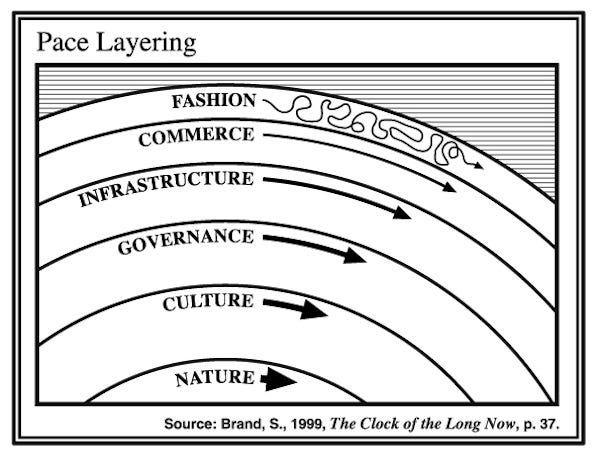
The Pace Layers model first appeared in Brand’s book, The Clock of The Long Now, to try to help people think more richly about longer timescales. It was a sketch, both visually and verbally, drawn for the book in the late 1990s with some primitive drawing software by the Long Now Foundation’s then Chief Executive, Alexander Rose. Here is that illustration:
And here, because you can find it online, is Stewart Brand’s original scribble:
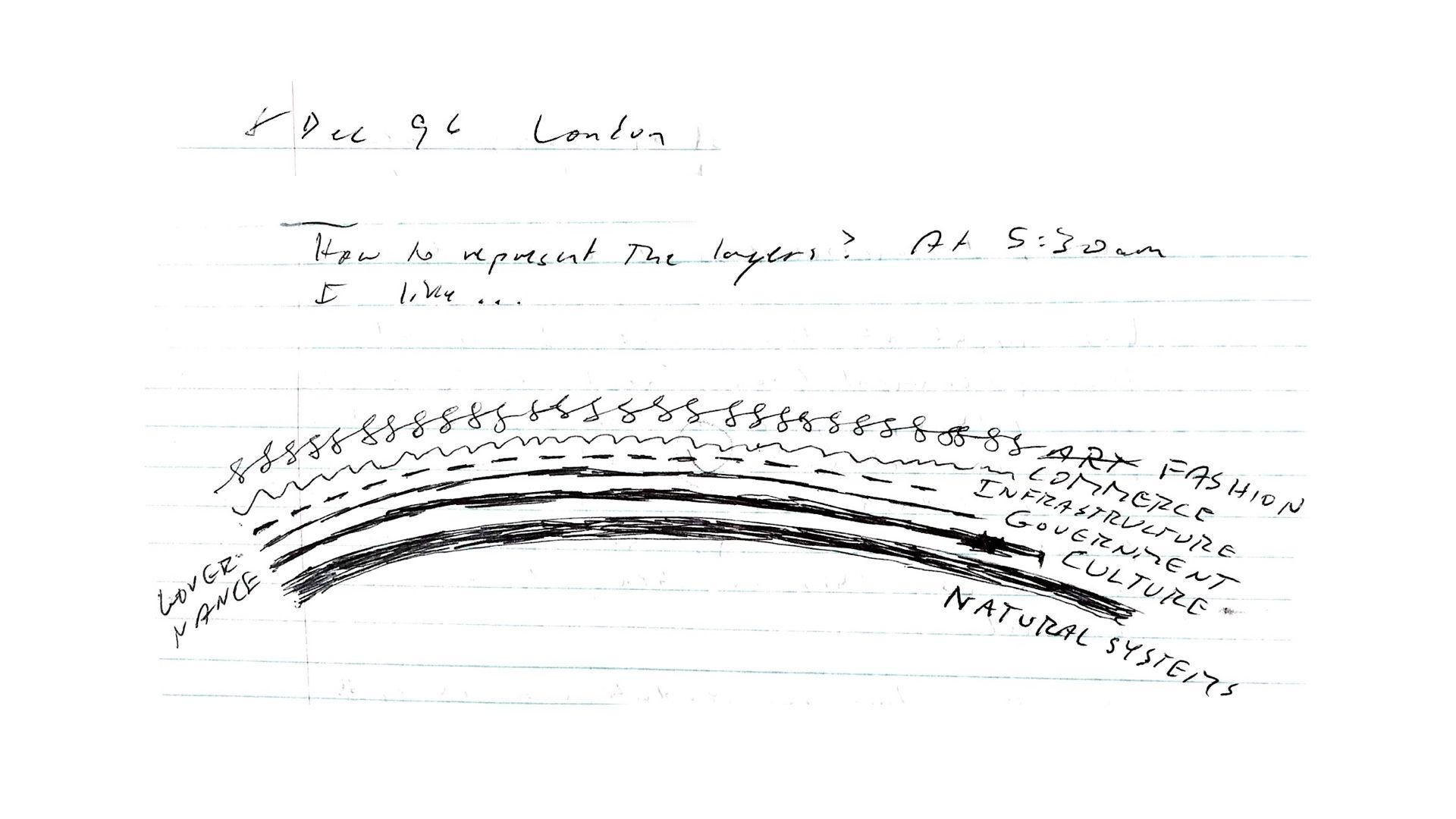
Impressionistic
The account in The Clock of the Long Now is best described as impressionistic, an idea that wasn’t really worked through. Fortunately there’s a fuller account almost two decades later in an article in MIT’s Journal of Design Studies [JODS], and much of the commentary here is taken from this article.
As you can see in the diagram, there are six layers. Fashion (sometimes Fashion and Art) is at the top, and then Commerce, and the Infrastructure. These are the ‘fast’ layers: indicatively fashion and media has a clock speed of 1-5 years, commerce about 20, and infrastructure runs at 60-80 years. These times are based on my interpretation of how Brand writes about them, rather than being prescriptive.
Below them are the ‘slow’ layers: Governance, Culture, and Nature. Again, judging from how Brand writes about these, their clockspeeds are 100-200 years, for Governance, 500 years (or more) for Culture, and thousands of years and more for Nature.
Learning from buildings
In developing the Pace Layers, Brand repurposed an idea from something he had learned and adapted while writing How Buildings Learn. This was that different elements of a building, similarly, have different speeds. The site of the building is more durable than the structure, and the structure in more durable than the ‘skin’. These are a building’s ‘slow’ layers. The ‘fast’ layers—services, space plan and stuff—all turn over much more quickly.
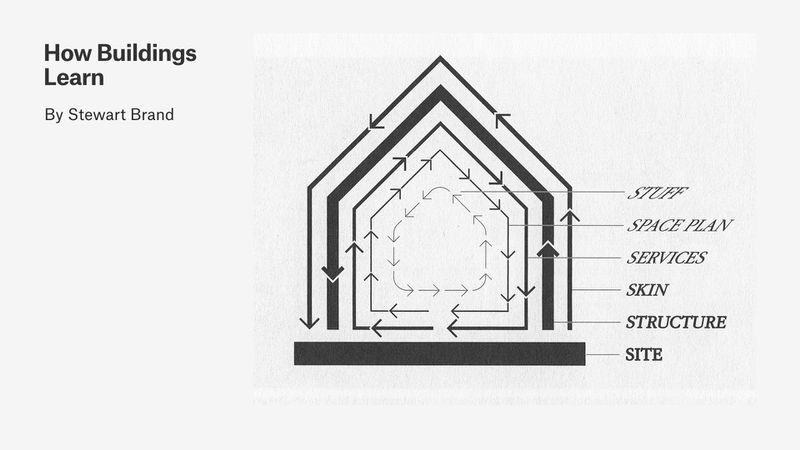
(From How Buildings Learn, by Stewart Brand, as seen in a blog post by Rune Madsen)
This insight came from the architect Frank Duffy, who realised that only about a third of the cost of a building was embedded in its construction: the rest was in adapting it after it had been built (hence Brand’s notion in the book of buildings “learning” through how they are used). Duffy’s model had four layers[1], not six, and he built a successful commercial practice by focussing on the other two thirds: refurbishment, reshaping, and so on. Unlike Pace Layers, the building layers come with time attached to them: Stuff gets turned over every five years, for example, Services (building infrastructure like cabling) every 25, Skin every 50 years.
Human scale
Brand also borrowed from the physicist Freeman Dyson, who proposed what looks like a logarithmic model of human scale at different layers. In the JODS paper, there’s a long quote from Dyson which is worth reproducing here:
The destiny of our species is shaped by the imperatives of survival on six distinct time scales. To survive means to compete successfully on all six time scales. But the unit of survival is different at each of the six time scales. On a time scale of years, the unit is the individual. On a time scale of decades, the unit is the family. On a time scale of centuries, the unit is the tribe or nation. On a time scale of millennia, the unit is the culture. On a time scale of tens of millennia, the unit is the species. On a time scale of eons, the unit is the whole web of life on our planet. Every human being is the product of adaptation to the demands of all six time scales. That is why conflicting loyalties are deep in our nature. In order to survive, we have needed to be loyal to ourselves, to our families, to our tribes, to our cultures, to our species, to our planet.
In the JODS paper, Brand has some more expansive descriptions of each of his layers. I’m not going to quote these, but it is worth paraphrasing. Fashion and art is all froth and energy. It experiments “as creatively and irresponsibly as the society can bear”, providing the energy for commerce. Infrastructure covers those things that have a high yield, but a long payback time—not just physical infrastructure, but education and science. These are often underwritten by the governance layer.
Culture is a “vast slow-motion dance” which “it moves at the pace of language and religion,“ and more slowly than “political and economic history”. In the JODS article, he gives this example of the difference between governance and culture: the names of the months have changed in the past 500 years—I could add to this that the details of the calendar have changed as well—while the signs of the Zodiac go back much further.
And then there’s nature, which moves at its own speed, with its own consequences. Nature bats last.
Fast layers and slow layers
Brand is also interested in the relationships between the layers, and in particular the relationships between the fast and slow layers. Both are necessary:
Fast learns, slow remembers. Fast proposes, slow disposes. Fast is discontinuous, slow is continuous. Fast and small instructs slow and big by accrued innovation and by occasional revolution. Slow and big controls small and fast by constraint and constancy. Fast gets all our attention, slow has all the power. All durable dynamic systems have this sort of structure. It is what makes them adaptable and robust.
The important thing here is that when Brand talks about the framework, he tends to use it as a sense-making framework.
The other substantive account is in a recording of a conversation between Stewart Brand and the American futurist and forecaster Paul Saffo at an event organised by The Long Now Foundation, in 2017. It can still be found on The Long Now Foundation’s website.[2]
Brand makes some elegant languid opening remarks, before Saffo comes in. Saffo has used the model with students at Stanford, and so his commentary is based on practice. Although he jokes that talking about pace layers with Stewart Brand is like discussing theology with the Pope, it’s clear that his use and practice has generated valuable insights.
For example, Saffo observes that many of the most interesting insights happen at the boundaries between different layers. One example: in a recent workshop where we used Pace Layers as a framing device, it became clear that many of our current problems with the tech sector were conflicts between the Infrastructure layer and the Governance layer, and worse, the companies driving them were creatures of the more short-term Commerce layer.
As Brand observes in the JODS article, “If commerce is completely unfettered and unsupported by watchful governance and culture, it easily becomes crime”.[3]
Radical discontinuities
Saffo also discusses the radical discontinuities that can be created when one of the slow-moving layers breaks. Radical breaks in the Governance layer (such as political revolutions) can have catastrophic social effects.[4] The pandemic was an example of a discontinuity in the Nature layer; earthquakes can have similarly deep effects. In the conversation with Saffo, Brand discusses the impact of the 1755 Lisbon earthquake on European thought, in particular producing Candide, with its deep impact on the European enlightenment.
As long as you accept that it is just a model, you’re in George Box territory: all models are wrong, but some are useful. Judging by the number of spin-offs you find when you do an image search for “pace layers”, clearly people find pace layers useful.
In practice
I have used pace layers in workshops in a couple of ways. The first is as an exploratory method. A group can take a topic they’re interested in, and use the pace layers model to build out their picture of it. This can quickly get people into both the deeper history of a question, it stretches their thinking, and also typically opens up competing worldviews and metaphors. In this way it can open up, perhaps in a quicker and more accessible way, the kinds of conversations that also emerge through Causal Layered Analysis. I have strong memories of one training session where a group started with a general question about more-than-human species and—after a pace layers conversation—distilled this into a question of “votes for cats”.
As a sense-making framework, it also has strengths. Britain’s absurd model for water system ownership—the only one of its kind in the world—is absurd because it has shifted water management from the realm of governance and infrastructure to the realm of commerce. And then has been surprised when this produced awful consequences. Similarly with the disastrous marketisation of Britain’s universities. The finance sector delivers poor outcomes because it has shifted itself into the frothy realm that ought to be occupied by fashion, all short run innovation and quick returns, when it should be anchored by governance.
In the workshop I mentioned above, we discussed Tuvalu’s plan to reconstruct its culture in the digital realm. Unlike most digital projects, this clearly lives at the level of Culture, prompted by the existential challenge to the island state of Nature, in the shape of rising sea levels. This takes us into the kind of territory that the Long Now Foundation was set up to explore. Culture, rightly, operates at a scale of hundreds of years. Digital technology generally lives somewhere between commerce and infrastructure—decades at best. This opens up immediate questions about maintenance—how to preserve a long-run cultural representation in what are, essentially, short-term layers.
—
A version of this article is also published on my Just Two Things Newsletter.
—
[1] These were, says Brand, “Shell (lasts maybe 50 years), Services (swapped out every 15 years or so), Scenery (interior walls, etc. move every 5 to 7 years), and Set (furniture, moving sometimes monthly.)”
[2] As you might expect from its name, the Long Now Foundation takes curation seriously.
[3] This insight is also made by Jane Jacobs in her book Systems of Survival, in which she characterises human societies as requiring a balance between “Traders” (short-term, commerce) and “Guardians” (long-term, governance). Traders without Guardians become mafia. Guardians trying to be Traders leads to private equity companies crawling all over the public sphere—running care homes, and so on.
[4] In the article Brand conflates the Russian and French Revolutions here, but the French Revolution produced long-lasting changes to systems of rights and law across Europe, despite the short-term turmoil of the Terror.
—
Previously Published on thenextwavefutures.wordpress.com with Creative Commons License
***

If you believe in the work we are doing here at The Good Men Project, please join us as a Premium Member today.
All Premium Members get to view The Good Men Project with NO ADS.
Need more info? A complete list of benefits is here.
—
Photo credit: (From How Buildings Learn, by Stewart Brand, as seen in a blog post by Rune Madsen)

