


—
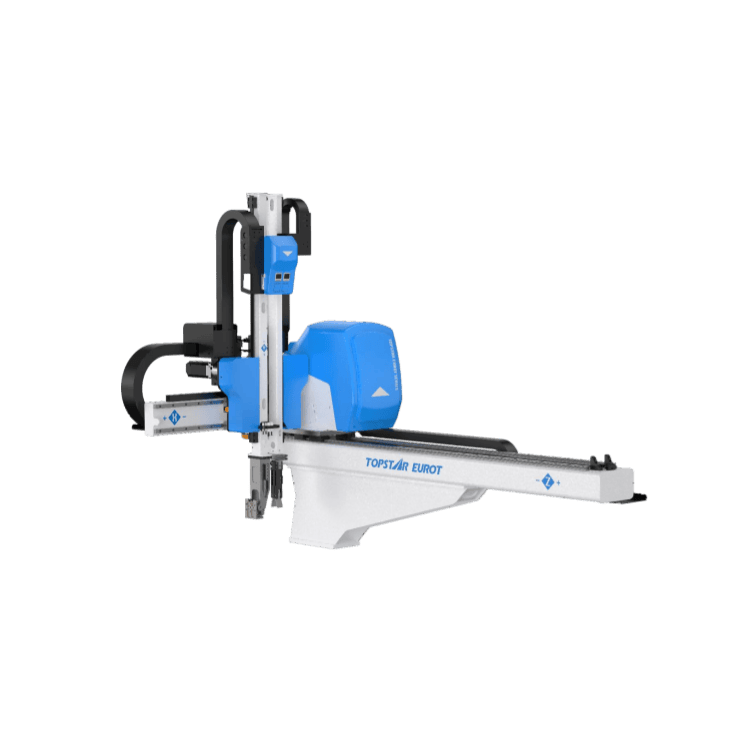
An efficient production line must keep pace with mold changes, variations in part weight, shortened cycle times, and stringent quality targets. This is precisely where the value of data lies. When robots can monitor motion status in real time, interpret load changes, and adjust their parameters before defects occur, automation ceases to be a static routine and becomes a responsive production asset. We consider adaptive control algorithms among the most practical upgrades for making injection molding robots intelligent. They enable robots to respond to actual production conditions rather than relying on a single, preset motion pattern. In daily operation, this means the robot can automatically adjust acceleration, speed, deceleration, and power output.
Adaptive Control for Injection Molding Robot: Why Fixed Motion Settings Are No Longer Sufficient
Robot motion in traditional injection molding typically follows fixed patterns. Engineers set speeds, define paths, and lock in acceleration and deceleration values based on expected part, mold, and cycle times. While this approach works well in stable production environments, issues arise when conditions change. Even minor variations—such as changes in part weight, mold temperature, ejection force, or gripping resistance—can affect robot motion. Fixed settings often fail to fully mitigate the impact of these variations.
This is particularly critical for injection molding robots, as their operating environments frequently change. A robot might need to grip parts of varying sizes, access confined areas within the mold, or move rapidly while avoiding collision risks. If motion parameters remain static, the robot may move too aggressively, generate unwanted vibration, or decelerate excessively. Over time, these issues lead to reduced precision, longer cycle times, and accelerated wear on mechanical components.
Sensing and Feedback in Injection Molding Robot: The Foundation for Automatic Adjustment
Adaptive control algorithms can only make correct decisions if they receive accurate, timely information. Consequently, sensing and feedback form the foundation for the automatic motion adjustments found in Topstar injection molding robots. Rather than moving passively and leaving outcomes to chance, the robot continuously monitors its own status and the surrounding process conditions via feedback signals.
These signals may originate from servo motors, encoders, torque monitors, position sensors, or load detection modules. Collectively, they relay information about the robot’s actual motion behavior to the controller. For instance, if the robotic arm encounters more resistance than expected, the motor current may rise. If the end-effector carries a heavier component, the acceleration response may change. The controller can promptly detect if the injection molding robot is approaching its limits or if path deviations begin to occur. For the customer, this signifies more than just technical excellence; it means the robot can handle the various fluctuations inherent in actual production without compromising stability.
Motion Modeling for Injection Molding Robot: How Algorithms Interpret Each Movement
Before an algorithm can automatically adjust motion parameters, it must first understand the motion itself. In practice, this means the robot uses a motion model to describe how the robotic arm, joints, and end-effector move under varying conditions. This model enables the controller to predict the outcome of each command and estimate the robot’s response.
The model accounts for factors such as mass, inertia, velocity, trajectory curvature, and load variations. When the robot begins to move, the algorithm does not treat the motion as a simple straight line; instead, it breaks the motion into four distinct phases: acceleration, constant speed, deceleration, and stopping. Since behavior differs across these phases, each requires a specific balance of parameters. A heavier load might necessitate slower acceleration but not necessarily a slower travel speed. A short-distance, high-precision transfer might require a gentler stop rather than a lower maximum speed. The model helps the system distinguish between these scenarios.
Parameter Tuning: Adjusting Velocity, Acceleration, and Deceleration
Once the adaptive control algorithm detects a change in operating conditions, it must determine how to adjust motion parameters. This process lies at the heart of automatic tuning. In Topstar injection molding robots, key parameters typically include velocity, acceleration, deceleration, jerk control, dwell time, and position tolerance. Each parameter plays a distinct role, and the algorithm adjusts them in combination rather than in isolation.
Velocity affects the overall cycle time, but speed alone does not guarantee smooth motion. If the robot accelerates too rapidly, the arm may experience jitter or overshoot. This is where acceleration becomes critical; it determines how quickly the robot reaches its target speed. When the load increases or the path becomes more complex, the controller can reduce acceleration to maintain stability. Deceleration plays an equally important role at the end of a movement. Controlled deceleration helps prevent abrupt stops, part slippage, or impact stress. This approach enhances both production stability and operational flexibility. Specifically, factories can reduce manual adjustments when switching between molds or products, thereby minimizing downtime and making production lines easier to manage.
Maintaining Precision in Actual Production
Even with carefully tuned motion parameters, path deviations can still occur. Factors such as vibration, mechanical tolerances, mold variations, and unexpected load changes can all affect motion accuracy. Therefore, adaptive control systems for injection-molding robots must incorporate path-correction capabilities. Path correction involves making minute, intelligent adjustments during the robot’s movement to ensure the precision of the final trajectory. The controller continuously compares the planned path with the actual path. If a significant discrepancy arises, the system fine-tunes joint movements or the end-effector’s position. These adjustments help the robot stay centered on the target path and avoid unintended contact with mold structures or surrounding fixtures. This is particularly critical in high-speed injection molding applications, where even slight deviations can compromise the picking, placing, or releasing of parts.
The True Value of Adaptive Control in Injection Molding Robot
Adaptive control transforms injection molding robots from machines with fixed motion patterns into responsive, production-aware systems. By integrating sensing, modeling, parameter adjustment, and path correction, robots can automatically adapt their movements to real-world operating conditions. This capability enhances speed, ensures product quality, reduces wear and tear, and supports flexible manufacturing. For Topstar, this represents more than just a technical feature; it is a practical s
—

