


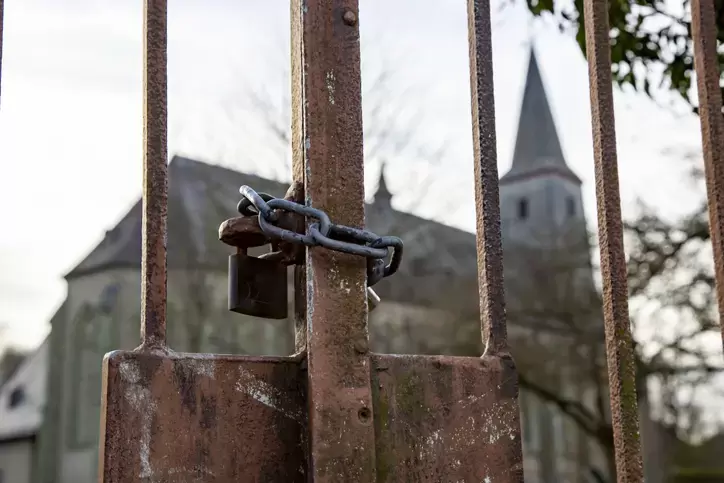
When I moved back to my hometown, I found my childhood church for sale.
There it was — the place where I sang in the kids’ choir, learned how to pray, and sat in pews with my legs dangling above the floor, watching sunlight pour through the stained glass and set the pulpit aglow like something holy. It was also the place where I was told that God loved me… but might burn me forever. I still remember the smell: old hymn books, dust, and that unmistakable mix of worn carpet and Avon perfume.
Now it was empty. Listed online like an old fixer-upper. “Plenty of potential,” the ad said — like it was talking about a house, not a place where people once begged God to save their marriages, their kids, themselves.
And as I stood outside, waiting to feel something like grief… I didn’t.
Because maybe this isn’t a tragedy.
Maybe this is mercy.
Let me explain.
A Church in Crisis
According to the online publication The Christian Century, an average of nine churches per day shut their doors for good in the USA. It is a fact. The institutionalized Christian Church in the West is dying.
The diagnosis is grim.
And yet, while church attendance has plummeted, belief in God hasn’t disappeared. Around 70% of Americans still call themselves Christian — they just want nothing to do with the institutional version.
So what do we make of the Evangelical exodus?
At this point, we might be tempted to do one of two things: throw up our hands in despair and surrender to the tide of culture, or dig in our heels and double down on a model of church that expired decades ago. Christian Minister and social commentator, Mark Sayers, In his book, Reappearing Church, says:
So what are we to do?
Sayers suggests that our present church crisis is actually an incredible opportunity for renewal. I agree with him. Throughout history, at times of cultural crisis, the church has found a way forward. But what does it look like?
The New Church
So if the old model is crumbling — what might grow in its place?
I’ve spoken with countless people who’ve walked away from church, not because they stopped believing in God, but because the version of church they knew felt hollow, hostile, or just hopelessly out of touch.
And when I listen to their stories — and look at what’s stirring across living rooms, street corners, and little gatherings all over the world — I start to see the shape of something new.
Here’s what I see emerging.
A Church that is Socially Progressive
If you read the book of Acts with both eyes open, the early church wasn’t safe, tidy, or respectable. It was chaotic, messy, and deeply offensive to the religious status quo. Hard-line Jews would’ve looked at these Jesus followers — eating with Gentiles, sharing meals across class lines, letting women speak — and thought: What the hell is this?
And they’d have a point. This little sect wasn’t clinging to tradition. It was breaking it open.
They made space for different cultures. They gave women a voice. They pooled their resources so that no one went without. And it wasn’t perfect — but it was alive.
Compare that to now. Where the church once led the way on justice and compassion, it’s now often the thing people are trying to escape. A movement that was meant to liberate has become a brand that excludes.
But maybe the new church — the one that’s forming quietly in living rooms and cafes and online spaces — is circling back, not to tradition for tradition’s sake, but to the roots: justice, generosity, welcome, disruption.
It’s not about being “progressive.” It’s about being Christian — in the original, scandalous sense of the word.
A Church that Sits in Circles, NOT rows
The new church meets around tables — in circles. Tables invite connection. Tables invite conversation. Tables invite friendship. It may be that the new church meets, as the very first church did, in people’s homes, around people’s tables, sharing good food together.
On the other hand, rows divide. Rows promote the consumerist mindset. Rows promote the brainless acceptance of information without critique. Rows perpetuate the hierarchical model that places an expert up front to mediate between God and us.
A Church With No Professional Clergy
Jesus embodies the idea that God is freely available to everyone. He is the one mediator between God and us. We do not need a corruptible person (usually a man) to drip-feed us our knowledge and understanding of God.
Yes, there’s value in wise leadership. Yes, some people are gifted to teach or guide. But the idea that one person stands at the front and drip-feeds everyone else their spirituality? That’s not Jesus. That’s a system.
And it’s an expensive one.
Most churches spend 70 to 90 percent of their income on staff salaries and building upkeep , all funded by the faithful through tithes and offerings. But if you asked people where they’d rather see their money go? Most would say: the poor. The vulnerable. People actually in need.
So maybe it’s time to rethink the whole structure.
And maybe it’s time we stopped paying people to do the things Jesus told all of us to do.
A Church Focused on Social Justice
Helping the poor and oppressed is actually one of the key themes of the Bible. In fact, there are more verses about this issue than any other topic. Here’s one of my favorites:
That’s God talking, by the way. The old church has been notoriously good at pontificating its morals to the world, but the new church should let its actions do the talking.
A Church That Builds Bridges, NOT Walls
The old church got really good at gatekeeping. Who’s in. Who’s out. Who gets a platform. Who gets silenced. It’s human nature, sure — the urge to draw lines, to protect the group. But let’s not pretend Jesus was into that.
He tore down barriers between Jew and Gentile, rich and poor, male and female. He didn’t build walls — he knocked them over. So if the church wants to look like Jesus, it needs to stop defending its boundaries and start building some damn bridges.
That means:
- Fully welcoming and embracing the LGBTIQ+ community
- Dismantling racism, classism, and misogyny — not just in theory, but in structure
- Dropping the fantasy that Christianity has a monopoly on truth
- Learning to celebrate truth wherever it shows up — even if it comes from outside our tribe
Because if something is true, it’s always been true — no matter who says it. And if we’re serious about following Jesus, then we’ll be serious about making room for everyone at the table.
A Church That is Environmentally Conscious
I always feel that each generation looks back on the previous and is appalled at their action or inaction regarding a particular issue. Our parents look back at their parents and shake their heads at the atrocities surrounding the World Wars and rightly ask, “How could that have happened?”
I have a feeling that our children and grandchildren might look back at us and be equally horrified at our inaction regarding the environment. Christians, who were called by God to care for and protect the Earth, should be leading the way with respect to environmental activism. Unfortunately, many Christians are known as climate change deniers despite all the scientific data to the contrary. However, the new church leads the way in caring for the Earth, viewing that as a God-given mandate.
A Church that is a Diverse Community
If you look around your church and everyone has the same background — there’s a good chance you’re not in a church. You’re in a Christian country club.
Real church is messy. It’s multicultural. It’s made up of people who vote differently, think differently, and worship differently — but who show up anyway, because something deeper holds them together.
The new church doesn’t cling to uniformity. It welcomes difference.
It’s not threatened by questions. It doesn’t need everyone to land in the same place on every issue.
What unites it isn’t sameness — it’s a shared love for God and a shared hope that we’re all being transformed into something more whole.
Agreement isn’t the goal. Love is.
A Church that is Simple
Cultural Christianity is exhausting.
There’s always another event, another roster, another program you’re supposed to show up to — because “good Christians stay busy,” right?
But what if the church stopped trying to do everything… and just did one or two things really well?
Do less. Do it better. Let people breathe.
The Church must change or die
Fifty years from now, the Church in the West will either look nothing like it does today… or it won’t exist at all. Personally, I think it’ll survive — but only if it transforms.
There’s that old quote — often misattributed to JFK — about the Chinese word for “crisis” being made up of two brushstrokes: one meaning danger, the other opportunity. Whether that’s linguistically accurate or not, it still rings true. What the Church is facing right now is both. A reckoning and an invitation.
If you’ve read me before, you’ll know I’m no fan of the institutional model we’ve inherited. I think it’s bloated, defensive, and in many places, spiritually bankrupt. But I still believe in Jesus. And I still believe in people. So I’m not walking away — I’m leaning in.
I’m exploring new ways of being the Church. Faith communities that feel more like what I’ve described here: honest, grounded, inclusive, and alive. This isn’t the end. It’s the composting of everything that no longer serves, so something new can grow.
First comes death.
Then comes resurrection.
—
This post was previously published on Backyard Church.
***
You Might Also Like These From The Good Men Project



If you believe in the work we are doing here at The Good Men Project, please join us as a Premium Member today.
All Premium Members get to view The Good Men Project with NO ADS.
Need more info? A complete list of benefits is here.
Photo credit: iStock

