


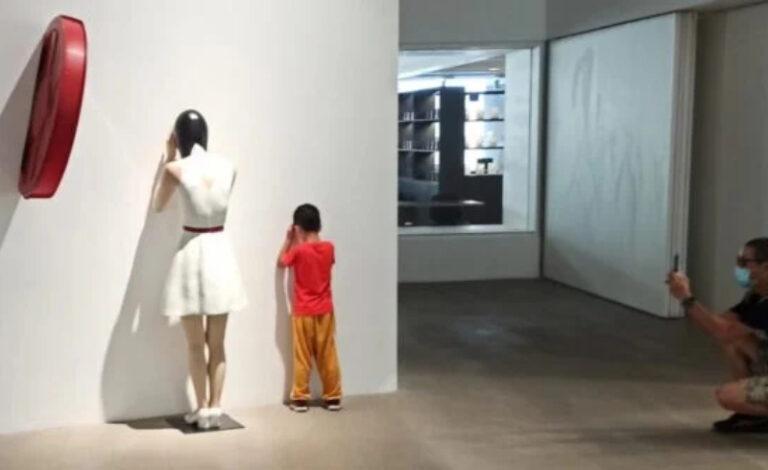
One interpretation of Xiang Jing’s sculpture The End can be that the young woman turns her face to the wall and hides it with her hands as a response to the mirror next to her. We might assume the mirror forces her to judge herself by social expectations of personal beauty or sexual attractiveness, which she cannot or does not want to meet.

Therefore, I think this is truly an iconic work of contemporary art that speaks to the pain and sadness that women still feel around the world due to social pressure. It is 2024 and women still face the same basic problem they have traditionally faced. This work should be in every art museum that wishes to show meaningful and thought-provoking work. It immediately resonates with every viewer. It is a powerful visual image of suffering that affects one directly, even before any type of analysis.
As Naomi Wolf pointed out in the 1990s, in her work The Beauty Myth, even as women approach full equality with men in the workplace, they are still under immense pressure to look feminine and to appeal to men. This work reveals the psychological effects of this, and seems to be the perfect visual statement against the further exploitation of women. The piece openly declares that women are still living in pain, and this has to stop.
It is almost a visual prayer that women in the future may be able to better withstand the pressures of society to turn them into sexual beings, or that men may miraculously rise to a level of maturity where they no longer expect women to be eye candy and primarily serve their sexual desires.
Yet, we can even be a bit more daring or thorough with our interpretation. We might assume that the woman is turning away from the mirror and to the wall. What if we play with our interpretation and assume, instead, that the presence of the mirror is coincidental to her turning to the wall. It, thus, replicates the image of a grieving woman for us. So if this interpretation were true (actually, I am just playing with ideas here) we would not know why the woman is grieving or distressed. We would just see a replication of a woman suffering.
Perhaps the presence of the mirror showing only the woman is reminding us, reinforcing for us, that we are observing pain and compelling us to share in the discomfort and distress that the woman is experiencing. We usually check a mirror to judge our own appearance; here the mirror forces us to focus entirely on the woman. The mirror reveals nothing new, it is just an exclamation point to the situation.
John Locke was one of the first philosophers to point out that when we see pain, we also feel pain as a result. It is often not the same type of pain that we feel, but this is a normal result for us, to feel a type of pain when we see others in pain. Locke surmised that this humanized us, and this was an integral part of our moral lives and a significant motivator for us to work toward eliminating pain in the world.
The mirror pushes us to realize, perhaps, that we are staring at this woman, so that we focus more on the effect that the original image is having on us, possibly actively calling each of us to action. I think in this interpretation the mirror is a type of call for action, to stop the repetition of the suffering. For men it encourages reflection on their expectations toward women and the possibility of relationships no longer based on selfishness and exploitation.
Perhaps it calls on men to realize that the Women’s Rights Movement was not just about equal money and power, there was and remains a deeper goal: men have to work harder on themselves to help achieve equitable relationships divorced from what amounts to sexual victimization.
Her grief is real and painful to her, and it is reflected further by the mirror. Instead of her pain being addressed, it is reflected and she stands there sobbing, in distress, as if at the end. This could be the end of the woman emotionally or this piece could be calling for the end of abusive expectations and relationships.
So there are at least a few choices here. The woman sees a mirror and does not want to look at herself. She fears that she does not meet physical standards and that her life is easily controlled by the desires and standards of others. Or, she does meet physical standards but hates the work that has to go into meeting these standards. Or, the mirror reflects or accentuates her pain and calls on each of us to do something on a personal level to help decrease this young woman’s suffering.
—
This Post is republished on Medium.
—
Photo credit: Author

