


—
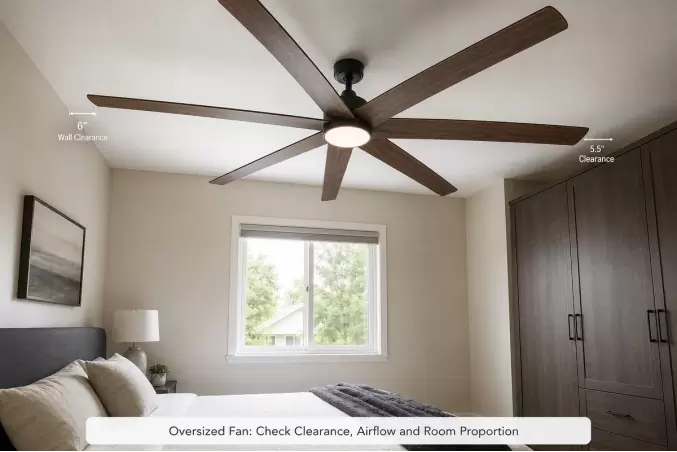
Yes. A ceiling fan can be too large for a room, even when the blades technically fit within the ceiling area. An oversized fan can create an uncomfortable draft, dominate a small ceiling visually, or leave too little clearance from walls, beams, sloped surfaces, lighting, or other architectural features. The better question is not simply “What is the largest fan that fits?” but “What fan size, airflow, mounting height, and layout work together in this room?”
Blade span is only one part of the decision. Ceiling height, room shape, furniture placement, the occupied area, speed range, and published airflow data all affect whether a fan feels appropriately sized. A large fan can work very well in the right space, but increasing diameter without considering the rest of the installation can create problems rather than improve comfort.
What Happens If a Ceiling Fan Is Too Big for the Room?
An oversized ceiling fan usually reveals itself in one of four ways: the airflow feels too aggressive, the fan looks out of proportion, clearances become tight, or the fan is centered over the room but not over the area where people actually spend time.
The Airflow Feels Too Strong
A large fan does not need to run at maximum speed to feel uncomfortable in a small space. If papers move constantly, lightweight curtains flutter, or people sitting or sleeping beneath the fan feel a persistent draft even at a low setting, the combination of fan size, airflow, mounting height, and placement may be too aggressive for the occupied zone. Bedrooms are especially sensitive because people often want gentle, steady air movement rather than a strong breeze directly over the bed.
The Fan Dominates the Ceiling Visually
A ceiling fan is also part of the room’s visual scale. A fan that stretches close to the walls can make a modest room feel crowded or lower than it really is, especially when the housing, blades, and light kit are visually heavy. A wide fan can look balanced in an open great room but oversized in a compact bedroom with the same ceiling height. Finish and blade profile matter, but the full blade span is the first thing the eye reads.
Blade and Fixture Clearances Become Tight
Physical fit matters as much as appearance. Before choosing a larger fan, check the distance from the blade tips to walls, beams, cabinets, vaulted ceiling surfaces, chandeliers, pendant lights, and other obstructions. Also check the complete installed height of the fan rather than looking only at ceiling height. The correct clearance depends on the specific fan, the installation instructions, and applicable requirements, so a generic room-size chart should never replace model-specific installation guidance.
The Fan Misses the Area That Actually Needs Airflow
A room can be large on paper but still have a much smaller occupied zone. In an open-plan living area, for example, the sofa and chairs may occupy only one side of the room while the dining area uses the other side. Installing one very large fan in the geometric center may not provide the most comfortable airflow where people sit. Room area should therefore be considered together with furniture placement and the location of the mounting point.
How Big Is Too Big for a Ceiling Fan?
There is no single blade-span number that becomes “too big” in every room. A useful way to judge oversizing is to test the fan against four conditions.
- Physical fit: The fan must have suitable clearance from walls, beams, fixtures, cabinetry, and other obstructions.
- Airflow fit: The fan should provide useful circulation without forcing occupants to use only the lowest speed because the breeze feels excessive.
- Vertical fit: Ceiling height, downrod length, fan body height, and the final blade position should create a practical installation.
- Visual fit: The blade span and housing should look proportionate to the ceiling and the furniture below rather than overwhelming the room.
If one or more of these conditions fails, the fan may be oversized even if it can physically be mounted. This is why room square footage is a starting point, not a complete answer.
Ceiling Fan Size by Room Dimensions
Room dimensions are still useful because they show the amount of floor area a fan is being asked to serve. The table below is best used as a planning check rather than a rigid sizing rule. Two rooms with the same square footage can need different solutions if one has a low ceiling and the other has a vaulted ceiling, or if one is square and the other is long and narrow.
| Room dimensions | Floor area | Planning notes |
| 10 x 10 ft | 100 sq. ft. | A 52-inch fan may feel visually large in some rooms of this size. Check low-speed comfort and clearances carefully. |
| 10 x 12 ft | 120 sq. ft. | A mid-size fan is often easier to balance. If considering a wider fan, confirm furniture position and the usable ceiling area. |
| 12 x 12 ft | 144 sq. ft. | A 52-inch fan can work in some layouts, but bedroom comfort, ceiling height, and mounting position matter. |
| 12 x 14 ft | 168 sq. ft. | Compare blade span with the shorter room dimension and make sure the fan is centered over the occupied zone. |
| 13 x 13 ft | 169 sq. ft. | A larger fan may be reasonable when the ceiling and layout support it, but diameter should be checked against airflow and clearances. |
| 15 x 15 ft | 225 sq. ft. | Larger residential fan sizes become easier to accommodate, especially in open layouts or taller rooms. |
| 20 x 20 ft | 400 sq. ft. | A 60- to 72-inch fan may enter consideration, but published airflow, ceiling height, and room shape still determine the better choice. |
The shorter room dimension is especially important because a very wide fan can approach walls quickly in a long, narrow space. The same 200-square-foot area can be arranged as a 10 x 20 ft room or roughly a 14 x 14 ft room, and those two ceilings do not present the same blade-clearance or visual-proportion problem.

Is a 52-Inch Ceiling Fan Too Big for a Small Room?
A 52-inch ceiling fan is not automatically too large for a small room, but it is large enough that the room layout deserves a closer look. The fan may be perfectly comfortable in one 12 x 12 room and feel oversized in another because of differences in ceiling height, furniture placement, fan design, and low-speed airflow.
Is a 52-Inch Fan Too Big for a 10 x 10 Room?
It can be. A 10 x 10 room has only 100 square feet of floor area, so a 52-inch fan takes up a substantial portion of the visible ceiling. If the room has a standard or low ceiling, a bulky housing, a large light kit, or furniture close to the perimeter, a smaller fan may feel more proportionate. If a 52-inch model is being considered, check the actual blade clearance, the finished mounting height, and whether its lowest speeds are comfortable for the people using the room.
Is a 52-Inch Fan Too Big for a 12 x 12 Bedroom?
Not necessarily. A 12 x 12 bedroom gives a 52-inch fan more breathing room than a 10 x 10 space, but the bed location and fan position matter. A fan centered directly above the bed may feel stronger than the same fan placed over a larger mixed-use area. For sleeping spaces, low-speed operation, available noise information, remote control, and lighting are often as important as maximum airflow.
Is a 54- or 60-Inch Ceiling Fan Too Large for a Bedroom?
A 54-inch or 60-inch fan can be appropriate in a large primary bedroom, but bedroom selection should not be based on maximum diameter alone. Start with the room dimensions, then check the ceiling height and the bed’s position relative to the fan. A wider fan may distribute air gently over a larger area when it has a useful low-speed range, while a smaller high-speed fan may create a more concentrated breeze.
The light kit can also change how large a fan feels. A slim fan with an integrated LED may look lighter than a fan of similar diameter with a deep decorative fixture. In bedrooms, a dimmable light, convenient controls, stable low-speed operation, and a proportionate installed height can matter more than simply moving the most air possible.
Is a 72-Inch Ceiling Fan Too Big?
A 72-inch ceiling fan is clearly intended for larger spaces, but the number alone still does not tell you whether it is oversized. In an open living room, great room, loft, or other spacious interior, a 72-inch span may look natural and provide broad coverage. In a compact bedroom, the same span can become visually dominant and may leave less practical clearance around the fan.

A useful real-world example is the 72-inch modern ceiling fan with light from Breezary. The 42004-BK uses a 72-inch, seven-blade design with a DC motor, six fan speeds, reversible operation, a remote control, and an integrated dimmable LED with three color temperatures. Breezary lists the model for large indoor rooms and provides 6-inch and 12-inch downrods, which illustrates why the full installation matters: blade span, speed control, ceiling height, downrod choice, and the occupied area all have to work together.
The lesson is not that every large room needs a 72-inch fan. It is that a 72-inch fan makes sense only when the room provides the scale and installation conditions to support it. Choosing by diameter alone can turn a useful large-room product into an oversized one.
Do Bigger Ceiling Fans Cool Better?
Not automatically. Ceiling fans do not lower the room temperature in the same way an air conditioner does; they create air movement that can make occupants feel cooler. A larger blade span increases the swept area, but actual airflow also depends on the motor, blade design, blade pitch, rotational speed, mounting height, and the way the fan interacts with the room.
This is why two fans with the same diameter can feel very different. One may move more air at high speed, while another may provide smoother, quieter circulation at lower speeds. When comparing large fans, look for published airflow information when it is available and consider how the fan will be used. A living room may need broad circulation across several seats, while a bedroom may benefit more from gentle low-speed airflow over the sleeping area.
Does Ceiling Height Change How Large a Fan You Can Use?
Yes. Ceiling height changes both the visual relationship between the fan and the room and the way the fan should be mounted. A wide fan that looks crowded on an 8-foot ceiling can look much more proportionate in a tall great room, but a high ceiling does not automatically mean that the largest available fan is the correct choice.
Standard Ceilings
On a standard-height ceiling, pay close attention to total installed height and the fan’s visual weight. A large diameter combined with a long downrod or a deep light kit can make the fixture feel lower and more dominant than expected. Use the downrod and mounting configuration approved for the specific model.
High Ceilings
High ceilings give a large fan more visual space, but the fan still needs to be positioned where its airflow can be useful. If it is mounted too high above the occupied zone, people may feel less air movement below. The correct downrod length depends on the fan, ceiling height, room layout, and the manufacturer’s installation guidance.
Vaulted and Cathedral Ceilings
Vaulted and cathedral ceilings introduce slope and obstruction issues. Check whether the fan supports angled mounting, what slope is permitted, and whether the blades will remain clear of the nearest sloped surface, beams, lighting, or upper-level openings. A large blade span can be visually attractive on a vaulted ceiling, but only when the mounting geometry works.
Is It Better to Have a Ceiling Fan Too Big or Too Small?
Neither extreme is ideal. A fan that is too small may leave parts of the room with weak circulation and may need to run at higher speeds more often. A fan that is too large can create excessive local airflow, clearance conflicts, and an unbalanced visual effect. The goal is a fan that provides comfortable coverage at useful speeds without overwhelming the ceiling or the people below it.
| Too small | Properly matched | Too large |
| May leave uneven coverage | Covers the occupied zone comfortably | May create a strong local draft |
| Often runs faster to feel effective | Works across useful low and mid speeds | Lowest speed may still feel strong |
| Can look underscaled | Looks proportionate to the room | Can dominate the ceiling |
| May miss distant seating areas | Matches the room layout | May create wall or fixture clearance issues |
One Large Ceiling Fan or Two Smaller Fans?
A single large fan works best when the room is relatively open, the mounting point is near the center of the occupied area, and there are no major obstructions. Two smaller fans may make more sense in a long room, an L-shaped room, a kitchen-living combination, or a space divided by beams, furniture groups, or separate activity zones.
For example, a long open-plan room may have a sofa area at one end and a dining table at the other. One extra-large fan centered between them could leave both zones slightly off-center. Two appropriately sized fans, each positioned over an occupied zone, may provide more even circulation and a more balanced appearance. The better solution depends on mounting locations, wiring, ceiling structure, and the airflow characteristics of the selected fans.
How to Choose a Large Ceiling Fan Without Oversizing It
If you want a larger fan, use the room as the starting point rather than the product diameter. A simple seven-step check can prevent most oversizing problems.
- Measure the room length and width, and note the shorter dimension as well as total floor area.
- Identify the occupied airflow zone: the bed, sofa group, dining area, work area, or other place where people actually need circulation.
- Measure the usable ceiling space around the proposed mounting point, including nearby walls, beams, sloped surfaces, cabinets, and light fixtures.
- Measure the ceiling height and compare it with the fan’s complete installed height and approved downrod options.
- Compare blade span with published airflow data, speed settings, blade design, and motor information rather than assuming the widest fan is the strongest or most comfortable.
- Check controls and low-speed operation. Large fans are most useful when they can provide broad, comfortable airflow without forcing occupants to tolerate a strong breeze.
- Read the installation instructions for the exact model before purchasing, especially when the ceiling is sloped, vaulted, unusually high, or has architectural obstructions.
If the room is genuinely spacious, compare large ceiling fans for large rooms by blade span, available airflow data, lighting, controls, and mounting requirements. Looking at the specifications together makes it easier to distinguish a fan that is appropriately large from one that is simply oversized.
Final Answer: Can a Ceiling Fan Be Too Large for a Room?
Yes. A ceiling fan is too large when its blade span, airflow, installed height, clearances, or visual scale no longer suit the room. The problem is not a single diameter number. A 52-inch fan can feel oversized in a compact 10 x 10 bedroom, while a 72-inch fan may look and perform naturally in a large open room with adequate ceiling space.
The safest approach is to measure first, check the mounting conditions, and compare the full specifications of the fan rather than choosing the largest model that fits on paper. Breezary offers ceiling fans in different sizes and configurations, but the right choice should always be based on the room, the installation, and the airflow experience you want.
Frequently Asked Questions
Can a ceiling fan be too large for a room?
Yes. A fan can be too large if it creates excessive airflow at the occupied area, leaves inadequate clearance from walls or fixtures, hangs too low for the space, or looks visually out of proportion to the room.
What happens if a ceiling fan is too big for the room?
The room may feel drafty even at low speed, the fan can dominate the ceiling visually, and the blade span may create clearance problems near walls, beams, cabinets, lighting, or sloped surfaces.
How big is too big for a ceiling fan?
There is no universal cutoff. A fan is too big when its diameter, airflow, installed height, clearances, or visual scale do not suit the actual room and occupied zone.
Is a 52-inch ceiling fan too big for a 10 x 10 room?
It can be. A 52-inch fan occupies a large portion of a 10 x 10 ceiling, so check blade clearance, ceiling height, low-speed airflow, and visual proportion before choosing it.
Is a 52-inch ceiling fan too big for a 12 x 12 bedroom?
Not necessarily. A 52-inch fan can work in some 12 x 12 bedrooms, especially when the ceiling and layout provide enough space. Low-speed comfort, noise, bed position, and installed height are important checks.
Is a 60-inch ceiling fan too big?
A 60-inch fan may be too large for a small enclosed room but appropriate for a larger bedroom, living room, or open area. Room dimensions, ceiling height, airflow, and clearances matter more than the diameter by itself.
Is it better to have a ceiling fan too big or too small?
Neither is ideal. An undersized fan may provide uneven circulation, while an oversized fan can create strong drafts and clearance or proportion problems. The best fan is the one that matches the room and occupied area.
Do bigger ceiling fans cool better?
Not automatically. A wider fan sweeps a larger area, but actual air movement also depends on the motor, blade design, pitch, speed, mounting height, and published airflow performance. Bigger does not always mean better comfort.
—

