



The thing about old church friends is that you assume you’ll all still believe the same stuff. Until you don’t.
I bumped into an old friend from youth group the other day. We hadn’t seen each other in years, but we used to spend every Friday night together at church — worship nights, mission trips, summer camps, the whole deal. Back then, if you’d asked me which of us would walk away from faith one day, I would’ve bet money it wouldn’t be them.
So we’re chatting, catching up, swapping the usual life updates — jobs, kids, how weird it is that we’re adults now. And at one point, I said something like, “I’ve been in this weird phase lately of unlearning and rebuilding my faith.” I expected a nod of recognition, maybe a “me too.”
Instead, they smiled and said, “Oh, I actually left Christianity a while ago. I’m more into Buddhism now. Meditation, mindfulness — it’s been a game changer.”
No drama. No bitterness. Just a quiet pivot in a completely different direction.
I walked away from that conversation thinking, Wow. I really didn’t see that coming. Not because it was wrong or bad — just unexpected. And oddly familiar.
Because I’ve been hearing more and more of these stories lately.
The Great “Deity Swap”
It turns out, stories like that aren’t rare anymore. More and more people are quietly stepping away from the faith they grew up with — not out of rebellion, but reflection. It’s not that they stopped caring. It’s that something stopped making sense.
A recent study backs it up: a growing number of Americans are rethinking what they believe, shifting spiritual lanes, or walking away from religion altogether. And the reasons behind it say a lot — not just about the church, but about where we’re all heading.
According to a recent study by the Public Religion Research Institute (PRRI), an astonishing 24% of Americans have waved goodbye to their previous religious traditions. This represents a staggering 50% surge from just two years ago. It seems that even the heavens are not immune to the fickleness of human whims.
A survey of over six and a half thousand adults revealed the top 6 reasons why people have changed their religious affiliation. Let’s take a look at the responses:
Number 1: Lost in Belief — Stumbling on Doubts (56%)
It seems that even the most devout believers can experience a crisis of faith. A staggering 56% of those who switched religious affiliations cited a loss of belief in their previous religion’s teachings as their primary reason. Whether it was the result of questioning doctrines and dogmas, encountering logical contradictions, or simply outgrowing childhood beliefs, these individuals found themselves on a spiritual journey of doubt and discovery. These are the deconstructors.
Number 2: Divine Disapproval — LGBTQ+ Treatment (30%)
Around 30% of people who changed their religious beliefs said it was because of how LGBTQ+ folks were treated or talked about. Not everyone is willing to stay in a place where love comes with conditions or where acceptance is rationed out based on who you love or how you identify. People are leaving because they’re done trying to square exclusion with the idea of a loving God. And fair enough.
Number 3: Faithless Foundation — Non-Religious Upbringing (29%)
Sometimes, the seeds of religious change are sown long before individuals even realize it. A substantial 29% of those who switched religious affiliations reported that their families were never particularly religious during their formative years. Without a strong religious foundation, they felt free to explore alternative paths, unencumbered by the weight of tradition or family expectations.
Number 4: Holy Scandals — Fallen Leaders and Shattered Trust (27%)
Scandals involving religious leaders have left a lasting impact on 27% of those who changed religious affiliations. Whether it was financial impropriety, moral failings, or abuses of power, these revelations shattered the trust and faith they once placed in their religious institutions, leading them to seek a fresh start elsewhere. The actions of prominent figures like Bill Hybels, Ravi Zacharias, Mark Driscoll, Brian Houston, and others have left a trail of spiritual collateral in their wake. Not to mention the Catholic Church. The disillusionment caused by these scandals has propelled many to seek a fresh start elsewhere, away from the tarnished reputation of their former faith communities.
Number 5: Personal Darkness — A Traumatic Event (18%)
About 18% of people said their shift in belief came after something deeply painful — a loss, a crisis, a trauma. Moments like that have a way of stripping everything back. The beliefs that once felt solid can suddenly feel hollow, or out of touch. For some, it leads to a different kind of faith — one that can actually sit with pain, rather than explain it away.
Number 6: When the Pulpit Becomes a Political Platform (17%)
In an era where politics pervades every aspect of life, it seems that the sanctuary has not been spared. For 17% of those who switched religious affiliations, their breaking point came when their church became too entangled in political affairs. The year 2016 really sent this phenomenon into overdrive (I’ll let you work out why that year is significant). Rather than seeking spiritual guidance at church, many parishioners suddenly found themselves subjected to partisan sermons and divisive rhetoric. Perhaps they realized that the pursuit of divine enlightenment should be separate from the political theater.
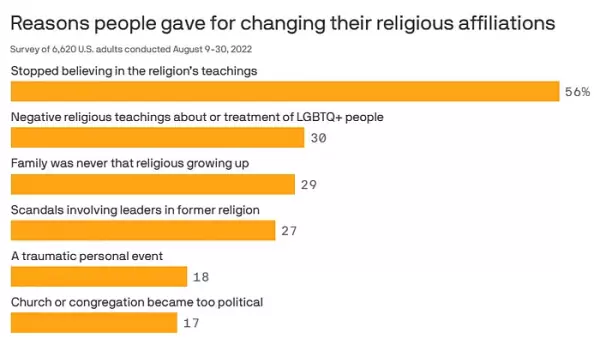
Data: PRRI, Health of Congregations Survey; Chart: Axios Visuals
I don’t know about you, but none of these responses come as a particular surprise. Here are a few more interesting findings from the research:
Catholicism’s Exodus
When it comes to abandoning their faith traditions, Catholics are streets ahead of the rest. The survey shows that a whopping 39% of former Catholics have set sail towards the land of religious non-affiliation. Could it be that the allure of robes and rosaries has waned in the face of the non-committal nature of the religious “nones”? Whatever the case may be, it seems the Vatican has a pressing vacancy for a chief spiritual retention officer.
Gen Z Makes for the Door
Gen Z, those aged 11 to 26, are also leading the charge in swapping and shunning religion faster than their predecessors. Their vibrant curiosity and desire for exploration will undoubtedly shape the spiritual landscape in ways we can only imagine.
The Divinely Content
Despite this grand religious shuffle, there remains a faction of loyal churchgoers who find solace in their chosen congregations. A majority (56%) believe that their current church is not more politically divided than it was five years ago.
What Are We to Make of All This?
I think it tells us something important: faith isn’t fixed anymore. People aren’t just sticking with the religion they were handed at birth or the one that fits best with their postcode. There’s a growing hunger to explore, to question, to find something that actually lines up with how people want to live and love in the world.
And the reasons people are leaving — they’re not shallow. They’re about integrity. About harm. About whether the church they once trusted still reflects the God they believe in. When nearly a third of people say they left over the way LGBTQ+ folks are treated, that’s not a fringe issue — that’s a moral deal-breaker.
Add to that the long shadow of leadership scandals — the abuse, the cover-ups, the manipulation — and it’s no wonder people are walking away in search of something more honest. Something less performative. Something that can hold the weight of real life.
For others, it’s personal pain that triggers the shift. Grief. Trauma. Doubt. When everything falls apart, you either find a faith that can sit with you in the rubble — or you go looking for one that can.
And then there’s politics. 17% said their church got too political — and honestly, that tracks. A lot of people didn’t show up on Sunday to be told how to vote or who to fear. They wanted something deeper. Something sacred.
Put all of that together, and it’s not just a trend. It’s a transformation. People are still spiritual — maybe more than ever — but they’re done with the versions of religion that feel small, exclusionary, or fake. And they’re not afraid to walk away to find something more true.
The Last Word
When I ran into my old youth group friend — the one I was sure would be a Christian for life — I walked away with more than just surprise. I walked away with a sense that something bigger is happening.
This research confirms what that conversation hinted at: people aren’t ditching faith because they’ve stopped caring. They’re walking away from systems that feel hollow, harmful, or out of step with the God they once met in youth group basements and campfire worship sessions.
There was a time when people didn’t go to church because they felt that they were too sinful, and God would reject them. Now, people do not go to church because they perceive that the church is too sinful, and God has rejected it (I’m talking about the institution, here!)
That is a seismic shift.
It reveals a fundamental transformation in our collective consciousness, where individuals are reclaiming their own spiritual authority and seeking a more authentic connection with the divine. It’s a revolution of the soul, reshaping the landscape of faith and leaving us in awe of the power of personal conviction.
The church missed the mark, and yet God is finding a way to our hearts, still.
—
This post was previously published on Backyard Church.
***
You Might Also Like These From The Good Men Project



If you believe in the work we are doing here at The Good Men Project, please join us as a Premium Member today.
All Premium Members get to view The Good Men Project with NO ADS.
Need more info? A complete list of benefits is here.
Photo credit: iStock

