


[Transcript available here.]
It’s a common sociological truism that gender is not just an identity but an action. Through their dress, appearance, mannerisms, speech quirks, and behavior, people convey that they are male or female, masculine or feminine or androgynous; other people “read” them as a certain gender (and may get quite embarrassed or offended when told that they made a mistake in what gender they’re reading someone as). The sociologist Erving Goffman studied one way gender is conveyed– the “code of gender”– through looking at the postures of people in advertisements. For instance, look at this:
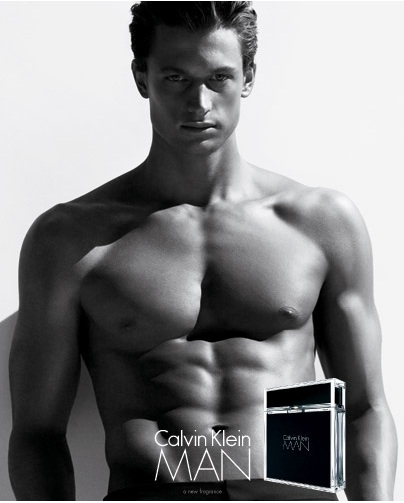
[Muscular, shirtless man stares straight into camera, his head and shoulders square and face expressionless.]
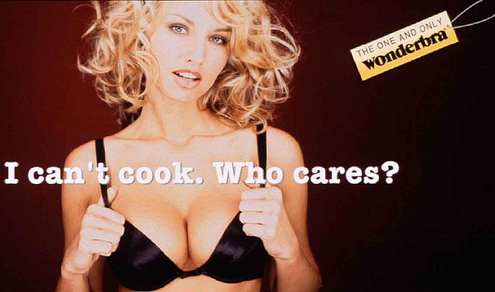
[Thin woman in nothing but a bra makes a sexface at the camera, her head tilted and her eyes widened.]
These advertisements are pretty damn similar, what with the whole “here is an attractive person, as naked as we can allow, looking at you in a way we think will enhance their attractiveness” thing. The expression differences are subtle and probably not even deliberate on the part of the advertisers (they were probably just looking for “sexy man” and “sexy woman”), but they’re real. The man appears powerful, in control, and emotionless; the woman looks emotional and sexually available.
Masculinity is about being strong, confident, and most of all powerful. So men (and masculine people in general) in advertisements (and in the wider culture) tend to adopt positions that make them appear strong. The prototypical example, of course, is standing upright with their hands in their pockets or arms folded, staring out at the viewer. Where women tend to “cant” (tilt their body, the way the woman’s head is tilted in that ad), men almost never do.
When people violate these codes of gender, it looks really fucking weird. For instance:

[The Avengers in combat, drawn so all the men are showing off their asses. Original artist here.]

[Man in stereotypical pin-up girl position. Original artist here.]
One bit of the analysis in the video I found super-interesting was when they discussed the increasing sexualization of men in advertisements, especially fashion ads. Of course, the advertisers want men to feel insecure about their bodies, because there’s this vast untapped market for beauty products. On the other hand, depicting unrealistically sexy men risks being gay and turning straight men off from the product. (Anyone else find it amusing that sexy ladies are assumed to be directed at men and sexy men are assumed to be directed at… also men?)
Sometimes, hilariously, they put women in the picture so that you know the guy’s straight. “See! Here’s a woman! Being all woman-shape! NOT QUEER.” Sometimes they just depict them as being muscular and athletic, which makes them look powerful and therefore masculine and not one of those damn queers. I have to say I think that point’s a little overstated– you can’t ignore that muscles are part of the beauty standard for men, and therefore when depicting a hot man you are going to depict a man with muscles. And of course they don’t depict men as sexy in the same way women are, with the canting and the sexfaces and all: that doesn’t even read as gay, it’s just funny.
Incidentally, fun thing for vaguely androgynous people to do (sorry, men with buzzcuts and large-breasted women in skirts, you might have to sit this one out). Go to a store walking in a stereotypically ‘masculine’ way, see how many people call you sir. Go to a store walking in a stereotypically ‘feminine’ way, see how many people call you ma’am. It’s fucking uncanny.


What images of men lack today is dimension. There is nothing to allow you the viewer to read anything in. The face is a mask, the eyes dead. The body is a sculpted machine, or at best a display rack for consumable goods. Look at movie industry portraits of the preWW2 era and you will see masculinity pictured in ways that would not stand up to analysis these days. Strength had to be implied because the naked upper body was not usually shown. Emotionlessness was soft-pedaled as pensiveness or a look of contemplation. Confidence translated as warmth and approachability. Dominance… Read more »
I have been inadvertently addressed as “sir” by people waiting on me…once in a fast food restaurant and once at the post office. I am a straight woman with very feminine facial features and long hair; however, I often wear my hair tied back, a ball cap on my head, and hoodies. In both of the “Can I help you, sir?” cases, the busy waitperson didn’t really look at me but saw a tall person in a ball cap and hoodie standing/walking in an androgynous or masculine manner in their peripheral vision. When I placed my order/request and the person… Read more »
Thank you, adbot, for serving up that “Body by Victoria’s Secret” to supplement the example Ozy provided of female-coded model poses.
The codes exist, but it’s possible to overstate them. In the Avengers picture, Iron Man and Hawkeye don’t read as weird for me (although I may be unusual), and I’m pretty sure that the Hulk’s ass spreading pose is more blatant about the sexualization than Black Widow’s admittedly sexualized original pose. As for the male pin-up, how much of it is weird because it’s a man, and how much is weird because he has a distinctive and not conventionally attractive feature and is wearing clothes that don’t lend themselves to sexualization? Look at a pin-up pose of a conventionally attractive… Read more »
About the Avengers picture- I think Ozy was just using that in this context because it exaggerates, and therefore emphases, female ‘sexy poses’, and is a useful illustration of how weird they look on men. The picture in its original context was, I suspect, intended mainly as a satire of those ridiculously impractical poses female characters are often found doing in comic books and comic art, and how their butts (and breasts, though the male Avengers are not given what they don’t have in the drawing) are emphasised as much as humanly possible for no reason other than to titillate.
It’s also interesting that the two examples of violating the code looking weird cited are both men taking the position defined to be feminine. Consider these photographs of Hope Solo (borderline NSFW) This was the cover photo for a large-circulation US magazine: http://a.espncdn.com/photo/2011/1005/espn_soloh_bww_576.jpg http://www.thedenimkit.com/wp-content/uploads/2011/10/this_is_hope_solo_naked_and_watering_the_lawn_in_espn_the_nudie_magazine-1.jpg There was, IIRC, the usual publicity for The Body Issue and I don’t recall the view being generally expressed that Hope Solo was weird. It certainly seems to be more acceptable for women to break the codes surrounding gender than for men to do so. (much of the photography of female athletes in The Body Issue… Read more »
So, the code is men = strong, confident, and most of all powerful and women = emotional and sexually available. And then there are the code violations. Tastes will vary, but if you look at those pics of Hope Solo, I as a straight man find them sexy as hell and not weird at all. But, she’s a real athlete… strong, confident, powerful. And naked, so sexually available. What’s weird about that being hot? The bearded guy doing pin up… he didn’t hit any of those things. He just looks like a goofy guy trying to be ironic. I don’t… Read more »
Maybe the point is that pin-up poses are actually quite ridiculous? From the comic book stand point, I do know quite a few women who are turned off by the way females are drawn. The only time I’ve seen a martial artist pose for ‘sexy’ instead of ‘power’ is in comedies (Jackie Chan in “The Legend of Drunken Master”). And then there is the “the smaller the armor, the better the protection” theme… many a drunken rant has included the line “If I had to choose one or the other, I’d armor my stomach and let my breasts flop out… Read more »
Wow! Great film!
I have heard this stuff before about advertising but this film is so great in crystallizing everything and making all the connections….I read these mags on the treadmill everyday…so funny to see it all broken down like this!
“(Anyone else find it amusing that sexy ladies are assumed to be directed at men and sexy men are assumed to be directed at… also men?)” What I find even more interesting is that when an ad is directed at women as a demographic there is little to no concern that the ad will offend women and therefore potentially cause women to be turned off of the product. Meanwhile, when ads are directed at men as a demographic, or at men and women together…well then there’s always concern about whether they will offend men, specifically by being perceived as gay.… Read more »
Meanwhile, when ads are directed at men as a demographic, or at men and women together…well then there’s always concern about whether they will offend men, specifically by being perceived as gay.
I’m curious as to where this concern is. Not that it doesn’t exist just where does it play out in the form of.
Alright take for example, women’s beauty products…they utilize the same sort of straight male gaze in their depictions of women as an ad for men’s razors (or whatever). There is no taking into account whether such stereotypical depictions of women might actually end up offending their customer-base (women). Adverts are full of all sorts of stereotypes and usually reflect the worst of western culture, I’d say…but even still, consider how often the possibility of offending a woman is used as a justification for shying away from a certain subject in an ad…it doesn’t happen. But the reverse happens…the fear of… Read more »
Are those companies really afraid of offending men or are they too lazy to look beyond male stereotypes in advertising?
@HeatherN
Think your crediting the marketers with more power than they actually possess. These people spend a lot of time and money trying to gauge how their audience will respond to ads and produce ads with that input. What they probably know is women do not experience the same level of hetereo-normative rigidity that men experience. So comparable ads that would trigger the obligatory homophobic response from men would cause no harm in women. It has nothing to do with a tolerance or in-tolerance for offending one gender or another.
I think it’s because men are, or are at least taught, to be turned off by each other’s bodies because doing otherwise would be “gay.” Women, on the other hand, are not, or at least not taught, to be turned off by each other’s bodies. It could also be because it is more acceptable for women to be masculine in our culture than it is for men to be feminine, so it’s okay for either gender to look at a woman’s body, since that is considered masculine. Also, for a man to act feminine is still largely considered degrading. This… Read more »