



I spent some time with my father last night, even though he’s been dead for many years now.
The portal that brought my father back to life, if only for a little while, was a letter he wrote to me when I was away at university.There, in his immaculate copperplate hand, were all his thoughts and news from the home front. Reading his letter, I was transported back in time, and if I closed my eyes for a moment, it felt like his spirit was lingering in the room with me.
More than kisses, letters mingle souls. —John Donne
During my university days, Dad used to write to me weekly.
The letters always contained a weekly allowance of cash, which typically paid for beer busts, snacks, and basic personal items. But it was the letters that I cherished because they kept me connected with my Dad. They often contained fatherly advice, newspaper clippings, and his love.
I kept all of Dad’s letters in a tattered shoebox.
After university graduation, I stored the shoebox in the bedroom closet at my parents’ house. I went on to graduate school, moved to a nearby city, and began my law enforcement career. Years clicked by. Dad grew old, became ill, and died.
A few months after the funeral, I visited my mother back home. I went upstairs, into my old bedroom (which my father had taken over as his home office) and rummaged through the closet for the shoebox full of Dad’s letters.
But it was nowhere to be found.
I asked my mother about it. She remembered decluttering and cleaning up the house after Dad died. “I’m sorry, but I think I threw the shoebox out. I thought it was just old paperwork of your father’s,” she said.
And just like that, four years of my father’s correspondence had forever disappeared from my life.
The mind alone without corporeal friend
I played it down with my mother, as it was an innocent mistake.
But deep down, I was devastated. So much history, advice, love, and memories were in those letters. Thankfully, five or six letters survived. I found them in other places, and to this day I pull them out to remember, reminisce, and try to catch a remnant of my father’s spirit.
A letter always seemed to me like immortality because it is the mind alone without corporeal friend. —Emily Dickinson
Letters are intimate, enduring, physical time capsules.
Letters are mementos containing a bit of the soul of another person. The style of handwriting, the thoughts expressed, and the unique personality of the letter writer all come together on the page. And the page is tucked into an envelope, complete with addresses, stamps, dates, times, and even fingerprints and coffee smudges.
Letters are a kind of immortality.
But letters are dying these days. Modernity has brought us, for better or worse, into the age of digital communication. We have more expeditious tools. Emails, texting, Zoom, social media apps. It’s fast, efficient, and instantaneous.
And it’s soulless.
I still remember writing and receiving love letters back in the day. The best letters found in my mailbox contained perfume. One lady I fancied used to write little x’s over her i’s. Each letter was as distinctive as the sender. And we took more time to compose our thoughts. We quoted poems. We dared to express deep feelings.
Somehow emails don’t capture any of this magic.
The collected tweets of Neil Gaiman
An essay in The Guardian, titled “Epistles at Dawn: The Dying Art of Letter Writing,” notes the following:
Loquacious letters and epistolary exchanges between authors are falling by the wayside in the digital age—and readers and literary estates are all the poorer for it.
How are literary archivists going to collect the correspondence of today’s best authors and writers? After all, nobody seems to write letters anymore. It used to be in the letters of great authors that researchers discovered unvarnished thoughts, hidden kernels, influences, fears, hopes, loves, and other treasures about their literary heroes.
The Guardian essay adds:
Emails are great for getting in touch quickly and easily, but as literary vehicles they are severely lacking. Notoriously Manichean, digital messages tend to oscillate between the deathly dull and formal and the blithely irreverent (complete with BTW, FYI, LOL’s and garbled text-speak) with precious little middle ground. Letters can be revealing, expansive, humorous; emails, even at their best, tend to exhibit only one of these characteristics of good writing. Of course, many contemporary novelists use social media such as Twitter and Facebook, sometimes to great effect; but publishing revolution or no publishing revolution, I find it hard to imagine that generations to come will one day download the ‘Collected Tweets of Neil Gaiman’ on to their e-reader.
Neil Gaiman is a fine writer, but I doubt his collected tweets would compete with something like “The Complete Letters of Oscar Wilde,” or “The Collected Letters of C. S. Lewis.”
Future literary archivists will have to become digital experts and scour the internet to excavate whatever fleeting kernels remain of today’s great writers. Even then, if writers are no longer crafting thoughtful letters, all that will remain are pithy tweets, curt emails, and dormant WhatsApp remarks.
Modernity may have made many aspects of our lives easier, but not necessarily better.
The death of letter writing, thanks to the advent of email and all the other digital tools, seems to be at our loss. A bit of deeper humanity was found in our letters, whereas emails and tweets reflect a more flippant and shallow expression.
Have today’s digital conveniences helped us progress?
Peter Hitchens, brother of the late Christopher Hitchens, in a video for The New Humanum, claims that “There is no such thing as progress. It’s a fantasy.” He argues that there is change, some for the better and some for the worse. But there is no progress.
Hitchens says that material things may get better, while spiritual and moral things may get worse.
I don’t know if this is true or not, but I do mourn the loss of letters. I miss their physicality, thoughtfulness, intimacy, creativity, and depth. I miss drawing cartoons on letters for friends (because I too often default to the convenience of email).
Letters contained a bit of our souls, and now that we no longer write letters, we seldom share that deepest part of our being.
The most significant memorial
Truth be told, sometimes emails contain cherished gifts.
Earlier this year I received an email from a past girlfriend. A wonderful, successful woman whose company, affection, and charm remain in the memories of my adolescence and early adulthood years.
She knew my parents well.
In her email, she shared a scanned copy of a letter my father sent her. She found it so many years later, tucked away in her safe, like a forgotten gift under the Christmas tree.
Reading the letter was like discovering a bit of my father. And for the first time, since the letter was not written to me. In the letter, Dad shares updates about life, including my university exploits. And he thanks her for a thoughtful Christmas gift (a history book) that she found for him whilst in Europe.
Letters are among the most significant memorial a person can leave behind them. — Johann Wolfgang von Goethe
I think the poet John Donne was right when he wrote “More than kisses, letters mingle souls.”
Kisses are lovely but ephemeral. Letters, if we take care and don’t throw out the shoebox, can last a lifetime.And when we read them, our souls get to mingle. The letter writer and reader come together again in space and time.
At least, that’s how it felt last night, reading my father’s old letter. The envelope is fragile, and the fountain pen ink on the envelope and letter is a bit faded. But then I’m a bit aged myself, and some of my memories are a bit faded.
Dad’s letter opens with, “Dear John, Another week and time for another cash infusion into my best investment, namely yourself, so enclosed are the bucks.”
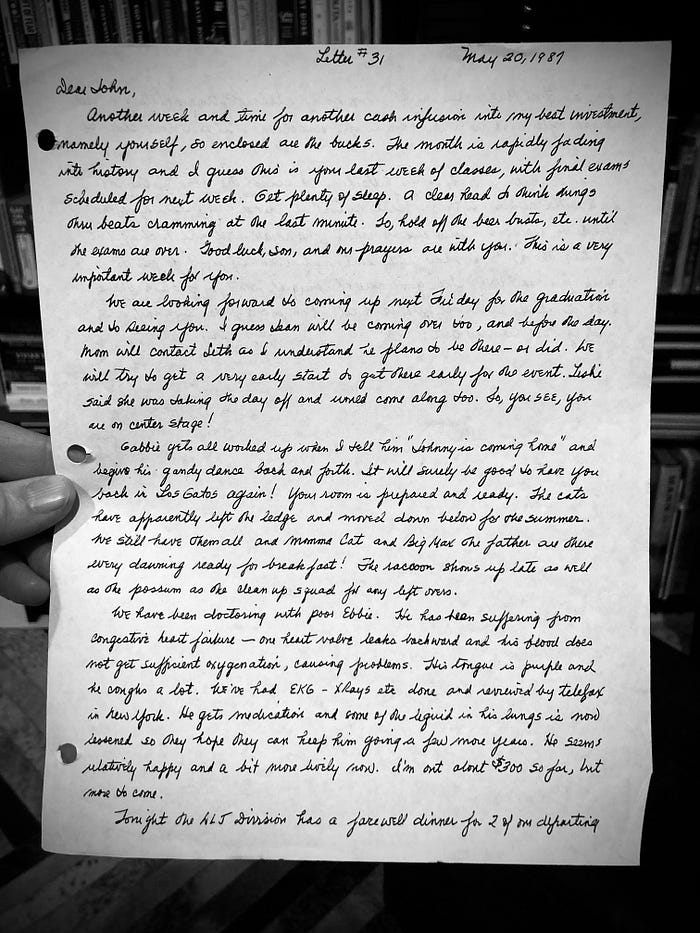
What a wonderful man my father was. And thank God I still have a few of his letters.
Perhaps, despite the ease of today’s digital communication tools, we should borrow the wisdom of Johann Wolfgang von Goethe, and write more letters. Slow down, grab a pen and paper, and pour some deep thoughts and feelings into an epistle for someone special. Leave behind your significant personal memorial.
Imagine the surprise of a family member or friend, when they open up the mailbox and discover your handwritten letter.
My Dad’s letters still affect me all these years later. They still make me feel connected to him. So why not share the gift of a personal letter with someone you know and love? Why not allow your souls to mingle a bit?
This is the immortality of letters.
Before you go
I’m John P. Weiss. I write elegant stories and essays about life. If you enjoyed this piece, check out my free weekend newsletter, The Saturday Letters.
—
This post was previously published on Medium.com.
—
The Good Men Project is a mission-driven men’s media platform. A major platform for stories about men, identity, fatherhood, and emotional intelligence—and a trusted home for the national conversation about masculinity.
The Good Men Project accepts paid guest posts and provides bulk guest post packages for SEO agencies and resellers.

If you believe in the work we are doing here at The Good Men Project, please join us as a Premium Member today.
All Premium Members get to view The Good Men Project with NO ADS.
Need more info? A complete list of benefits is here.
Photo credit: John P. Weiss

