



As a new year has begun, it is time to consider, yet again, all those hopes and dreams that we have for the new (and hopefully better) year ahead.
According to a survey of over 500 adults in the USA, run by consumer data website, Statista, the top New Year’s Resolutions for 2021 included: Exercising more, eating more healthily, and spending more time with family and friends.
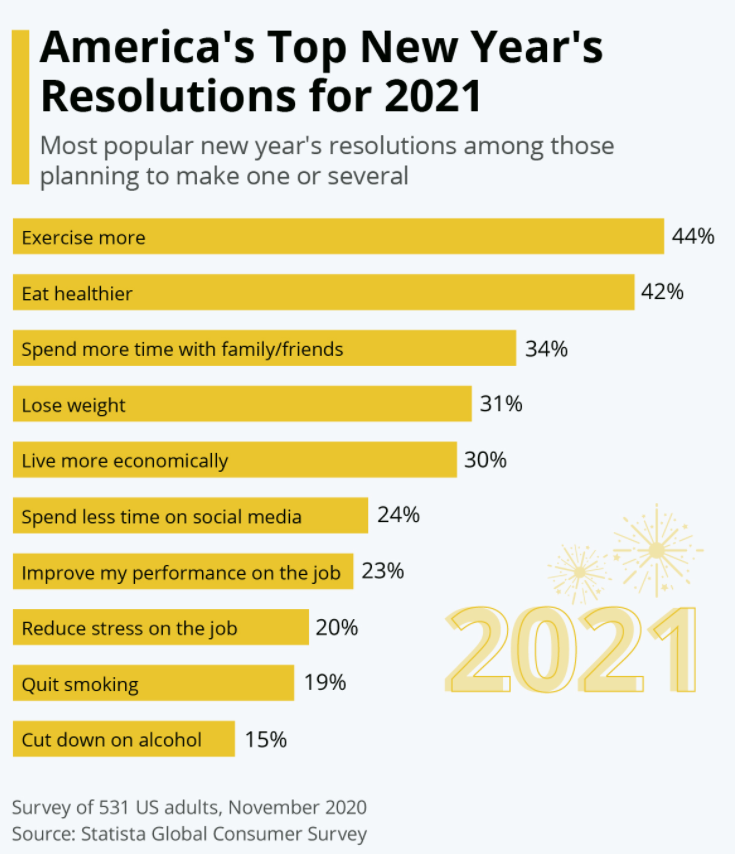
Source: Statista Global Consumer Survey
Notwithstanding the fact that things like global pandemics can throw our best and most well-intentioned plans to the wind, Forbes magazine reports that only around 8% of New Year’s Resolutions are ever accomplished. So why even bother?
Not to be deterred, this year, I have resolved to stick to my New Year’s plans. What is more, I am skipping over all the common resolutions like the ones listed above. Rather, as a person of faith, I have decided that my new year’s resolutions will include a bunch of goals for nurturing my spiritual side.
When I was looking for ideas for my list, I turned to Google (where else does one look?) for some inspiration. I typed into the search bar: “New Year’s Resolutions for Christians.”
This was a bad idea.
The problem is that the shadow of my former life as an evangelical Christian still lingers large and follows me around. Whenever I turn and try to beat it into submission, it somehow evades me! And when I go searching for inspiration on Google on how to be a better Christian, my shadow finds a veritable smorgasbord of suggestions on how to return to the daily grind of performance-based religion.
Website after website and blog after blog offer no practical suggestions on how to live a life that actually imitates Jesus’ practices and priorities. Rather, I was presented with endless lists of habits and activities that ‘good Christians’ ought to be participating in. And, to be honest, I found it mildly to moderately nauseating. One website that I found offered these suggestions:
- Read your Bible 20 minutes a day, every day
- Go to Church every week without fail
- Set aside 15 minutes each day to pray
- Join a Bible study
- Ask a friend to Church
- Start tithing
- Read a certain number of Christian books each month
- Find an accountability partner
- Break an addiction
Now, if you think that these are great ideas, then good for you! I would have thought that as well once — back when I was a ‘good Christian.’ But, I suppose I’m not a good Christian anymore because even in reading these proposed resolutions, I feel a weight on my shoulders and have to suppress the urge to turn and run.
My shadow man (the old evangelical in me) delights in this list because it reduces Christianity down to an easy-to-follow checklist that mainly consists of prayer, Bible reading, and church attendance. Simultaneously it absolves me of responsibility for any real personal growth, change, or transformation. So long as I’m following the checklist, I’m all good — and surely God is suitably appeased.
Still, credit where credit is due. This list for ‘good Christians’ has inspired me to write a list for ‘bad Christians’ — the kind that are sick of playing the game of religion but are still genuinely seeking God. Here is my list of New Year’s Resolutions for bad Christians:
Don’t read your Bible 20 minutes a day, every day
It still amazes me that Christians believe that dutiful obligation to a religious habit such as Bible-reading, in and of itself, impresses God and makes any real difference. Don’t get me wrong. I’m sure that Bible reading is good and useful and has the power to change people. At the same time, some of the most horrible people I’ve ever known are prolific Bible-readers. They fail to notice, appreciate, and apply to the overarching metanarrative of Scripture — being one of reconciliation and love.
Instead of religiously reading the Bible for 20 minutes a day, here is a better idea: Read the Bible occasionally — and then go and actually apply something that you learn. Wouldn’t it be better to read less and apply more? After all, the Bible itself says: “Do what God’s teaching says; don’t just read, listen and do nothing. When you only sit and listen, you are fooling yourselves.”
Fail to go to Church every week — without fail
My Dad was a church pastor, so I grew up in the church system. I attended two services every week for most of my life and felt guilty when I didn’t. When I do the math in my head, I estimate that I have attended over 4000 church services. That’s a lot of sermons.
But I’ll level with you.
I reckon that 3990 of those church services made no difference to my life. That is not to say that I didn’t enjoy many of them, but as for lasting impact and change, and real emotional and spiritual growth, well… it’s sad to say, the church didn’t really contribute all that much.
Walk into your average church service, sit down and look around. What do you notice? Overwhelmingly you will see that people are bored. When I left the institutionalized church, I actually found that I grew closer to God, as I discovered new and different ways of connecting with the divine that had previously been outside my paradigm. Give it a try!
Don’t set aside 15 minutes each day to pray
Imagine being in a relationship with a person who only spoke to you out of obligation, and then only for a set length of time. Poor old Jesus! It might look something like this YouTube clip:
If you have to religiously “set aside” time to force yourself to talk to a person every day, just because you feel that you should, then I suggest that you don’t like that person very much, to begin with — or maybe they don’t really exist.
I don’t know about you, but I would rather people speak to me because they want to, not because they feel they have to. So, here’s a better idea: Just pray when you feel like praying — in freedom and spontaneity — not out of religious duty or obligation.
Leave your Bible study behind
Many Christians assume that immediately after Jesus died, rose from the dead and went back to heaven that a leather-bound copy of the Bible descended from the sky in a beam of radiant light.
Consequently, modern-day Christians seem to place a ridiculously high level of importance on studying the Bible. This despite the fact that the Bible — in the form that we now have it — didn’t come along until over three centuries after Christ. Moreover, more than half the Christians in the world don’t even have access to a physical copy to call their own — yet they manage, somehow, to maintain their faith in Christ.
Bible study is useful to a point, but let’s be honest. Study for the sake of study might increase one’s knowledge, but it will not necessarily change one’s heart. Most Christians are educated beyond their level of obedience, in any case.
Ask a friend to skip Church with you
Now that you’ve discovered the simple joy of not having to get up early on a Sunday morning, dress up nice, and put on a fake smile, why don’t you invite a friend who still goes to church to do the same?
Perhaps you can pack a picnic and go and spend some time in the grand cathedral of God’s creation; rest, relax, and enjoy your surprise when you realize that God skipped church as well!
Stop tithing and start giving
Fact: Research tells us that 75% of the money you give to the church is used to pay the pastor’s wage and maintain the church building. So, when the pastor gets up and gives his long-winded pre-offering talk where he tries to convince you that ‘good Christians’ ought to participate in the ancient and obsolete practice of tithing, remember he is literally pleading for you to support his livelihood.
Now, I can appreciate that any charitable entity has administrative costs that are covered by a certain percentage of donations — but 75% percent!? Give me a break! You may think that this is a good use of your finances. As for me, I would rather be giving to support grass-roots causes where I know that my money is actually getting to those who need it — like the poor and needy, for example.
Read a certain number of non-Christian books
Christians are adept at reading books that support and perpetuate the same ideas and patterns of thinking that they’ve always had. So strong is the confirmation bias that we immediately reject anything that challenges our thinking.
Maybe you’ve already rejected this article. Perhaps you’ve labeled me a heretic (After every blog post I write, several people usually do).
However, I would encourage all Christians to read authors that actually challenge their thinking and force them to confront the most difficult and troubling questions of the faith. How can we grow otherwise?
Maybe we’ve convinced ourselves that it’s unhealthy to discuss these difficult questions. We worry that exposed to the light, our faith will fade away. If it’s tested, it may just shatter. But, if our faith is that fragile, it probably was never true. If our God is so easily defeated, he is probably not really the true God. Whether we have built castles of doctrine on flimsy foundations or have metaphorically curled ourselves up into a ball around the fundamentals of the gospel, avoiding the tough questions will never lead to any kind of real answers.

Photo by Jilbert Ebrahimi on Unsplash
Find an accountability partner
Christians just love accountability partners! Usually, a Christian will find a person of the same gender and is very similar to them (perhaps a little older), who will ask them how they are going with their Bible reading, prayer, and church attendance — and ensuring that they don’t publically sin too much.
The problem with this is that if your accountability partner is pretty much a clone of you, in terms of faith and practice, possessing all the same beliefs and biases, then chances are, you are just going to hear the same old messages on repeat and never learn anything new. They will be no challenge and no growth.
Here’s an idea: Find an accountability partner who is totally different from you. Do you know who is often the best at keeping a Christian accountable? A non-Christain. Why? Because they are very adept at spotting your hypocrisy and are more than happy to point it out for you. Do you want to actually address your self-righteousness and pride? What could you learn from a wicked heathen? Plenty.
Break your addiction to religion
If you can catch him or her, try to confront the shadow of your past life as a good evangelical Christian. You will find them sneaking up to you whispering in your ear, all kinds of lies.
They will tell you that you must do this or that to win God’s favor. They will implore you to pick up certain religious practices to appease God as well as your own inner voice that tells you, “You have to prove yourself!” They will remind you of your own sin, making you feel miserable and guilty, while simultaneously pointing out the sin of others and inflating your ego with pride and self-congratulation.
In the past, we might have called this the voice of Satan. Still, more than likely, it is actually just the ghosts of our own upbringing in a guilt-based religious system — one that was constantly reminding us of our wretchedness and exhorting us to be better.
Here are the facts: The Christian faith is based purely and completely on the idea that God’s love is poured out unconditionally, indiscriminately, freely, and graciously on all of humanity. It is not dependent on human goodness or effort. You are simply loved because you are God’s child.
Your shadow will try to convince you that this is a lie.
Above All…
The world needs fewer Christians who think that the way to be a better Christian is to read the Bible more, pray more, and attend church more — the kind who reduce the practice of faith down to rituals, routines, and religious activities.
Above all, if you are a person of faith — any faith — try to be more like Jesus, who, being the preeminent teacher of love, compassion, and reconciliation, showed us a better way to live. That out to be our ultimate resolution!
Speaking of being like Jesus, Australian Theologian, Michael Frost, posted his own New Year’s resolutions on Twitter back in 2019. His list still resonates with me:
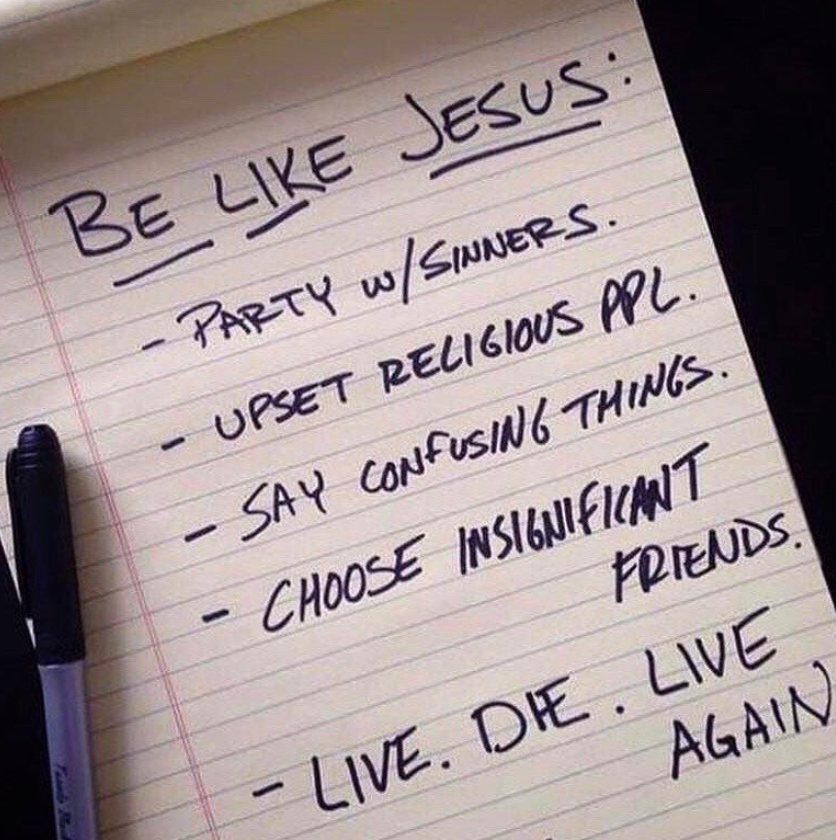
Image Source: Twitter
For more articles on life, faith, and spirituality, Sign-up for my monthly newsletter
—
This post was previously published on medium.com.
***

If you believe in the work we are doing here at The Good Men Project and want a deeper connection with our community, please join us as a Premium Member today.
Premium Members get to view The Good Men Project with NO ADS. Need more info?
A complete list of benefits is here.
—
Photo credit: Shutterstock

