


National Arbor Day is Friday, April 26. The last Friday in April is a celebration in which the Arbor Day Foundations encourages individuals and groups to plant and care for trees.
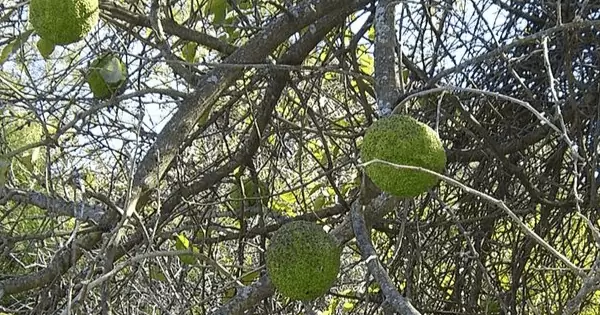
The Bois D’arc (French for ‘bow wood,’ pronounced bodark) is little known outside its range in Texas, Oklahoma, and Arkansas. Maclura pomifera may also be called Osage orange, hedge ball, horse apple, monkey ball, or yellow-wood, depending on your neck of the woods. In those regions, nature lovers and tree huggers revel in a sense of pride of their fellow native.
April is National Poetry Month. Celebrate Arbor Day with a poem. Then go and plant a tree.
Ode to Bois D’Arc
The Osage orange is a lowly tree.
French explorers called this wood ‘bo dark.’
Natives of the 16th century
used many parts of the wood and bark.
This ‘wood of the bow’ served well in war.
Bows and war clubs were used on the Plains.
Tannin from bark could help cure leather.
Ropes were twisted for use or exchange.
Dye from the roots yielded a yellow.
It’s used to make uniforms khaki.
And it was a creative fellow
who used it for fence in the prairie.
‘A hedgerow of bois d’arc was bull-strong,
horse-high, and pig-tight,’ old experts said.
Horse apple fence posts also last long.
The wood is even good for the dead.
Grave markers, gates, and parts for machines,
foundations, wheel rims, and rail-road ties,
were made from the hardest wood ere seen.
Its essence repels mildew and flies.
But like the tree of evil and good,
there’s a shady side to the hedge ball.
If you try to burn it as fire wood,
wild sparks will fly to directions all!
A tougher, thornier, more tangled
specimen of cantankerousness,
odd grains that grow twisted and angled,
does not exist in the wilderness.
Try to prune bois d’arc limbs if you please,
the branches will bend with your chain saw.
Board ark lumber splits and cracks with ease;
the toughest wood west of Arkansas.
Thorns adorn this arboreal quirk.
Itchy inch-long spikes will shame barb-wire.
They tried paving streets but it didn’t work.
It floats in flood and is fuel for fire.
But like the natives of the Blackland,
the versatile qualities shine through.
Bois d’arc roots grow in clay, loam or sand.
And we’re bodacious in all we do!
This poem was previously published by the Friends of Hagerman National Wildlife Refuge.
—

Photo:Wikepedia Commons

