


—
There’s a moment a lot of men can relate to. You’re helping clean out a parent’s house, or going through a grandparent’s belongings after they’ve passed, and tucked in the back of a dresser drawer — behind old watches and faded photographs — you find a small cloth pouch or a cardboard tube that’s heavier than it should be. Inside are a handful of large silver coins. They’re bigger than anything in your pocket. They feel different. They look like they belong in a museum.
Chances are, you’re holding Morgan silver dollars.
It’s one of the most common entry points into coin collecting, and it’s been that way for generations. Not because someone sat down and decided to start a hobby, but because a piece of family history ended up in their hands and they wanted to understand what they were looking at.
A Coin That Carries Its History
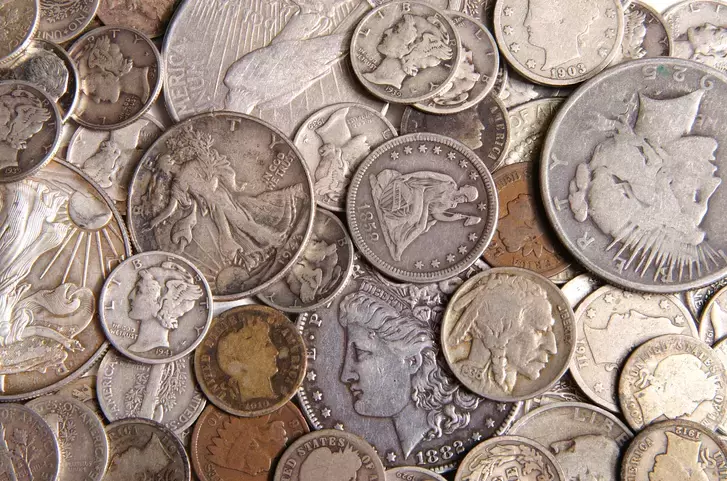
The Morgan dollar was minted from 1878 to 1904, and again in 1921. It was designed by George T. Morgan, an English-born engraver at the United States Mint, and it remains one of the most recognizable coins in American numismatics. The obverse features Lady Liberty in profile, with wheat and cotton woven into her hair. The reverse shows an eagle with outstretched wings clutching an olive branch and arrows.
But what makes the Morgan special isn’t just the design. It’s the era. These coins circulated during westward expansion, the gold and silver rushes, the rise of the railroad, and the transformation of the American economy after the Civil War. When you hold one, you’re holding something that might have been carried in a miner’s pocket in Nevada or exchanged at a general store in a frontier town. That connection to history is part of what makes them so difficult to put down once you’ve picked one up.
Each coin contains .7734 troy ounces of silver — they’re 90% silver and 10% copper. At today’s silver prices, that puts the melt value of a single Morgan dollar in the neighborhood of $56. But most Morgans trade well above their silver content because of collector demand. A common-date coin in circulated condition might sell for $60 to $80. A key date like the 1893-S can bring $4,000 or more. The 1895 proof-only issue is considered the crown jewel of the series and has sold for six figures.
You Don’t Need to Be an Expert to Start
One of the things that keeps people from getting into coin collecting is the assumption that you need to know everything before you buy anything. With Morgans, that’s not really the case. The series is well-documented, widely available, and forgiving for beginners.
Here’s what makes them approachable. Over 86 million Morgan dollars were struck in 1921 alone, across three different mints. That means entry-level coins aren’t hard to find or expensive to acquire. You can pick up a circulated 1921 Morgan — the same type of coin your grandfather might have saved — for a reasonable price that won’t make you nervous about handling it. And that matters, because part of the appeal of this hobby is actually holding the coins, turning them over, looking at the detail, and learning to read the wear patterns that tell you where a coin has been.
From there, the rabbit hole opens up naturally. You start noticing mint marks — the small letters on the reverse that tell you whether a coin was struck in Philadelphia, New Orleans, San Francisco, or Carson City. You learn that a coin’s condition can mean the difference between a $60 coin and a $1,000 coin. You find yourself checking dates against a Morgan silver dollar value guide to understand what you have and what to look for next.
That’s usually the moment it stops being something you inherited and starts being something you’re building.
A Hobby With Built-In Structure
One of the underrated aspects of collecting Morgans is that the series gives you a natural framework. There are 97 regular-issue date-and-mintmark combinations across the original 1878–1904 run plus 1921. You’re not collecting an open-ended category with no finish line — you’re working through a defined set, filling gaps, upgrading coins you already own, and deciding which key dates are worth stretching for.
How you organize is up to you. Some collectors work chronologically. Others focus on a single mint — Carson City Morgans, marked with a small “CC,” are particularly prized because the Carson City Mint operated only from 1870 to 1893 and produced comparatively small quantities. Others pursue condition, trying to assemble the highest-grade examples they can find for each date. The structure is there if you want it, but so is the freedom to follow your own curiosity. And unlike a lot of hobbies, what you’re collecting has tangible value that has historically held up well — grounded in both silver content and collector demand.
Something to Share
There’s another dimension to collecting silver dollars that doesn’t get talked about enough: it’s one of the few hobbies that naturally crosses generations.
If you have kids, handing them a Morgan dollar and watching them react to the weight and size of it is a small but genuine moment. Explaining that the coin is more than 100 years old, that it’s made of real silver, that the eagle on the back was designed by a man who came to America from England to work at the Mint — that’s the kind of thing that sticks with a kid.
Some fathers and grandfathers build sets alongside their children, giving them a coin on birthdays or holidays. Others use it as a way to introduce basic ideas about money, value, and history without it feeling like a lecture. There’s something about a physical object — something with weight and texture and age — that communicates in ways a conversation about investing or saving just can’t.
And when the time comes, those coins become the next generation’s dresser-drawer discovery. The cycle continues.
Getting Started Without Overthinking It
If you’ve found yourself holding a few silver dollars and wondering what to do next, here are a few practical starting points.
First, don’t clean them. This is the single most important piece of advice in coin collecting, and it’s counterintuitive. A coin’s natural patina — the toning and wear it’s accumulated over a century — is part of its character and its value. Cleaning a coin with polish or chemicals can permanently damage the surface and reduce what it’s worth. Handle coins by their edges, and store them in holders designed for the purpose.
Second, figure out what you have. Check the dates and mint marks against a value reference to get a sense of whether you’re holding common dates or something more significant. Not every old coin is a rarity, but some of them surprise you. The difference between a $60 coin and a $6,000 coin sometimes comes down to a single letter on the reverse.
Third, visit a local coin shop if there’s one near you. The coin collecting community is, broadly speaking, welcoming to newcomers — especially someone who walks in with a family collection and genuine questions. A reputable dealer will take the time to explain what you have. If you’re thinking about selling, get opinions from at least two or three dealers before making a decision, and keep in mind that dealers buy below market value and sell above it — that spread is how they make their living, and it’s normal.
And finally, give yourself permission to keep a few. Even if the collection isn’t worth a fortune, the coins that your grandfather chose to save meant something to him. Sometimes the right move isn’t maximizing the value — it’s picking out a couple of coins that feel meaningful, putting them somewhere safe, and letting them be the beginning of something new.
The Long View
Morgan silver dollars have been collected continuously for nearly 150 years. The hobby has weathered economic downturns, gold and silver price swings, and the rise and fall of countless other collectible markets. It endures because the coins themselves are compelling — beautiful in design, rich in history, and grounded in the tangible value of the silver they contain.
If you’ve come into a few silver dollars by way of family, you’re already further along than you think. You don’t need to become a full-time numismatist. You just need enough curiosity to look up a date, enough patience to learn what makes one coin different from another, and maybe enough sentiment to hold onto something your grandfather held onto before you.
That’s usually enough to get started. And for most people, once they start, they don’t stop.
This article is for informational purposes only and does not constitute financial or investment advice. Coin values fluctuate based on market conditions, silver prices, and collector demand. Readers considering buying or selling coins should consult with reputable dealers or numismatic professionals.
—

