


—
The majority of conventional sports and hobbies aren’t done at night. However, nighttime offers many possibilities for unique thrill-seekers and explorers.
Nighttime sports and hobbies aren’t a new thing, though. We’ve been observing and exploring nature since the beginning of our time on Earth—the only difference today is we have the equipment to make nighttime activities more accessible, more enjoyable, and safer.
Technology enhances our experience of the natural world after dark. It allows us to see farther, detect new phenomena, cover more ground, identify threats quicker, observe better, and have more fun.
Here, we list the top nighttime activities that benefit greatly from modern technology, such as night vision equipment. We also briefly discuss how night vision technology works and helps us accomplish feats impossible with our natural abilities.
How Night Vision Works
Were you ever curious how those night vision cameras, scopes, monoculars, or binoculars work? As you use them, it helps to understand the underlying technology behind these remarkable devices.
Night vision technology has revolutionized our ability to navigate low-light environments or even see in complete darkness. It has extensive applications in areas ranging from wildlife observation to home security. It is critical to military operations.
This ability is accomplished through infrared light. The technology in night vision devices amplifies existing light or detects heat emitted by objects. While infrared is invisible to the human eye, it can be detected by a night vision device.
Night vision technology classifications
Two types of night vision technology exist today: digital night vision (DNV) and image intensification (IIT). Image intensification or IIT devices are the most common commercial night vision technology type. IIT amplifies existing light so it is visible in no-light or low-light conditions. It converts light into electrons.
The heart of an IIT device comprises an image intensifier tube. An IIT vacuum tube contains a photocathode, electron multiplier, and a phosphor screen. The photocathode is responsible for converting light into electrons.
These electrons are amplified by the electron multiplier and converted back to light by the phosphor screen. The amplified light is shown as an image on a screen, which the user sees.
IIT devices have several advantages, like being lightweight, portable, relatively inexpensive, and long battery life. Their disadvantages include being affected by bright light, having a limited field of view, and producing a grainy image.
Digital night vision, or DNV, on the other hand, is a newer type of night vision technology. It uses a digital sensor to capture sharper images in no-light or low-light conditions. The sensor creates an image that can be displayed on the user’s screen.
DNV night vision’s advantages include a wider field of view, a sharper image, and less interference by bright light. Disadvantages of this new technology include being more expensive, having a shorter battery life, and being heavier and thus less portable than IIT devices.
As a hobbyist, it is up to you to choose which technology suits your purpose based on the type of nighttime activity, specific application, budget, and comfort or convenience.
Nighttime Hobbies Where Night Vision Is Indispensable
Night vision enhances your experience of the nighttime environment, whether it’s a low-light or no-light scenario.
In many cases, it is indispensable. The following are fun nighttime activities that benefit significantly from using night vision devices:
Night hunting
While people have hunted for survival since the dawn of the species, night hunting is a relatively recent pastime. The gradual improvement of hunting tools over millennia has made us very efficient hunters.
However, night hunts were not precisely our domain until we developed the right equipment.
Night hunts have become popular recently. These hunts have the same goal as the daytime activity. Hunters generally follow the same rules as daytime hunting. However, the means differ. Night hunters must supplement themselves with information on correct behavior in the dark.
Moreover, safety is a concern. You need to be mindful of the safety of all participants involved in low-light or no-light conditions.
The primary obstacle to night hunting is darkness. Therefore, night vision devices and modern thermal imaging optics must overcome it. Getting over the visibility hurdle is crucial to achieving your goals—getting the desired trophy.
Night hunters generally prefer night vision scopes. These scopes allow them to scout or inspect the area before the hunt. The scopes are crucial for the perfect aim. There are several types of scopes available to help hunters in varied conditions.
Many hunters believe that sights with thermal imaging are the most effective. The devices capture heat signals from afar, enabling the hunter to spot even small animals quickly. Temperature distribution maps also appear on the screen. The temperature map guides the hunter in identifying which parts of the animal’s body are best to target, helping kill an animal with only one shot.
On the other hand, classic night vision optics are excellent auxiliary equipment. Binoculars, cameras, and monoculars all help track and determine the animal species of the target.
Remember that even with modern technology, night hunting remains a dangerous hobby. In some instances, the human hunter could turn into prey. Night vision helps hunters monitor the environment constantly, allowing them to spot approaching predators or dangerous insects, snakes, and small fauna and take the measures necessary for safety.
Moreover, it helps prevent accidents between hunters in the same party.
Bird and animal watching
Most bird watchers conduct their activities during the day. However, some prefer to observe nocturnal behavior. Many naturalists also enjoy watching nocturnal animals and observing the beauty of the night’s ecosystem and wildlife.
Night vision optics and thermal imaging devices are perfect for observing the natural world at night. They enable hobbyists to spot living creatures quickly, examine their appearance and behavior, and take photographs or videos.
When animal-watching at night, it’s essential to be adequately clothed and use items that disguise your presence and smell. Nocturnal creatures can detect humans because of their excellent hearing and low-light vision. Detection might cause them to run away or keep their distance, thus disturbing their usual patterns.
Thermal imagers and night vision devices are crucial to this hobby. By spotting thermal radiation, the former indicates the presence of warm-blooded creatures. These devices help spot various animals, identify their species, and assess them for size and degree of danger.
Night vision goggles or binoculars can be attached to the head. The hands-free setup helps hobbyists with movement and access to other items in their kit.
Night vision devices are also indispensable for moving along dangerous or unfamiliar terrain. They help people avoid hazards like branches, holes, and sharp objects.
Astronomy
The night sky is one of the most fascinating aspects of nature. It connects the Earth with the beautiful mysteries of outer space. Astronomical observation has been a hobby of curious people of all ages and backgrounds, from amateurs to scientists.
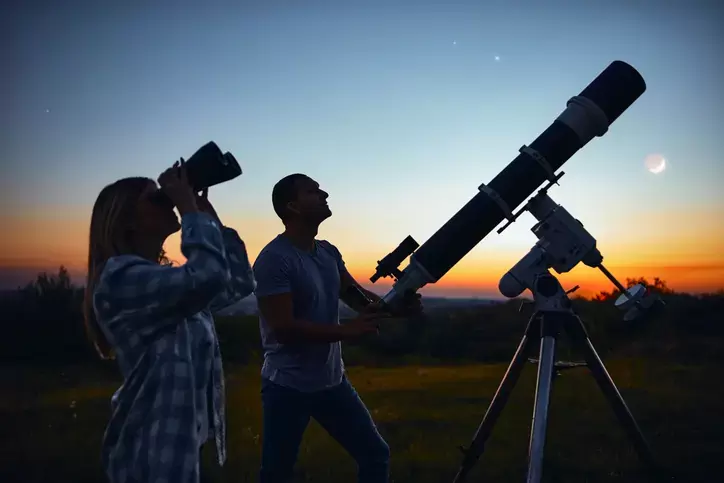
Astronomical observation requires a combination of night optics and telescopes. Night optics in the form of cameras and monoculars can be installed in a telescope. The combination of both technologies allows observers to see more. Merging both night optics with telescopes also allows for taking high-quality night sky photographs, using the material to study space.
Stargazing enthusiasts can use binoculars and night vision goggles. Such equipment has its limitations when observing individual objects but is excellent for viewing the larger tapestry of constellations and even galaxies. Night optics with large zooms allow you to see the moon in great detail, including its craters.
Night Vision: The Perfect Equipment for Night Owls
The modern lifestyle leaves little time to pursue our hobbies during the day. There is too much to do—too many responsibilities with a full-time job.
Thankfully, there are many avenues for pursuing our favorite sports at night. Beyond night hunting, animal watching, and astronomy, many other nocturnal pursuits allow today’s man to explore nature and challenge his limits.
Night vision devices are indispensable for most of these after-dark hobbies, especially outdoors. The desire to explore our natural world has existed as long as we have.
Our primal desires to expand our knowledge and conquer the environment remain with us. We continue to long for challenge and discovery. These devices augment our natural abilities, helping us stay safe, observe our surroundings accurately, and enjoy our night adventures.
—

