


—
There is a familiar type of homeowner who will spend half a Saturday replacing a faucet, fixing a cabinet hinge, or diagnosing a noisy appliance before calling for help. Yet one of the simplest maintenance jobs in the house can still slip by for months: changing the furnace filter.
What happens if you don’t change your furnace filter is not that the furnace instantly fails. The consequences can develop gradually, making the problem easy to overlook until comfort or performance changes.
The Small Job Protecting One of the Most Expensive Systems in Your House
A furnace or HVAC filter captures particles from return air before they can circulate through the home or build up inside HVAC equipment.
As the filter loads with dust, hair, lint, and other debris, it adds resistance to the airflow the blower is trying to move.
ENERGY STAR warns that a dirty filter can slow airflow, increase energy use, and allow dirt to build up in the system, potentially contributing to expensive maintenance or early equipment failure.
For such an inexpensive part, the filter has an outsized role in routine HVAC maintenance.
What Happens When a Dirty Filter Starts Choking the System
Less Air Means More Work
When airflow becomes restricted, the blower still has to move enough air through the system to heat or cool the house. That can mean longer operating times, weaker airflow at the vents, less consistent temperatures, and higher energy use.
In heating mode, severe airflow restriction can cause a furnace to overheat. Modern furnaces use safety controls that can shut the burners down when internal temperatures get too high. Carrier notes that a dirty filter can restrict airflow enough to trip the furnace’s high-limit safety switch.
During cooling, insufficient airflow across the evaporator coil can also contribute to coil freezing. A dirty filter is not the only possible cause, but it is one of the easiest causes for a homeowner to prevent.
The Cheap Problem Starts Getting Expensive
A clogged filter does not guarantee a failed blower motor, damaged heat exchanger, frozen coil, or another major repair. It can, however, create operating conditions that add unnecessary stress to the equipment.
Angi’s 2026 cost guide places heat-exchanger replacement at roughly $1,250 to $3,000, depending on the furnace, labor, and other factors. Actual costs vary by location, equipment, and warranty coverage.
The Five-Minute Fix That Can Help Prevent an Expensive Call
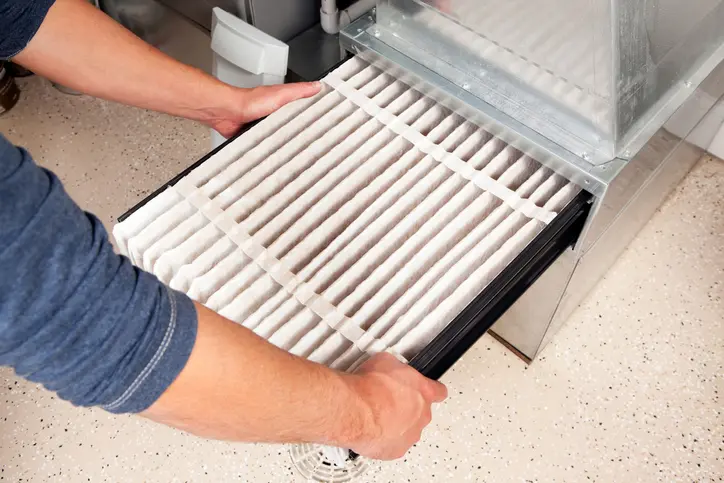
Checking a filter is one of the simplest preventive jobs a homeowner can do. Turn the HVAC system off, find the filter slot or return grille, remove the existing filter, and check the size printed on its frame. If it is visibly loaded with debris, replace it with the correct size and install the new filter with its airflow arrow pointing in the proper direction.
Keeping spare furnace air filter replacements at home makes it easier to replace a dirty filter as soon as you notice it. Choose replacements with the correct dimensions and a filtration level suitable for your HVAC system.
MERV stands for Minimum Efficiency Reporting Value and describes how effectively a filter captures certain particle sizes. When upgrading filtration, EPA recommends at least MERV 13, or the highest rating the system fan and filter slot can accommodate.
How Often Should You Actually Change It?
There is no single furnace filter replacement schedule that fits every home.
ENERGY STAR’s general guidance recommends monthly checks and replacement at least every three months, or sooner if the filter looks dirty. Filter-specific schedules can differ: Carrier recommends replacing 1-inch fiberglass filters every 30 days, 1-inch pleated filters every 30 to 90 days, and 4-inch media filters every six to 12 months. Follow the guidance for your particular filter and system.
Pets, renovation dust, heavy seasonal use, and higher filtration needs can all affect how quickly a filter loads.
Five Signs It’s Time to Check Your Filter
1. The Filter Has Heavy Dust or Debris Buildup
Heavy buildup is a reason to check whether the filter needs replacement.
2. Airflow From the Vents Feels Weaker
Reduced airflow can have several causes, but a clogged filter is one of the easiest places to start checking.
3. The System Runs Differently Than It Used To
Longer run times can indicate that the system is struggling to reach the thermostat setting. In some furnaces, severe restriction can instead contribute to overheating and short cycling.
4. Energy Bills Start Creeping Up
A dirty filter can force the HVAC system to work harder, which may increase heating or cooling energy use.
5. The House Feels Dustier or Less Comfortable
Increased household dust or uneven temperatures can be clues that the HVAC system deserves attention. None of these clogged furnace filter symptoms proves the filter is the only problem, but checking it takes only a minute.
Self-Sufficient Doesn’t Mean Waiting Until Something Breaks
There is a version of self-sufficiency that treats every breakdown as a challenge: open the toolbox, watch a few videos, and keep working until the machine runs again.
A better version starts earlier.
Changing a filter, noticing weak airflow, and scheduling professional service when a safety control or mechanical component is involved are all forms of competence.
That approach also protects the household budget. Preventive maintenance is less dramatic than emergency repair, but that is exactly the point.
Make Filter Checks a Monthly Habit
Set a recurring monthly phone reminder to inspect the filter, and record each installation date on the frame or in your maintenance notes. That gives you a simple record to consult instead of relying on memory.
—

