


—
There is a familiar pattern that does not fit neatly into either a sleep clinic or a mental health clinic.
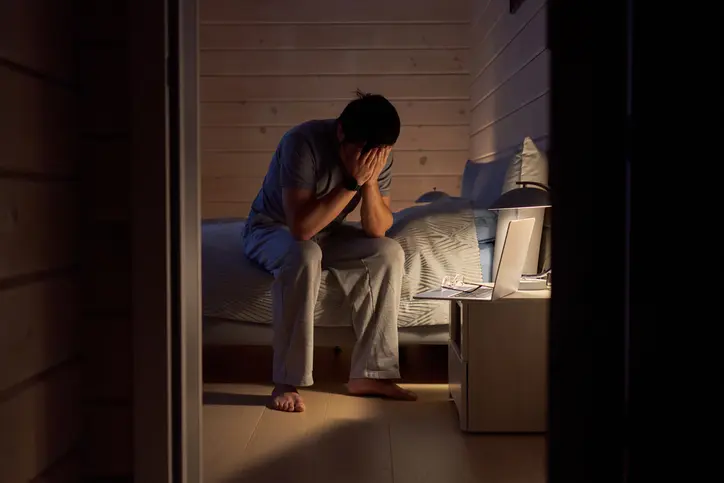
Someone begins sleeping poorly during a stressful period. After a few weeks, they become more irritable and anxious. Concentration becomes harder. They start worrying about whether they will sleep that night, which makes it even harder to fall asleep. Eventually, they may feel low, exhausted, and unlike themselves.
Which problem came first?
Sometimes there is no simple answer.
Sleep and mental health have a genuinely two-way relationship. Depression and anxiety can disturb sleep, but persistent sleep problems can also increase vulnerability to emotional symptoms. A large 2025 longitudinal study of insomnia and depression followed people for five years and found that persistent or worsening insomnia symptoms predicted later clinically significant depressive symptoms. The relationship also ran in the opposite direction, with worsening depressive symptoms predicting subsequent insomnia.
This matters clinically because treating sleep as nothing more than a symptom of poor mental health can leave an important part of the problem untreated.
Sleep Is Not an On-Off Switch for the Brain
Sleep is an active biological process.
Across the night, the brain moves through different stages while systems involved in memory, emotional regulation, metabolism, immune function, and alertness continue working. When sleep is repeatedly shortened, delayed, or fragmented, the effects can become visible during waking hours.
People may notice irritability first. Others describe feeling emotionally fragile, mentally foggy, or unable to handle ordinary stress as well as usual.
A 2026 meta-analysis involving 118 studies examined daily relationships between sleep and mood. Better perceived sleep quality and longer sleep were associated with better emotional states the following day. Mood during the day also showed a smaller relationship with how well people subsequently slept, reinforcing the idea that the connection works in both directions.
Nancy Foldvary-Schaefer, D.O., a neurologist and sleep medicine specialist at Cleveland Clinic, has described the broader effects of chronic poor sleep on brain and mental functioning.
That does not mean every difficult day after poor sleep represents a mental health disorder. It does mean persistent sleep disruption deserves more attention than simply telling someone to get to bed earlier.
Insomnia Can Become Its Own Problem
Insomnia often begins for an understandable reason.
A relationship problem, illness, bereavement, work stress, anxiety, or a depressive episode may initially disrupt sleep. But in some people, insomnia continues even after the original trigger improves.
The bed itself may start becoming associated with wakefulness and frustration. Someone looks at the clock, calculates how little time remains before morning, and becomes increasingly anxious about not sleeping.
Trying harder to sleep can paradoxically make sleep feel more difficult.
David Plante, M.D., Ph.D., a psychiatrist and sleep specialist at the University of Wisconsin School of Medicine and Public Health, has highlighted the importance of treating insomnia rather than assuming it will automatically resolve when depression improves.
Writing about the sleep and depression connection, he described an “opportunity to prevent depressive episodes using evidence-based treatments for insomnia.”
This represents an important shift in thinking.
Historically, insomnia occurring with depression or anxiety was sometimes treated mainly as a secondary symptom. Today, clinicians increasingly recognize that persistent insomnia may need direct treatment alongside the psychiatric condition.
Why Treating Insomnia Can Affect More Than Sleep
One of the best studied treatments is cognitive behavioral therapy for insomnia, usually abbreviated CBT-I.
Despite the name, CBT-I is not simply general counseling about stress. It is a structured treatment that may include stimulus control, carefully managed time in bed, cognitive techniques, sleep scheduling, and strategies aimed at changing behaviors and thoughts that maintain insomnia.
A 2024 systematic review and meta-analysis involving 19 randomized trials and 4,808 participants with major depressive disorder and insomnia found that CBT-I improved both insomnia remission and depression response compared with control conditions. The authors concluded that benefits extended beyond sleep symptoms alone.
More recent evidence also suggests that some improvements may last. A 2026 systematic review and meta-analysis found reductions in depressive symptoms at follow-up periods extending to 12 months after CBT-I, although the size of the effect decreased over time.
Andrew Krystal, M.D., a psychiatrist and sleep specialist at UCSF, has seen skepticism about behavioral insomnia treatment firsthand.
Discussing CBT-I with UCSF, he said that many initially skeptical patients “become the most ardent supporters once they experience it.”
The message is not that treating insomnia replaces treatment for depression or anxiety. Rather, sleep may need to become an active part of the mental health treatment plan.
But Sometimes It Is Not Insomnia at All
This is where sleep medicine becomes especially important.
A person may tell a psychiatrist, primary care doctor, or therapist that they sleep badly and feel exhausted. The natural assumption may be insomnia.
But not everyone who wakes tired has insomnia.
Obstructive sleep apnea can produce many daytime symptoms that overlap with mental health complaints, including fatigue, difficulty concentrating, reduced motivation, irritability, and cognitive fog.
In obstructive sleep apnea, the upper airway repeatedly narrows or closes during sleep. These breathing disturbances can fragment sleep and produce intermittent changes in oxygen levels.
Muhammad Qasim, M.D., a pulmonology and respiratory medicine specialist and Medical and Health Writer at MySleepApneaTeam, emphasizes an important distinction in evaluating these patients: clinicians need to establish whether someone cannot sleep, sleeps but repeatedly wakes, or appears to sleep for enough hours yet remains profoundly unrefreshed.
Those patterns can point toward very different problems.
In someone who reports low energy and poor concentration, asking about loud snoring, choking or gasping, witnessed breathing pauses, morning headaches, dry mouth, and excessive daytime sleepiness may reveal clues that would not emerge from a mental health history alone.
Sleep Apnea and Depression Can Overlap Without Being the Same Disease
The relationship between obstructive sleep apnea and mental health is complex.
A 2026 systematic review and meta-analysis found substantial comorbidity between OSA and mood disorders, particularly major depressive disorder, although there was considerable variation among the included studies.
Another systematic review and dose-response meta-analysis reported that more severe OSA was associated with greater depression risk. Because much of that evidence came from observational studies, however, it cannot establish that sleep apnea directly causes depression in every patient.
Several explanations may contribute to the overlap.
Fragmented sleep can affect mood and daytime functioning. Intermittent oxygen changes and physiological stress may also play roles. At the same time, OSA and depression share potential contributing factors, including obesity, cardiovascular disease, chronic illness, medication use, and reduced physical activity.
There is another practical problem: the symptoms can resemble one another.
A patient with OSA may report fatigue, poor concentration, memory difficulty, and reduced interest in activities. A patient with depression may report many of the same things.
Dr. Qasim’s respiratory perspective is particularly relevant here. Screening should not become an either-or decision between mental health and sleep apnea. Both may be present, and identifying one should not prevent clinicians from considering the other when the symptom pattern supports it.
Anxiety Has Its Own Nighttime Pattern
Anxiety can affect sleep differently.
Some people cannot switch off their thoughts. Others fall asleep but wake during the night and immediately begin worrying. Physical symptoms such as muscle tension, palpitations, or a sense of heightened alertness can make the bedroom feel less like a place of rest.
The relationship can again become self-reinforcing.
A 2024 longitudinal study examining sleep disturbance and anxiety found evidence of a bidirectional relationship, with sleep disturbance appearing to be the stronger predictor of later anxiety in the population studied.
This does not mean improving sleep alone will treat every anxiety disorder.
But persistent insomnia should not automatically be considered irrelevant once anxiety has been diagnosed.
The Clock Matters Too
Mental health is influenced not only by how long someone sleeps but also by when and how consistently they sleep.
A person who sleeps seven hours one night, five the next, and nine the following night may have a very different sleep pattern from someone who consistently sleeps seven hours at roughly the same time.
A large 2025 prospective study of sleep regularity found that more regular sleepers had lower subsequent risks of diagnosed depression and anxiety than people with highly irregular sleep schedules. Importantly, irregularity was associated with risk even among people whose overall sleep duration fell within recommended ranges.
A separate 2025 systematic review similarly found consistent evidence connecting irregular sleep timing with higher depressive and anxiety symptoms.
These studies show association rather than proving that irregular schedules directly cause mental illness. Still, they broaden the clinical conversation beyond the simple question, “How many hours do you sleep?”
Three Questions Can Change the Conversation
When sleep and mental health symptoms occur together, three questions are particularly useful.
1. Is the person getting enough opportunity to sleep?
Someone working night shifts, caring for a baby, or routinely staying awake until 2 a.m. may be chronically sleep deprived without having a primary sleep disorder.
2. Is there enough opportunity to sleep, but sleep will not come?
That pattern may suggest insomnia, particularly when difficulty falling asleep, staying asleep, or returning to sleep persists and affects daytime functioning.
3. Is the person apparently sleeping, but still waking exhausted?
That raises a different set of possibilities, including obstructive sleep apnea, restless legs syndrome, circadian disorders, medication effects, hypersomnolence disorders, or other medical conditions.
These questions do not establish a diagnosis, but they can prevent very different sleep problems from being grouped together under the vague label of “poor sleep.”
Nancy Foldvary-Schaefer offers a useful threshold for taking ongoing sleep problems seriously. In her Cleveland Clinic interview, she explained that when trouble sleeping progresses “into a few weeks and then a few months, it’s time to talk to your doctor.”
Mental Health Treatment Should Not Stop at the Bedroom Door
Sleep and mental health are intertwined, but neither should be used to explain away the other.
A person with depression may need treatment for depression and treatment for persistent insomnia. Someone with anxiety may benefit from addressing both anxious symptoms and the behavioral cycle that keeps insomnia going. A patient who appears depressed because of exhaustion and cognitive fog may also need evaluation for sleep apnea.
Sometimes all of these issues coexist.
That is why the most useful approach is often not to ask whether a problem is “mental health” or “sleep.”
A better question is how the two are interacting in this particular person.
For Dr. Qasim, that means paying attention to the quality of nighttime breathing as well as the number of hours spent in bed. For psychiatry and behavioral sleep specialists, it means recognizing insomnia as a condition that may deserve treatment in its own right.
The emerging evidence increasingly points in the same direction: sleep is not simply what happens after the day’s mental and emotional work is finished.
It is part of mental health itself.
—

