


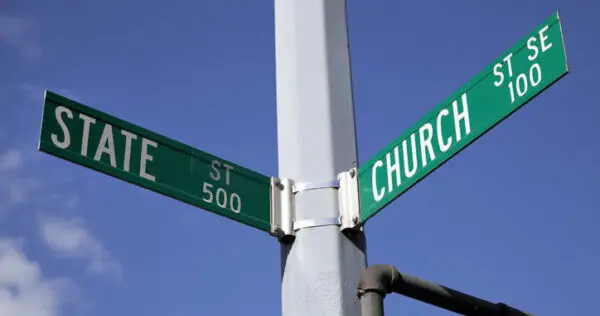
This past August, my wife and I attended the Brandi Carlile concert at Tanglewood, the famous outdoor venue in the Berkshire Mountains. It was an outstanding musical and storytelling event that solidified our status as true fans. No, I do not have a shoulder tattoo testifying to my newfound devotion to the poet-songwriter. Among the songs performed was a new one titled “Church and State.” She recently performed it live on TV. Lest you think the song is anti-religion or anti-faith, I’d note that Brandi was quite clear about her personal beliefs in God in many interviews.

In the middle of the song, Carlile quotes, with poetic variation, from Thomas Jefferson’s 1802 letter to the Danbury Baptists on Church & State, which later became part of the First Amendment to the US Constitution.
I contemplate with sovereign reverence that act
Of the whole American people, which declared that
Their legislature should make no law
Respecting an establishment of religion
Or prohibiting the free exercise thereof
Thus building a wall of separation
Between Church and State
Americans routinely conflate two distinct ideas. “Church and state” refers to institutions: government and organized religion. “Faith and politics” refers to people: how conscience, values, and spirituality shape the actions of citizens and leaders in public life. We should keep the first firmly separate. We should not—and could not, even if we tried—separate the second.
Rhode Islanders can fairly claim a central role in the separation of church and state. Roger Williams, banished from the Massachusetts Bay Colony in 1635 for his preaching, made his way south and founded Providence the following year as a refuge for those whose consciences put them at odds with the authorities. The colony became a haven for Baptists, Quakers, Jews, and others unwelcome elsewhere. Just last night, I walked past Touro Synagogue in Newport, the oldest synagogue building still standing in the United States. In 1790, George Washington wrote to its congregation, promising a government that gives “to bigotry no sanction, to persecution no assistance.”
Williams gave us the image of a wall long before Jefferson did. In 1644, he wrote of a “hedge or wall of separation between the garden of the church and the wilderness of the world.” Williams was not worried that religion would contaminate government. He was worried that the government would trample on the garden. The wall was meant to protect the church from the state, not the other way around. That’s the original concern; today, we face a different problem.

Lutherans, too, have a long history with this distinction. Martin Luther taught that God governs the world with two hands: through the Gospel, God forms faith and forgives sin in the life of the church; through law and reason, God works in civil government to restrain evil and order the common good. Both are God’s work, but they are not the same, and confusing them harms both. James Madison later credited Luther’s doctrine of the two kingdoms with paving the way for the modern idea of separating church and state.
My own denomination, the (ELCA) Lutheran Church, returned to this question in 2025 with a new social statement, Faith and Civic Life: Seeking the Well-being of All. The church maintains “institutional separation of church and state in a relation of functional interaction.” In other words, the institutions remain separate, but engagement between them should continue.
The US Constitution of 1787 mentions religion only once, in Article VI: “no religious Test shall ever be required as a Qualification to any Office or public Trust under the United States.” That was a radical choice at a time when nearly every state had religious qualifications for public office. Four years later, the First Amendment added two clauses that work as a pair. The Establishment Clause says the government may not establish or favor a religion. The Free Exercise Clause says the government may not prohibit the practice of religion. One protects citizens from a state religion. The other protects religion from the state.
The famous wall idea came in 1802, when President Jefferson wrote to the Baptists of Danbury, Connecticut, a religious minority in a state that still used tax money to support the Congregational church. Quoting the First Amendment, he described it as “building a wall of separation between Church & State.” Those are the words Brandi Carlile sings at Tanglewood. Connecticut did not end its established church until 1818.
This means the government neither funds worship, compels prayer, imposes religious tests, nor declares an official faith. At the same time, churches do not wield state power or serve as arms of a political party. Legal scholars might debate my summation, and I welcome feedback, but I think I’m pretty much on target.
But how do one’s faith, beliefs, values, or ethics shape the way one votes or lives as a citizen? Can faith and values inform our political activity? James Talarico, a Texas state legislator and seminarian now running for the U.S. Senate, has offered an emphatic yes
No one steps into the voting booth without a set of beliefs. As Talarico says, “We all bring our moralities, our philosophies, our ethics, our worldviews to our politics, and faith is no different.” Atheists, Buddhists, Jews, Muslims, and Christians all bring moral frameworks into public life. The real question is which values they bring—and how.
We’ve had this discussion before in our nation’s history. Martin Luther King Jr. wrote that the church should be “not the master or the servant of the state, but rather the conscience of the state.” In 2006, Barack Obama told a gathering of religious progressives that “secularists are wrong when they ask believers to leave their religion at the door before entering into the public square.” This sentiment has not been confined to progressive thinkers. The conservative Lutheran-turned-Roman Catholic writer Richard John Neuhaus warned in The Naked Public Square that removing religion from public discourse doesn’t create neutral ground; it leaves a vacuum for something else to fill.
Neuhaus, though I’m not always a fan of his writings, was prescient on this matter. In my view, what is filling the void is a lack of values, ethics, and moral discernment. The void is filled with hyper-individualism and consumerist perspective. In short, the void is filled with a me-first, me-only, entitled-to-what-I-want ideology.
Faith in public life, for better and worse
American history is full of faith shaping politics. Abolitionists preached against slavery from their pulpits. Women’s suffrage drew deeply on religious reformers. The civil rights movement was organized in Black churches and expressed in the language of Exodus. When Rabbi Abraham Joshua Heschel marched at Selma, he said he felt his legs were praying.
But the other side of the story is also true. Scripture was quoted to defend slavery, justify segregation, and displace Native peoples from their land. Faith in politics is not inherently good.
If faith and ethics are going to inform our politics properly, then we need a few principles.
- The first principle is persuasion, not coercion. People of faith may make their case in the public square, but they should not use state power to impose it.
- The second is humility. People of faith, any faith, should be cautious in suggesting they no best. Arrogance is not what we need, no matter who it comes from. A faith worth having will sometimes judge my own party as sharply as it judges the other.
- The third is pluralism. “We the people” includes all of us.
Conclusion
I believe our political views and civic participation should stem from our faith and ethics, not the other way around. Christian nationalism reverses that order, bending faith to serve a political identity and agenda. As in much of life, there are no easy answers, no sound bites or clickbait. The matter of faith and politics demands challenging conversations and thoughtful debate. We will get better results if we take a more discerning approach.
On that warm August evening at Tanglewood, I saw thousands of people on a lawn in the Berkshires, believers, skeptics, and seekers, cheering Carlile as she sang Jefferson’s words. Everyone there brought something of what they believed and loved. Not a bad image of the public square.
—
Previously Published on substack and is republished on Medium.
—
Photo credit: iStock

