



Two Jeremy Mann oil paintings hang on the wall beside the bookcase in my little writing studio.
They are dark, almost monochromatic figure studies, loosely expressed in Jeremy’s unique, masterful originality. A few years back, I spent an entire day driving from Las Vegas to an art gallery in Santa Fe, New Mexico, to attend Jeremy’s one-man show.
I was not disappointed.
The entire gallery was filled with his cityscapes, figure paintings, en plein air studies, and monochromatic photographs from homemade cameras. Jeremy mingled amongst the patrons, a homemade cigar box camera slung over his shoulder, as he graciously answered questions and tolerated photos with shameless groupies.
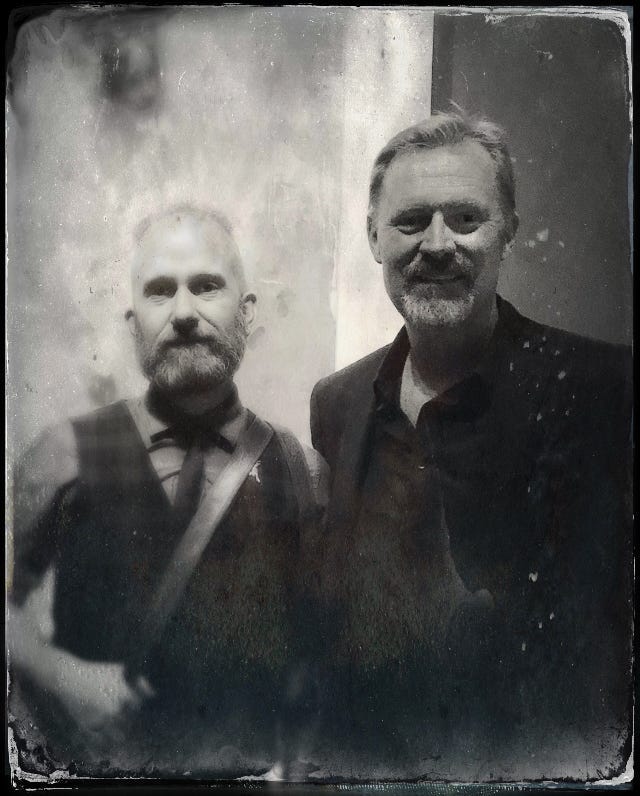
I discovered Jeremy’s artwork years ago, at a time when I grew weary of the uninspired and imitative landscape paintings I was producing.
I used to flip through art magazines, noting how similar and derivative everyone’s work appeared. Occasionally, there would be outrageous or insanely garish pieces, but they seemed desperate cries for attention, relying on novelty more than innovative depth and skill.
Then I turned a page and landed on a profile about the painter Jeremy Mann. I never heard of him, but his work felt exciting and fresh. Exactly the kind of inspiration I longed for.
Jeremy’s muted tones, semi-abstract cityscapes, and evocative figure studies all spoke to me, declaring, “See, this is what’s possible when you dig deep and release the utter truth of your creative vision.”
I bought the magazine, returned home, and began researching Jeremy Mann online. I found his website, signed up for his newsletter, and bought all his books. I learned about his unorthodox methods, like staining canvas surfaces, wiping away paint with solvents, and applying broad marks with ink brayers, windshield wipers, and other strange tools.
Most importantly, I began reading his philosophy about creating art.
A lot of artists and creatives spend too much time worrying about the tools of their trade, rather than plumbing the art inside themselves waiting to be expressed. We buy the same paint brushes that our heroes use, or we photograph with a Leica camera because that’s what Henri Cartier-Bresson favored. We fail to realize that it’s not about the tools, it’s about what’s inside us.
In an interview, Jeremy Mann shared the following insights:
It’s not what’s in your hands, it’s what’s in your head. These damn tools in our clumsy mitts are actually the hindrance to creating a great painting, so the only way to get around that hurdle is to spend the time, energy, expertise and intelligence to figure that tool out, find all the marks it can possibly make that I enjoy, and then I will be able to express directly what’s in my head. But then, having realized that is the solution, I spin slowly around my studio, my brow furrowed again (the way it does just before a discovery) … ‘I can use anything, then…’ Yes! And I’ve since moved far beyond these days, using 4-foot rollers, door jambs, windshield wipers, bottles, liquids, spit, whatever! And therein lies the foundational theories of style and uniqueness in artistry. It doesn’t matter what you use, it’s what you know and how you use those tools which sing their notes to your soul alone, with which to make your unique mark on the world.
The more I studied Jeremy’s work and read his views about creating art, a profound epiphany manifested in my consciousness. The epiphany was about honesty, authenticity, and making something real.
Something that comes from the deepest regions of your artistic soul.
Not something that the gallery suggests you do, or that your editor thinks will sell best, or that you think your audience wants to see.
Your best work springs from honesty and truth. From that unique voice, only you possess, deep within, longing to sing to the world.
Just the other day I received Jeremy’s latest email newsletter. In it, he tells the story of a student in one of his workshops. The student is convinced that he’s destined to be a portrait painter.
But Jeremy convinced the student to base his final workshop painting on an iPhone photo the student took of a goat “in a night field with eyes ablaze.”
Why?
Because, when asked why he took the photo, the student said, “I don’t know, I saw this yesterday…just liked it…but it’s stupid…no? It’s silly…no?”
And guess what?
The student’s goat painting, his final workshop painting, was the “best piece ever,” according to Jeremy. Many in the workshop agreed.
Something about that goat in a field at night, with blazing eyes in the moonlight, spoke to the student. So much so that he took an iPhone photo of it. And Jeremy recognized this. He knew that the student was not a portrait painter. Something deeper and truer and more real needed to get out. Needed expression.
Your best work springs from honesty and truth.
Not from what you think others want you to be or produce. The art you’re meant to create will only sing if it’s authentic.
Recognize this in yourself.
Just write something honest
In the motion picture The Whale, actor Brendan Fraser plays Charlie, a reclusive English teacher suffering from severe obesity.
Charlie is a recluse who lives in a cluttered, dark apartment where he teaches an online writing class. He tells his students that his laptop camera is broken when really he taped over the camera to hide his obesity.
In the film, Charlie tries to reconnect with his estranged teenage daughter, hoping for redemption. But he’s also slowly eating himself to death.
The Whale began as a play written by Samuel D. Hunter, who used to teach a course in essay writing at a public university in New Jersey to dozens of disaffected college freshmen.
In an essay for the Los Angeles Times, Hunter wrote:
I was teaching a kind of writing that felt anathema to my work as a playwright — I was asking students to depersonalize their writing, to stamp out any trace of emotion or personality in service of cold, hard objectivity.
Deep into the semester, Hunter became impatient with the work he assigned his students. He loathed the shallow analyses his students wrote about authors like Malcolm Gladwell. He pleaded with his students, not unlike Charlie does in The Whale:
Just write something honest. Don’t worry about making it a good essay. Just tell me what you truly think. Let’s start there.
Sometimes teachers get bogged down in analysis, comparison, details, and rules at the expense of the underlying humanity and soul of their craft. They overlook the most important thing, which is the truthfulness of the work.
In the movie The Whale, Charlie implores his students to just write something honest. In the following clip from Speakeasy Stage Company, the actor playing Charlie goes into a bit more detail.
“Forget everything you know about what makes a good essay and just write,” Charlie says in the play. “Just write. Just sit down and write me something. Just give me something honest.”
This is what all creatives need to do.
Yes, there’s a time for study, analysis, comparison, rules, and the like. But then we need to get out of our own way. We need to find the thing inside of us that yearns for release.
And what, exactly, is the thing inside us?
For the late poet, novelist, and short story writer Charles Bukowski, the thing inside him was a bluebird.
I only let him out at night sometimes
Charles Bukowski was mercilessly beaten by his father.
He suffered from severe acne, was shy and socially withdrawn, and was often bullied as a boy due to his slight build. He took classes in writing and journalism at Los Angeles City College but eventually dropped out. He moved to New York to become a writer but found only rejection slips and hardship.
Bukowski gave up on writing and spent ten years as an alcoholic, living with prostitutes and in flop houses.
He nearly died.
Then, at age 35, he began writing again and publishing in small, underground newspapers and literary presses. His writing slowly took off, largely through word of mouth. He developed a following as a sort of down-and-out, people’s poet. According to Poetry Foundation, Bukowski described his readers as, “the defeated, the demented and the damned.”
Bukowski was a prolific writer, producing over forty books of poetry, prose, and novels.
His subjects were often about drinking, women, gambling, and those forgotten on the margins of society. He observed and wrote about the harsh realities of the world, and the beaten down souls who inhabit it. He once wrote: “There is a loneliness in this world so great that you can see it in the slow movements of the hands of a clock.”
And yet, Bukowski was utterly honest and at times deeply poignant in his work.
Consider the following Bukowski poem (or even better, listen to it here, read exquisitely by Tom O’Bedlam).
Bluebird
there’s a bluebird in my heart that
wants to get out
but I’m too tough for him,
I say, stay in there, I’m not going
to let anybody see
you.
there’s a bluebird in my heart that
wants to get out
but I pour whiskey on him and inhale
cigarette smoke
and the whores and the bartenders
and the grocery clerks
never know that
he’s
in there.
there’s a bluebird in my heart that
wants to get out
but I’m too tough for him,
I say,
stay down, do you want to mess
me up?
you want to screw up the
works?
you want to blow my book sales in
Europe?
there’s a bluebird in my heart that
wants to get out
but I’m too clever, I only let him out
at night sometimes
when everybody’s asleep.
I say, I know that you’re there,
so don’t be
sad.
then I put him back,
but he’s singing a little
in there, I haven’t quite let him
die
and we sleep together like
that
with our
secret pact
and it’s nice enough to
make a man
weep, but I don’t
weep, do
you?
Everyone has a bluebird in their heart.
The bluebird represents the essence of our creative spirit. Our emotional and artistic expression. But we fear vulnerability, which might bring judgment and mockery.
So we compromise.
Late at night, or maybe early in the morning before work, we scribble out a bit of our vulnerability in personal journals, diaries, and obscure little blogs. After sunset, before bed, we let the bluebird out to sing for a while. Or maybe in the morning, before the sun comes up and exposes our creative yearnings and hopes.
For some, it goes on like this for years. A lifetime even.
Resignation, control, safety, and self-protection cage our self-expression. Our bluebird. Until one day, if we don’t come to our senses, the little bluebird inside us dies. And when that happens, it’s only a matter of time before we die, too.
This is why I bought the Jeremy Mann paintings that hang in my little writing studio.
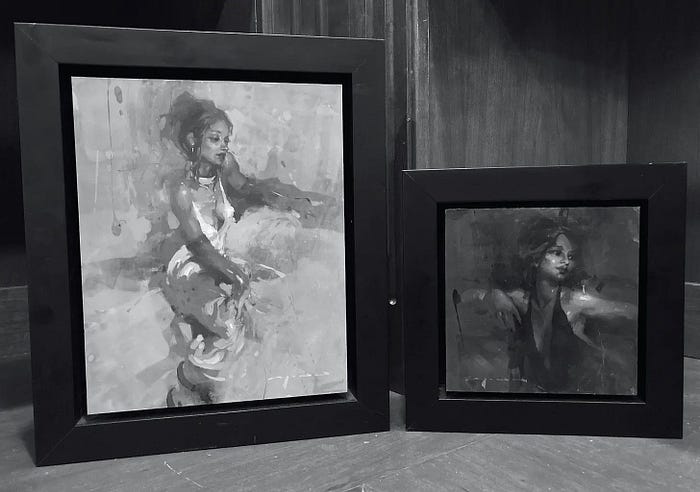
Because Jeremy’s paintings are honest and true. They remind me to not pour whiskey on my bluebird. To stop hiding him. To embrace my creative spirit, and uncage my artistic expression. To let my bluebird sing and be free. They remind me that our best work springs from honesty and truth.
Embrace the thing that is truly you.
Your bluebird.
Feed it. Nurture it. Protect it. Develop it. Love it. And then, when you’re ready and brave enough, open the cage door and set it free.
There’s nothing more lovely than the song of a bluebird set free.
Before you go
—
This post was previously published on Medium.com.
—
The Good Men Project is a mission-driven men’s media platform. A major platform for stories about men, identity, fatherhood, and emotional intelligence—and a trusted home for the national conversation about masculinity.
The Good Men Project accepts paid guest posts and provides bulk guest post packages for SEO agencies and resellers.

If you believe in the work we are doing here at The Good Men Project, please join us as a Premium Member today.
All Premium Members get to view The Good Men Project with NO ADS.
Need more info? A complete list of benefits is here.
Photo credit: Conner Weiss

