


We needed our own heroes like we needed bread to eat.
— Jose Eduardo Agualusa in “The Book of Chameleons”
The struggle between history and memory takes place in books and on battlefields; in canons and in cannons. The Book of Chameleons shows how it isn’t just a state and academic matter, but one of everyday people; bringing it down to the personal, mundane, and clandestine.
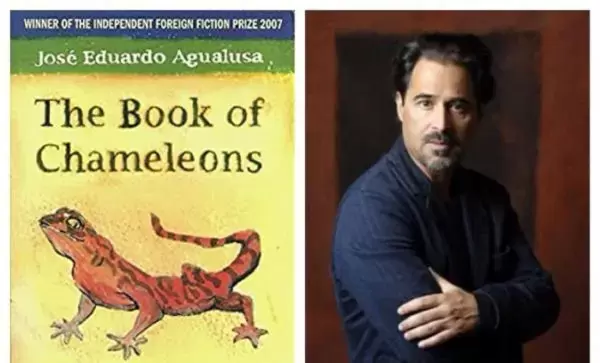
Set in Luanda, Angola, The Book of Chameleons follows Felix Ventura, an albino Angolan who sells pasts — creates documents, finds newspaper articles, draws up birth certificates, photos, anything the customer needs to be immersed in them in their new personal history. His calling card is “Felix Ventura. Guarantee your children a better past.” The book is narrated by a crawling denizen of the house, a tiger gecko that Felix names Eulalio.
One day a foreigner comes to Felix’s house to solicit his services. The foreigner is a photojournalist who takes photos of “war, of hunger and its ghosts, of natural disasters and terrible misfortunes.” Initially, Felix is reluctant to take him as a client because the stranger wants an African genealogy, which Felix considers to be a peculiar request. The foreigner is a tall man with a “small bright eyes, hooked nose, prominent cheekbones” and a curved mustache, “the kind people haven’t had these past hundred years.” The stranger doesn’t accept Felix’s rejection and leaves him five thousand dollars to start. Felix reconsiders and gives the stranger a new identity as Jose Buchmann.
Felix also meets and falls in love with a woman Ângela Lúcia. Ângela is described as having braids, and tanned skin with “a fresh pomegranate glow.” She’s a photographer who spent her childhood drawing rainbows and writing poetry. Excited about his new past and ignoring Felix’s warning to not look into it, Jose Buchmann searches for his mother, and this search unravels the true history of everyone involved.
The novel deals with historical record as a type of memory. Our memory can be a more vivid and accurate depiction of historical events, eras, kingdoms, and governments, but they can also fail us — romanticizing mistruths, and versions of the past through the prism of perspective.
Eulalio has dreams where he is a human, Felix warns the stranger José Buchmann not find his new mother, Buchmann’s fantasy is shattered both when he meets Ângela and remembers the true identity of a vagabond he’s been following and photographing.
On a larger scale, The Book of Chameleons deals with how former colonial subjects wrestle with creating post-colonial identity. The history of Angola is mired in both beauty and blood. It is a fertile and vibrant landscaped littered with landmines, vestiges of civil war lasting from 1975 to 2002 (this coming after 13 years of anti-colonial and struggle from independence). Post-colonization and independence sparks the search for and forging of “new” futures by reclaiming and recreating their indigenous African pasts.
In a 2007 interview with Words Without Borders, Agualusa was asked if a “made-up past” can come to define somebody’s future, and if this idea applies to nations as well. He replied:
Yes, no doubt about it: by making up a past you’re able to alter your future. That’s why the idea is so attractive. The final objective is to modify everything…There are a lot of books that explain how some so-called “traditions” were made up in a matter of days. In newer countries like Angola the temptation to create national heroes and traditions is very strong and answers a collective need It’s been done before and it’s being done again now.
Memory is a text itself, which can inform, color, reflect, transform, fabricate, mutate, define and re-define identities. It can convince and betray us. We are liberated and oppressed by the memories others have of themselves and each other. Felix does an interesting alchemy of all these things.
But unlike the new pasts Felix crafts, our history is “lovely or terrible, and it will be there forever.” We can change our past like a chameleon changes its colors, but the static fact is we are still the same lizard.
The Book of Chameleons is a phenomenal read that I highly recommend.
—
Previously Published on Medium

