


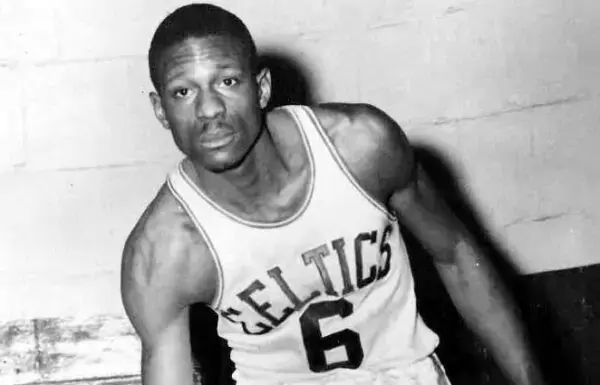
The debate over the greatest basketball player of all time usually involves comparing statistics and championships and looking at highlight reels. For many fans, the default answer has become Michael Jordan because modern sports culture worships individual dominance. Jordan, in fact, became more than an athlete, he became a global brand, a symbol of competitive excellence, a corporate myth. Yet if the question is expanded beyond scoring titles and shoe sales, if greatness includes leadership, humanity, courage, conviction and what a player contributed to society, then Bill Russell emerges as the far greater figure.
The difference between Russell and Jordan reflects two fundamentally different assessments of “greatness.” Jordan embodied fear, intimidation, extreme pressure on his own teammates and ruthless individual supremacy toward his own goals (framed as collective goals). Russell represented collective success, loyalty and moral courage. One guy broke teammates down to harden them and push them toward his goal, while the other elevated teammates so everyone could rise together. One cultivated a mythology around himself, while the other often sacrificed personal glory for team success and social principles.
On the court, Jordan’s accomplishments are extraordinary. Six NBA championships, six finals MVPs, five regular-season MVPs, ten scoring titles. He dominated basketball both aesthetically and psychologically and he often scored with a combination of violence and grace at the same time. Yet, Jordan often created a locker-room culture characterized by intense pressure, criticism and fear of failing to meet his standards.
Stories about Jordan humbling teammates have become central to his legend – and people smile, shake their heads approvingly and chuckle. He insulted weaker players, punched a teammate in practice and lead through intimidation. Accounts from his teammates describe a player who was extremely demanding in practice and often openly critical when his standards weren’t met. He pushed teammates hard and created an environment where performance was constantly being tested against his expectations toward his goal. A team championship became his individual goal, which he pursued with his supporting cast.
This is the big difference between Russell and Jordan. Jordan pushed everyone hard because championships were his personal goal. Russell worked collaboratively with his teammates because he knew he was part of a team. He was the center of a basketball team working with men for whom he had respect, not men he wanted to push for personal satisfaction.
Modern culture often romanticizes Jordan’s behavior as a “killer instinct.” The mythology surrounding Jordan depends heavily on the belief that it’s OK if fear creates excellence. This approach, frankly, does not help the world, in fact, it pours gasoline onto the world’s problems. He is the sports hero of a dying planet, a planet consumed by greed and aggression and a winner take all attitude. If they ever did a remake of the 1970s sci fi film Roller Ball, I’m tempted to say that the character of Jonathan could be rewritten to reflect more of a Jordan approach to sports and not a Russell approach. Current sports fans seem readily willing to celebrate competitive values and attitudes that are consuming their planet.
Jordan shot 49.7% from the field, but what really defines him is how many shots he took. He averaged 22.9 field‑goal attempts per game, which is one of the highest shooting rates in NBA history. We can’t compare Russell to Jordan offensively, because Russell helped his team win through defense. Russell’s statistical brilliance begins with rebounding, where he stands alone in league history. Averaging 22.5 rebounds per game across his career and showing a capacity to ignite transition defined Boston’s entire identity at that time. He posted multiple 50‑rebound nights.
Russell’s leadership style produced collective overachievement as teammates consistently played above their individual talent levels, and he even won two titles as a player‑coach, demonstrating rare strategic and interpersonal command. Against Wilt Chamberlain, the most statistically overwhelming scorer ever, Russell’s teams consistently won. In fact, he won seven of eight playoff series against Chamberlain, proving his impact translated directly into winning against the best.
So this raises a larger question: of what value is greatness if it intimidates and uses the people around it? His leadership style resembled corporate authoritarianism: results justified any possible emotional damage. Jordan demanded loyalty from teammates while offering relatively little emotional security in return. Even in retirement, many stories about Jordan center not on warmth or mentorship but on domination, fear and control.
Russell’s philosophy was almost completely the opposite. Russell understood basketball as a collective art form. He cared less about individual statistics than about whether the team functioned as a unified organism. He transformed defense from a reactive activity into an act of intelligence and generosity. Rather than chasing blocks into the crowd for personal glory, Russell redirected shots to teammates so the fast break could begin. His genius was fundamentally collaborative. Basically, Russell took the personal ethics of a good and socially conscientious man and translated them onto the basketball court.
This mentality shaped the Boston Celtics dynasty of the 1950s and 1960s. Russell won eleven championships in thirteen seasons, an accomplishment so absurdly amazing that modern sports culture struggles to process it.
More importantly, he won without centering himself as the heroic star. Russell believed teammates needed confidence and dignity so he was aware of their emotional needs. Some players needed encouragement, others needed responsibility, others needed to be left alone. Russell adapted himself to them rather than forcing everyone to orbit his ego. While Jordan often seemed to view teammates as extensions of his will, Russell viewed them as human beings whose trust had to be earned.
This distinction becomes even more meaningful when placed against the racial realities Russell endured. Russell played in a deeply racist America and he was not merely facing hostile crowds in opposing arenas – he faced hatred in his own city of Boston.
Boston fans celebrated him on the basketball court but off the court was a different situation as, at that time, they often denied him basic human respect. His home was vandalized, racists broke into his house and destroyed property and even defecated in his bed. He received death threats and constant abuse.
Despite bringing unprecedented success to Boston, Russell frequently felt alienated from the city he represented. In 1969, he suddenly retired from the Celtics and was estranged from the organization for years. He once described the Boston of that time as a “flea-market of racism” and in his autobiography Second Wind, he wrote about the racism even permeating the city government of that time.
Unlike many athletes pressured to entertain quietly while ignoring injustice, Russell openly aligned himself with the Civil Rights Movement. He supported Muhammad Ali when Ali was condemned for refusing military induction during the Vietnam War and he marched alongside Dr. King and other activists and spoke publicly about racism even when it damaged his popularity. Russell understood that fame without moral courage was not worth pursuing.
Jordan chose to be overtly apolitical. Perhaps the most famous sentence associated with Jordan’s political and social philosophy came in 1990 when he reportedly said, “Republicans buy sneakers too.” He had chosen not to support a Black Democratic candidate in North Carolina running against Jesse Helms. The statement captured a broader truth about Jordan’s public identity, he avoided controversial political engagement because controversy threatened universal marketability.
Jordan became the ideal corporate athlete precisely because he was politically nonthreatening, companies could sell him everywhere and to everyone. He represented aspiration stripped of social conscience. His image transcended race partly because he rarely forced white America to confront uncomfortable racial realities. In commercial terms, this strategy was brilliant as Jordan became one of the wealthiest athletes in history and transformed the business of sports endorsements forever. Yet, there is a moral difference between being universally admired and being morally courageous.
Russell understood that taking principled stands could cost him money, approval and emotional peace. Jordan often appeared to maximize acceptance across every demographic simultaneously while Russell risked popularity to preserve his integrity. Jordan preserved popularity by minimizing political risk.
When examining the entire picture, Russell’s version of greatness feels deeper and more complete. Jordan mastered domination, while Russell mastered leadership. Jordan became the ultimate predatory capitalist sports icon: global, profitable, untouchable, endlessly marketable. Russell became something rarer: a champion who treated sports as also connected to ethics, community and human dignity. Jordan made basketball into a spectacle while Russell made basketball into a type of citizenship.
Well after his playing career, Michael Jordan did show public engagement with social issues. In 2016, amid heightened national tensions around policing and racial conflict, he issued a public statement addressing police/community relations, and provided $2 million in donations to organizations working on community/police relations and groups involved in legal advocacy efforts.
Later, in 2020 after the killing of George Floyd, Jordan and the Charlotte Hornets publicly expressed support for racial equality and social justice initiatives, and Jordan announced further funding commitments through his business and philanthropic channels aimed at advancing racial equity. Jordan and the Hornets have supported voter access and civic engagement initiatives in recent years, reflecting a more consistent willingness in his post-playing life to engage with political and social issues compared with his playing career.
One could, of course, argue that these later expressions of social awareness were, in part, shaped by external pressure. In 2016 and 2020, the level of public attention around police violence, racial injustice and athlete activism created a climate in which silence from prominent figures like Michael Jordan would be widely criticized. The world had begun to change and Jordan had to change too.
In that sense, his public statements and actions can be read as responses to heightened expectations placed on elite cultural figures to take visible positions during moments of national crisis. Bill Russell acted with public defiance against racism during a time when he would largely be criticized and even attacked for doing so.
In any case, Jordan demanded allegiance upward toward himself and his personal mission of victory. Russell gave loyalty downward and outward to teammates, often protecting their confidence and public dignity. Jordan’s leadership frequently revolved around pressure while Russell’s revolved around respect, support and trust.
Modern culture tends to prefer Jordan because modern culture worships individual supremacy. Jordan’s style fits America’s mythology of hyper-competitive capitalism: crush weakness, dominate rivals, win at all costs, become the brand and who cares what the world looks like as long as I am doing well. Russell represents a less glamorous but much more humane vision. He believed greatness meant lifting others while enduring suffering without surrendering self-respect. His greatness was not merely athletic but civic.
If the GOAT debate is reduced to aesthetics, numbers, branding, scoring and global fame, Jordan wins. He remains the most iconic basketball player ever – because that was his goal and he pushed people to help him get it. But what profits a person if he gains the whole world but loses something human in the process. If greatness includes moral courage, humane treatment of others, leadership philosophy, sacrifice and contribution beyond the basketball court, the argument shifts dramatically and Bill Russell’s legacy stands higher.
—

