


The first “theory” about diversity that I remember learning in school was in 9th grade. Until recently, I didn’t know it was a very whitewashed version, though I’m not shocked.
I remember standing in the hall outside my French class talking to a classmate. Because our freshman health teachers were planning to use some newer, progressive sex ed info, some parents were pissed. It was the first time they’d be teaching the controversial “Rainbow Curriculum” in our school, which this kid supposed was pretty rad.
For both the bougie public high school and broods of suburban teens, The Rainbow Curriculum was edgy. Where I grew up, most adults were fiscally conservative, i.e. privileged Brads, Chads, and Karens.
My education was quite solid, thanks to astronomically high property taxes, upper-middle class parents with advanced degrees, and a large population of reform Jews. No doubt our religious “diversity” helped this edgy concept eek through.
After digging into its origins 30 years later, I learned of the “‘explosive’ arguments and drama in New York City schools over these new lessons.” (New York Times, 1992) As the Schuyler Sisters sang in Hamilton, “History [was] happening in Manhattan. And we just happen[ed] to be in the greatest city in the world”… Except my school was in a small hamlet 55 minutes north by MTA train.
The “rainbow spectrum” that I learned about (everyone falls on a continuum from straight to gay) was not even the original rainbow. Either my memory sucks* or they whitewashed the whole thing and my mostly white friends and I were never taught the bias or racism parts. *Note: my long term memory is pretty damn good.
I recently discovered that my “nice white parents” and white educators skipped over the impetus for this new curriculum: Adding culturally competent content to reflect the diverse student body.
To teach about the AIDS epidemic and multiculturalism were solid 90s NYC Board of Education goals in my opinion. Many concurred, it was “more overdue than it was shocking,” and a…
“…delayed reaction to events [more] than a radical innovation. Demographic changes in public school populations, which will raise the number of minority students to 40% by the end of the 1990s, are pushing schools to more accurately reflect in their curriculums the changes in their classrooms. The trend is also an aftershock of the civil rights and social struggles of the 1960s and 1970s. where the student body was approaching 40% students of color.” — Rethinking Schools 1993
To make the curriculum robust, they added in a section about “homosexuality.” They wanted to reflect intersectional identities of the 1 million students, families, and teachers in NYC.
My school’s demography was the polar opposite. A total of zero kids were “out of the closet” in my school. By the time I graduated in ’95 there were maybe 2 young men who came out. And, my graduating class had about 350 kids, and maybe 3 of them were Black.
In NYC, Christian conservatives got loud, waging an all-out war against the “Children of the Rainbow’’ Teachers’ Guide and its authors.
But anti-racism was not their perceived target. The school board used $7k in public funds, enlisted clergy, Pat Robertson, and engaged “the right-wing Family Defense Council, who ‘immediately recognized it as part of the homosexual movement. It was gay and lesbian propaganda.’”
Of course, it was book suggestions like “Heather Has Two Mommies,” that made the alt-right pundits lose their ever-loving minds, as discussed in “Trouble over the Rainbow: Controversy Engulfs NYC’s Multicultural Curriculum.”
Ultimately, Chancellor Joseph Fernandez, a visionary brought in from Miami to save New York City’s failing schools, was “fired in an emotional battle over teaching students in the nation’s largest school system about AIDS and [promoting] tolerance of gays.”(UPI, 1993)
In hindsight, teaching about human differences and a spectrum was radical for my school, but not because it included LGBT content. Raised in homogeneity, the “rainbow” in any context was something to fear, like homeless people in Grand Central Station, drag queens in the village, or Black people in Harlem. Be afraid.
Because cis-straight white and wealthy was the gold standard, different meant imperfect, bad, and wrong. Like “Don’t Say Gay,” it was an easy way in. “Sodomy” scares parents, and fear sells.
Religious debaters: If we humans were made in God’s image, and God is infallible, how can we be anything but total perfection?
…
Human differences are analog.
From what I recall, when we finally got to it, the actual health classes were not remarkable. Seeing the “rainbow”–sexuality along a spectrum–was not shocking; it was obvious. It wasn’t confusing — it was easy to understand.
What was confusing and still is to this day? How could parents get this mad about schools teaching the latest scientific and medical theories? We’re fluid (literally). Humans are organic and natural, versus digital and coded. Spectrum? Check.
I started wondering, who would be upset by the idea that human differences exist on a continuum? Humanity or humankind in its totality can be considered a living organism. And, ICYMI, we’re kind of all the same — our DNA is, anyway, except for like .01%.
Aren’t teachers supposed to acknowledge the full range of human experiences anyway?? The need to teach kids early on about our differences, so they learn to embrace rather merely tolerate others, seems like a no-brainer.
While the Kinsey Scale remains the gold standard for classifying humans on a spectrum, research has evolved since the 90s. “Spectrum” comparisons are still being made, but far more fascinating (yet surprising to literally no one who has these identities), there is clear overlap between those who are “on the spectrum” with autism — and gender dysphoria. (Reminder gender ≠ sexuality, and both can be equally fluid.)
“In the 1990s, as growing numbers of children sought care related to their gender identity, clinicians and researchers began to notice a trend: An unexpected number of these children were autistic or had autism traits.” — Gender and Sexuality in Autism Explained
Even in a world that acknowledges the full spectrum of identities, unfortunately, we can’t jump to a post-binary world just yet. We still have to make meaning out of these constructs (race, neurodivergence, gender) in order to repair the resulting inequality and injustices that come with those labels.
Language is always evolving; so can our need to put everything in limited categories or classify by the binary. How one identifies on the spectrum of neurodiversity, gender, or even race, can evolves with age and with exposure to new options and opportunities to embrace our true selves.
We need to be as fluid with terminology as the concepts that live on a spectrum. To close economic, education, safety, and health gaps we must embrace people sharing more openly about their identity, and educate on the ridiculousness of some of these classifications. Show just how ridiculous it is to categorize people by with data viz tools like Human Variation.
“Researchers often use the phrase ‘gender diverse’ as an umbrella term for different gender identities, similar to the way some people use ‘neurodiverse’ to describe variations in cognitive style, including autism and attention deficit hyperactivity disorder.” — Gender and Sexuality in Autism Explained
Used for centuries to create rulers and servants, winners to praise and losers to exploit, we must abandon values associated with certain sides of a spectrum. Acknowledge all humans are worthy regardless of forced labels or our lack of language available to describe them.
When I find language too limiting, I often turn to other languages for the perfect term or phrase. Everyone on every spectrum deserves Kavod / כבוד , Hebrew for “dignity, honor, and respect.” Period.
…
If our Collective goal isn’t to other, why can’t every identity and human trait be on a fluid model?
Could “being on the spectrum” be something to desire, rather than a place to ascribe defects?
In America especially, capitalism dictates a binary around flaws: perfect, efficient, and whole equals worthy. Defective, slow, or broken is therefore unworthy. Who says?!? If we want to creating inclusive design, shouldn’t we start with questioning the very values that dictate worthy work: decolonize our concept of good?
We have to break the binary, the system they so desperately want us to conform to. Ascribing positive and negative to every part of who we are is not possible. Humans could never truly be categorized this way and it will not make us “work” any better.
Our current economy is driving diagnoses to categorize “impairments” which is simply outdated ableist, eugenicist thinking.
The DSM-5 cannot be the arbiter of measuring the success or failure of the human body and mind. Gender dysphoria is in the DSM but I thought gender was a social construct so how can thinking you are another gender be a disorder?
We cannot pathologize every idea that falls outside of capitalist patriarchal heteronormativity just to sell the “fix” what is deemed broken.
Our current healthcare can’t truly embrace the spectrum. Orgs like the CDC don’t exist in a country full of healthy people; they need to label some of us “sick.”
Just imagine those on any spectrum supported by their community, accepted by their family and employer, with access to mental healthcare and pharmaceuticals if needed.
Most things on the spectrum do not have definitive tests or ways of managing care. It’s important to acknowledge this because beauty is in the eye of the beholder, as is it’s opposite.
You can’t test for light vs. dark skin––yet shadism shows up when there is a spectrum of skin color. There’s no diagnostic blood test for neurodivergence yet ableism shows up to label autistics high vs. low functioning. I won’t even begin to unpack the many ways gender is weaponized.
Why not diagnose via “strengths”? If we focus on flaws, faults, and illness, we cease to find ways to support or embrace humanity. We have to eliminate disease through an all out war. We employ “corrective action,” which evidence shows rarely works, to remove the special part of us that makes us not-ordered.
Humans are wired to thrive with positive feedback and strengths-based management. Criticism and constant “Stop doing that!” has literally never worked for a soul. Ask any parent, sibling, partner, student, or friend. Ask yourself, the last time you were repeatedly corrected, how did you feel? Did it change what you did afterwards or long-term?
The jury is out on therapies and medications while the mere existence of some “disorders” is altogether unclear, so why label us at all?
What if “deficient” was no longer in the lexicon of how we measure human beings? What if the assumption was that all humans are inherently good as is? Being trans or dyslexic would not equal broken or bad. What if instead of deficits, we simply all have differences?
Instead of dramatic, we’d be skilled at displaying our emotional side. Instead of gender dysphoria, we’d just be different than what someone else decided at birth. In a more compassionate society, we’d be viewed as different due mainly to unfair circumstances–not considered damaged goods.
Logic says: If this, then that. If we’re mostly the same, yet humanity is this gorgeously diverse — then you better believe there’s a rainbow. We’re all just trying exist and shine bright, finding our way through stormy weather.
What if being on a spectrum is a feature, not a bug?
…
Emily Weltman is a writer, social entrepreneur, neurodivergent intersectional feminist and founder of Collective Flow Consulting and the FLOWLab and cofounder of Rage 2 Rainbows.
—
This post was previously published on medium.com.
***
You may also like these posts on The Good Men Project:
 White Fragility: Talking to White People About Racism |
 Escape the “Act Like a Man” Box |
 The Lack of Gentle Platonic Touch in Men’s Lives is a Killer |
 |
—
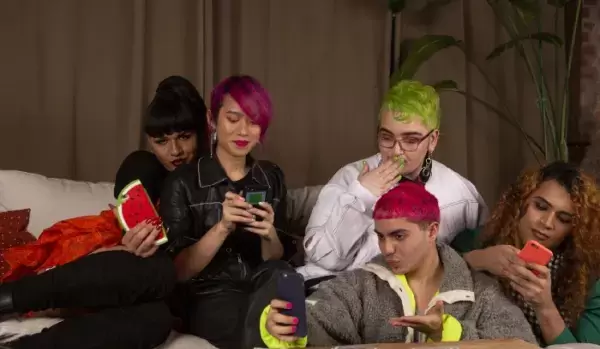
Photo credit: Vice’s “The Gender Spectrum Collection:Stock Photos Beyond the Binary”

