


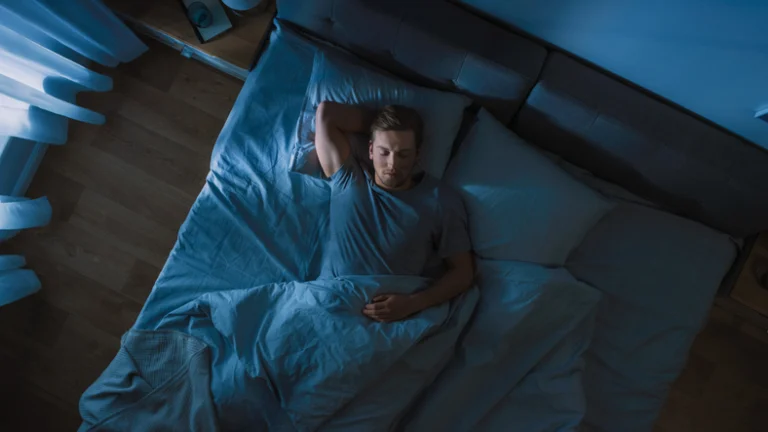
Ask a room of men when they last remembered a dream and you get a particular kind of shrug. Not embarrassment exactly. More like being asked when you last thought about your own handwriting.
Most will tell you they don’t really dream. They’re wrong, and the way they’re wrong is interesting.
You spend roughly two hours a night in REM sleep. That happens whether or not a single frame of it comes back with you in the morning. There is a second life running every night, for years, almost entirely unobserved.
I got interested in why, and the answer turned out to contradict the version I’d been repeating.
The Part That Holds Up
Sleep isn’t one flat state. It runs in cycles of roughly ninety to a hundred and twenty minutes, and the composition of those cycles shifts as the night goes on.
Deep slow-wave sleep is front-loaded, concentrated in the first third. That’s the heavy, dreamless part, and it’s why the first few hours feel non-negotiable.
REM runs the other way. The first REM period of the night is short, often under ten minutes. The last one can stretch to thirty, forty, sometimes sixty. The long, vivid, cinematic dreaming is waiting at the back of the night.
So the man who sleeps six hours instead of eight isn’t shaving a uniform slice off the whole thing. He’s cutting the end, and the end is where the dreams are.
There’s a second layer. Under sleep restriction, the body doesn’t sacrifice everything evenly. In recent work on repeated short sleep, deep slow-wave sleep held its ground even as total sleep dropped from about seven and a half hours to under six. REM shrank along with the night. The body defends the deep stuff first, which means the share of your night given to dreaming falls as the night gets shorter.
I’ll be careful here, because this is where health writing usually overreaches. Nobody has run the specific experiment: take a group of men, remove ninety minutes from the end of their nights, measure exactly how much REM disappears. What we have is the architecture, and the architecture points one direction. Treat it as a strong inference, not a proven number.
The Part That Doesn’t
Here’s what surprised me.
If short sleep were the main reason men don’t recall dreams, longer sleepers should remember more. They don’t.
A 2025 survey of over eleven hundred preteens found no relationship at all between sleep duration and dream recall. The researchers ran the statistics in a way that actively supported the null result, which is a stronger claim than simply failing to find something. What did correlate with every dream measure was a different variable entirely: how often the sleeper woke in the night.
A study of 204 adults tracked at home for fifteen days points the same way. The predictors of dream recall weren’t the obvious ones. Not age, not sex, not memory ability. What predicted it was lighter sleep, a tendency toward mind-wandering during the day, and this is the part I keep turning over: the person’s attitude toward dreaming. Men who found dreams interesting remembered more of them.
What Actually Erases It
The best explanation researchers have is almost insultingly simple.
A dream isn’t stored while you’re asleep. For it to reach long-term memory, there has to be a moment of waking awareness while it’s still there. No moment, no memory. It happened, and then it didn’t.
Wake a man directly out of REM in a lab and he reports a dream about 82% of the time. Out of non-REM sleep, roughly half that. The stage you surface from matters enormously.
Which reframes the alarm clock. The problem isn’t only that it shortens the dream-heavy hours. It’s what it does to the transition. You go from a long REM period to fully vertical in about four seconds, and then straight into a phone. There’s no soft edge, no drift, no minute of lying there with the images still hanging around.
The dream needed that minute. Sleep researchers call the fog afterward sleep inertia, and most men treat it as dead time to be powered through. For dreams it’s the entire window. What’s in your head on waking sits in short-term memory and gets overwritten by the first genuinely engaging thing you look at. Your phone is engineered to be that thing.
It also explains why “attitude toward dreaming” isn’t as mystical as it sounds. If you think dreams matter, you pause on waking and go looking. That pause is the mechanism.
Where the Old Books Land
Chinese medicine has its own account, and I’d hold it loosely, it’s an observational tradition, not a physiology. But it maps onto the experience in a way I’ve never quite gotten over.
In the classical texts the Hun (魂), sometimes rendered as the ethereal soul, is housed by the Liver. The Ling Shu puts it as 肝藏血,血舍魂, the Liver stores the Blood, and the Blood houses the Hun.
The image is one of daily movement. The nineteenth-century physician Tang Zonghai wrote that the Hun resides in the eyes during the day and returns to the Liver the moment we close them. At night it comes home. When there’s enough Blood to house it, it rests quietly and the night is deep. When there isn’t, it drifts, and the night fills with restless, tiring dreams.
In the organ clock, one to three in the morning belongs to the Liver. The hours the tradition marked as the homecoming are the same hours where modern sleep labs find those long REM periods gathering.
Those physicians weren’t describing REM sleep. They had no way to see it. But they were watching the same nights, and they concluded that what happens in the final stretch of darkness is where the restoration actually occurs. So does the sleep lab.
The Short Version
Go to bed forty-five minutes earlier, because nothing else works without it. Wake gradually if your schedule allows it. Then stay completely still for about a minute before you move or open your eyes properly, and write down one fragment, one image, one word, before you touch a screen.
Men are generally good at protocols and bad at believing that something this small could matter. Most who try it start remembering within a week or two.
There’s no productivity argument here. I’m not going to tell you dreams will make you a better manager. It’s just that there’s an hour of your own life running every night that you’ve never seen, and the entry cost is about sixty seconds of holding still.
—
iStock image

