



I stumbled across a post on Twitter/X today that, back when I was an Evangelical, wouldn’t have caused me to bat an eyelid. In fact, the average Evangelical might have given it a cheery “Amen!”
But, these days, for some reason, reading these words caused me to have an almost visceral reaction. Memories flooded back — echoes of sermons, Sunday school lessons, and fervent prayers from days gone by.
In the Tweet, a man named Jacob Lovelace explains the “good news” of Jesus Christ in a few simple sentences. It looks like this:
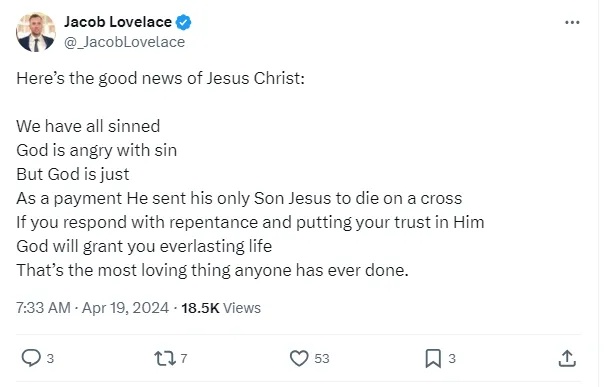
Source: Twitter/X
At the time of my writing, this little Tweet had been viewed almost twenty thousand times. And, sure, it has resonated with many, but for me, it hit differently. Back in the day, I would’ve read those words and nodded along, maybe even retweeted them with a “preach!” thrown in for good measure.
But now?
Not so much.
It’s not that I’ve lost my belief in Jesus or anything like that. It’s just that the way I understand it all now is so different. What Jacob Lovelace has posted as a line-by-line explanation of the Gospel just leaves me with a whole bunch of questions that I don’t think are all that unreasonable.
Let me explain.
“We have all sinned”
This miniature Gospel presentation starts, in typical Evangelical style, with the fact that we have all sinned. Hey, I don’t dispute that fact. If we are honest with ourselves, it’s true. We have failed to live up to the standards we set for ourselves, let alone the standards set for us by God or anyone else.
So, my problem is not with the fact that we have all sinned. My problem is with the fact that this, for some reason, is the starting point of the “good news” as presented by evangelicals.
But the Bible starts at Genesis 1, not Genesis 3.
The starting point of the Gospel message is actually the fact that God created people, in his image, fearfully and wonderfully, as a creative expression of his divine nature — which is love.
The love of God is the beginning of the story. It has to be, or else anything God does after that point is not a redemptive story but a grasping to re-establish control. After all, redemption, at its core, is about restoration and reconciliation—a journey back to the embrace of a loving Creator. It’s not about God asserting control or imposing punishment. It’s about God’s relentless pursuit of us despite our flaws and failings.
So, when I see a message that begins with our sinfulness, I feel like it missed the mark. It skips over the most fundamental aspect of who we are—beloved sons and daughters of a loving God.
It begins with love.
And maybe if we started there, if we truly grasped the depth of that love, everything else — the forgiveness, the redemption, the grace — would fall into place in a way that feels more authentic, more true to the heart of the Gospel message.
“God is angry with sin.”
Lovelace’s second statement is that “God is angry with sin.”
Here’s my problem with this statement. It makes God seem extremely impatient, petty, and difficult to please. After all, it’s hard enough to go ten minutes without erring in some way. So, if God is angry with sin, that means God is angry pretty much all the time.
Who wants to follow a deity who’s just waiting to unleash wrath at the slightest misstep? It paints a picture of a God who’s more interested in keeping score than extending grace.
Don’t get me wrong. I am sure that sin does make God angry from time to time, particularly in instances where people are unjustly hurt. But the way it’s often presented, as this constant simmering anger just waiting to boil over, misses the mark entirely.
I can’t help but think of the parable of the prodigal son, in which the father’s response to his wayward child isn’t anger or condemnation but radically countercultural love and forgiveness. That’s the kind of God I believe in—one who’s not defined by anger but by the kind of love that dispenses with decorum to embrace us in our brokenness.
So, yeah, God might not be thrilled about sin, but I don’t think that means he’s sitting up there in heaven, fuming at every little slip-up. If anything, I think it means he’s reaching out his hand, ready to walk with us through our messiness and lead us back home.
But God is just
I think I get what Lovelace is really trying to say here. By saying, “But God is just” after “We have all sinned, and God is angry with sin,” he is setting us up to tell us that God really had no choice but to punish.
By framing God’s justice solely as punishment, it reduces a complex concept to a simplistic notion of retribution. It’s as if God’s only role is to uphold a cosmic scoreboard, tallying up our wrongs and doling out penalties accordingly.
But that’s not justice — it’s just vengeance in disguise. True justice is about restoration, about healing the brokenness caused by sin. It’s about addressing the root causes, not just punishing the symptoms.
We seem to forget that every time God chooses to forgive, he is breaking his own laws which demand justice. Every act of forgiveness is, in a sense, a suspension of justice — a decision to prioritize love and mercy over retribution.
Think about that.
As payment, he sent Jesus to die.
When you ask the average evangelical Christian why Jesus Christ came to this Earth, almost invariably, and with great confidence, they will say, “Jesus Christ came to die for our sins.”
But if you forget what the church has spoon-fed you your entire life, what did Jesus actually say his life’s purpose was? Surely, you would expect that if the indisputable reason for Christ’s coming was to die for our sins, Jesus himself would have said as much, right?
So, did he?
Not really.
Shocked?
You shouldn’t be. People have been adding their own spin on Jesus’s words for millennia. Don’t get me wrong; I’m not saying that Jesus didn’t die for our sins. I’m just telling you that Jesus never said that was why he came. It was other people who interpreted Jesus’s life that way.
In the four biographies of Christ — known as the Gospels — there are 18 occasions where Jesus says, “Here is why I came,” or “Here’s why I was sent.” These 18 statements come from the horse’s mouth, so to speak. You can read about them here.
What is clear is that Jesus’s mission wasn’t solely about his death — it was about something much broader and more profound. Jesus came to reveal God’s kingdom on Earth — to show us what it looks like when heaven touches down in our midst. Sure, his death played a crucial role in that mission, but it was just one part of a much larger story. When we reduce Jesus’s purpose to simply dying for our sins, we miss the breadth and depth of his message.
If you respond, Jesus will give you everlasting life.
“If you respond with repentance and putting your trust in Him, God will grant you everlasting life,” says Lovelace.
The problem with framing the Gospel this way is that it reduces faith to a mere transaction — a quid pro quo relationship with God. It’s like saying, “Do this, and you’ll get that,” as if eternal life were some kind of reward for checking the right boxes. But is that really the essence of Jesus’s message? Is it just about securing a ticket to heaven by saying the right words and believing the right things?
By framing salvation as contingent upon our own actions — repentance and trust — it places the burden of securing eternal life squarely on our shoulders. It’s as if we hold the keys to our own salvation, and all we have to do is unlock the door with the right combination of words and beliefs.
Is it by grace that we have been saved or not?
Sure, we require faith. But, to me, faith is a very low bar. The rest is up to God.
That’s the most loving thing anyone has done.
Lovelace concludes his summary of the evangelical gospel by saying, “That’s the most loving thing anyone has ever done.”
But is it, really?
Is it really loving to create a universe where the wages of sin (even the smallest of sins) had to be death? Is it really loving that God demands payment for sin through the sacrifice of his own Son?
These questions expose the disturbing underbelly of the evangelical gospel, revealing a theology built on fear, coercion, and a distorted view of love. It’s a theology that reduces God to a cosmic dictator, demanding bloodshed to satisfy his insatiable appetite for justice.
In truth, framing the Gospel in such terms is not an expression of love but a manifestation of divine tyranny. It’s a narrative that undermines the very essence of love, substituting it with fear and manipulation.
So, how should I frame the Gospel?
I suppose the big problem that I have with Lovelace’s expression of the Gospel is that he seems to zero in on the apparent wickedness of humankind and then describes God as needing to be appeased by the shedding of blood.
I am sure that Lovelace meant well, but it doesn’t paint God in a great light. In fact, it really doesn’t sound like very good news at all.
I can hear the objectors saying, “How then would you frame the Christian gospel message, Dan?”
Since you asked, here is how I would describe the good news as I understand it:
Firstly, we are all beloved creations of God, made in His image and endowed with inherent dignity and worth. Despite our imperfections and shortcomings, God’s love for us remains steadfast and unwavering.
Secondly, while human sin impacts our relationships with others, self and God, God’s response is not one of anger or condemnation but of compassion and grace. He longs to restore us to wholeness and reconcile us to each other and Himself.
Thirdly, in His infinite love and mercy, God sent His Son, Jesus Christ, to dwell among us, teaching us by word and example the way of love, compassion, and forgiveness. Jesus lived a life of radical love and selflessness, demonstrating God’s relentless pursuit of reconciliation with humanity.
Fourthly, rather than demanding payment for sin, Jesus offered Himself freely as a sacrifice out of love for us. He willingly endured mankind’s worst to demonstrate God’s best.
Fifthly, salvation is not earned through our own efforts or good deeds but is a gift freely given by God’s grace. It is not about appeasing a wrathful deity but about entering into a loving relationship with a compassionate and merciful God through simple faith, which is a low bar.
Finally, the Gospel message is one of hope, liberation, and joy. It is the proclamation of God’s love and grace extended to all humanity, inviting us to experience the fullness of life in communion with God and one another.
And ultimately, the Gospel is not about fear, condemnation, or appeasement but about love, forgiveness, and restoration. It is the story of God’s unending pursuit of humanity, offering us the opportunity for redemption and new life.
In my opinion, that IS good news.
—
This post was previously published on Backyard Church.
***
You Might Also Like These From The Good Men Project


Join The Good Men Project as a Premium Member today.
All Premium Members get to view The Good Men Project with NO ADS.
A $50 annual membership gives you an all access pass. You can be a part of every call, group, class and community.
A $25 annual membership gives you access to one class, one Social Interest group and our online communities.
A $12 annual membership gives you access to our Friday calls with the publisher, our online community.
Register New Account
Need more info? A complete list of benefits is here.
—
Photo credit: iStock

