



The composers Max Richter, Dustin O’Halloran, Helen Jane Long, Ludovico Einaudi, and others are conducive to creative work and soothe my soul. I avoid vocalists or complicated instrumentation, as they tend to distract and fray my calm equilibrium.
The simpler the music, the better.
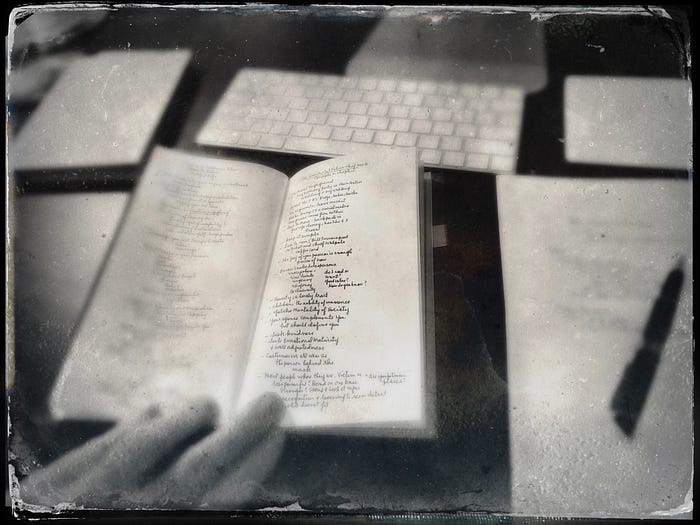
I page through a few soft leather-bound journals that populate my desk. They contain notes from my reading, random observations, thoughts, and ideas for stories and essays.
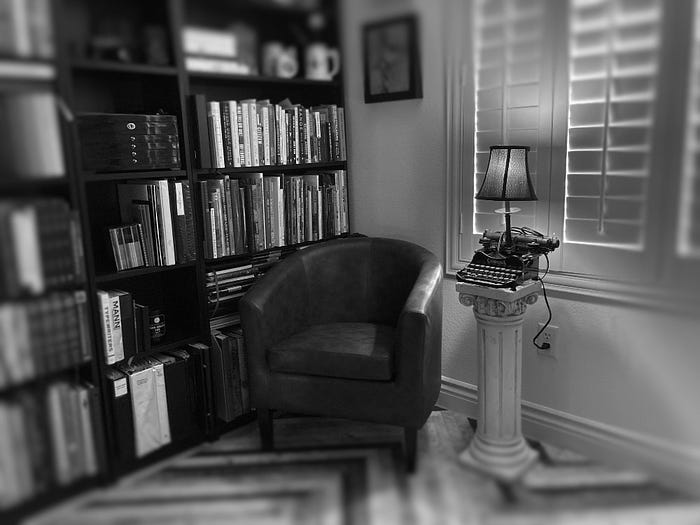
If the gods of creativity are elusive, I retreat from my desk to the little leather reading chair in my office.
I switch on the adjacent typewriter lamp and explore the bookshelf. We have a much larger library in the living room, but if I go spelunking through those cavernous shelves, I might never make it back to my office.
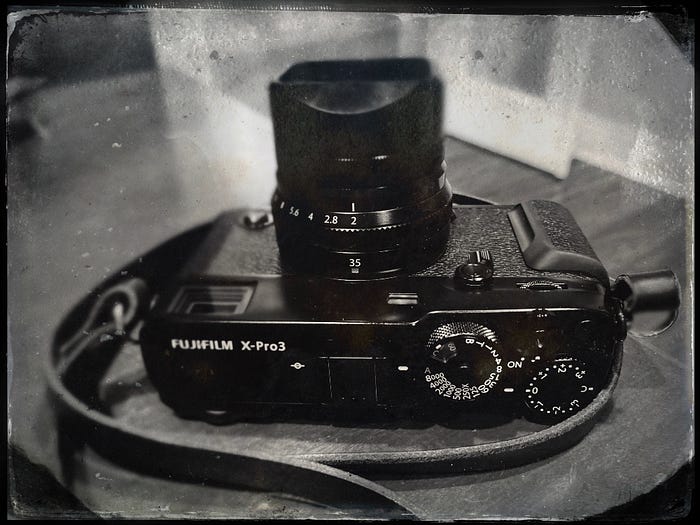
Other times, I pick up my Fujifilm X-Pro3 rangefinder-style camera, click it on, eye the viewfinder, and toggle through whatever forgotten photographs await my discovery. The images are all monochromatic, as I prefer the elegance and simplicity of black-and-white photography.
Sometimes I land on a particular photo and it sparks a memory, feeling, or idea that invites cogitation and written exposition.
In the end, it doesn’t matter where inspiration eventually comes from. What matters is that I am in a simple, quiet study. The cat is purring. The noise, pain, and relentless distractions of the outside world melt away.
And this is when I usually produce my best work.
The mother of excess is not joy but joylessness
We live in an age of excess.
Excess noise. Excess choices. Excess politics. Excess loneliness. Excess violence. Excess technology. Excess despair.
It can all be a bit overwhelming.
When I was a kid, we only had a few channels on the TV. Now there are endless channels, as well as myriad streaming options. Not to mention all the social media, YouTube, TikTok, etc.
And there are so many gadgets.
Gadgets that speak with us. Gadgets that clean our floors. Gadgets to tell us how healthy we are. Gadgets to distract, entertain, and yet somehow keep us from actually talking to one another.
Does all of this make us happy?
Some people like this abundance of distractions, and no doubt the Internet and today’s diverse digital landscape make it easier to explore interests and find like-minded folks.
And yet, many of us are overwhelmed and exhausted.
The mother of excess is not joy but joylessness. —Friedrich Nietzsche, Human, All Too Human: A Book for Free Spirits
I think the antidote is simplicity.
Most of us try to do too much
A kind reader wrote to me the other day and asked for advice.
He’s an engineer by profession. He has written but not finished illustrating a children’s book. He began a comics blog but abandoned it due to time constraints. The same thing happened with his illustrated poetry website.
More recently he started writing a book and “a song or two,” but felt the pressure “to put that on pause before it’s ever gotten going.”
He wrote to me because he was intrigued by my early retirement to become a full-time writer. He’d like to transition, “one day,” to full-time creative work.
Most of us try to do too much because we are secretly afraid we will not be able to do anything at all. —Rick Aster, Fear of Nothing
I relate to so much of what he wrote because I was a lot like him when I was younger.
I wanted to be a musician. I played keyboards and sang in two bands. I trained for years in jujitsu, earning a brown belt. I drew editorial cartoons for two newspapers. I spent years studying landscape painting. I liked to write and publish articles.
Jack of all trades, master of none.
And while I enjoyed my law enforcement career, I fantasized about transitioning to a career in the creative arts. A painter, maybe, or a writer.
Along the way, I discovered minimalism and the notion that less is more. I began finding ways to simplify my life. I crafted a simpler wardrobe. I sold or donated things I didn’t need.
And then I began to whittle down my creative pursuits.
Commitment in an age of infinite browsing
Last year, I read Peter Davis’s book “Dedicated: The Case For Commitment In An Age Of Infinite Browsing.”
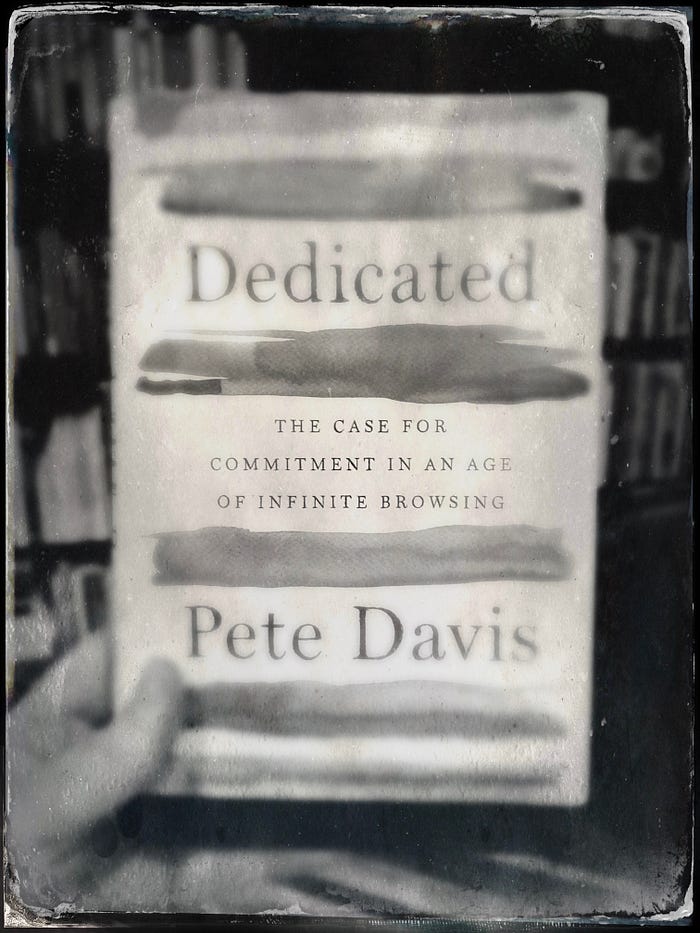
The description of Davis’s book on Amazon states the following:
Most of us have had this experience: browsing through countless options on Netflix, unable to commit to watching any given movie — and losing so much time skimming reviews and considering trailers that it’s too late to watch anything at all. In a book inspired by an idea first articulated in a viral commencement address, Pete Davis argues that this is the defining characteristic of the moment: keeping our options open. We are stuck in ‘Infinite Browsing Mode’ — swiping through endless dating profiles without committing to a single partner, jumping from place to place searching for the next big thing, and refusing to make any decision that might close us off from an even better choice we imagine is just around the corner. This culture of restlessness and indecision, Davis argues, is causing tension in the lives of young people today: We want to keep our options open, and yet we yearn for the purpose, community, and depth that can only come from making deep commitments.
Don’t like ads? Become a supporter and enjoy The Good Men Project ad free
We love to keep our options open.
But the problem is that we never commit. We flit around with this interest and that. Or worse, we get absorbed in superficial distractions. That’s part of the advice I shared with my reader, the engineer who draws comics, writes children’s books and poetry and creates music.
Here’s part of what I wrote:
Figure out which of your creative pursuits bring you the most joy. Because if you don’t love it, success might be elusive. Also, be honest with yourself about your skills. If you love to sing but God didn’t grant you a great voice, finding success might be difficult. But, if you love something and are also reasonably decent, that’s a good start. Then, double down on that passion. Because it’s just really hard to do it all.
A few years back I was juggling quite a few creative passions. But it was my writing that seemed to be taking off. It was my writing that gave me the greatest creative fulfillment. So I set aside the other creative pursuits as occasional passion projects, and I committed to my writing.
I learned to simplify in this age of excess and endless choices. I picked one thing and stuck with it.
Another bit of advice I shared was the following:
Don’t dive into a creative passion in the hopes of fame or money. Those who do usually betray their truest work for whatever they think the audience or publisher wants.
Do it because it makes your heart sing. And keep doing it.
When we simplify our lives, we make room for the things that matter most.
Over the years, I moved to a more affordable state. I sold a bigger house for a smaller, simpler, more comfortable one. I sold my gas-guzzling truck for a more economical car. I said no to discretionary distractions.
I crafted a simpler life that prioritizes free time, books, writing, and solitude for noise, comparison, competition, and the empty promise of relentless consumerism.
How about you?
Are you ready to simplify your life? Have you thought about what creative passion and pursuit gives you the most joy? If so, how can you make your life simpler and focus more on that one thing? How can you strip away the noise and distractions and commit to the creative passion that fills your heart with joy?
You don’t have to quit your job or abandon your family obligations. You just have to strip away the excess, simplify, and hone in on your passion.
What if you stopped wasting time on social media and endless distractions and finally committed to the one thing you care about the most?
The beauty of eternal life
I’ve been reading quite a bit lately about Carthusian monks.
In the Catholic faith and general monastic traditions, the most austere, ascetic, and hardcore monks are the Carthusians. They spend most of their days alone in individual “cells,” which are like small apartments.
The ambiance of solitude, the absence of any disturbing noise and of worldly desires and images, the quiet and calm attention of the mind to God, helped by prayer and leisurely reading, flow into that “quies” or “rest” of the soul in God. A simple and joyful rest, full of God, that leads the monk to feel, in some way, the beauty of eternal life. —Carthusian Monks
Only one vegetarian meal is delivered to the cells of Carthusian monks each day by lay brothers. The monks eat alone in solitude. Then they return to study, reading, and prayer.
They hardly ever speak.
They get up at night for prayers and mass, sometimes not returning to bed until 3 AM. Then they’re up again early in the morning, for prayers and church. They never take a vacation or have a day off.
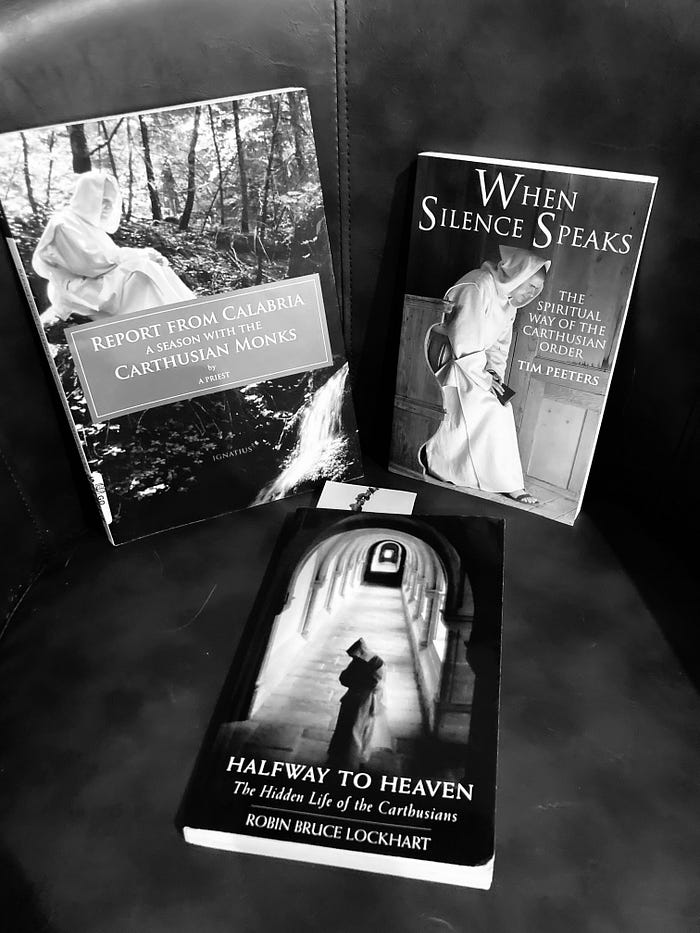
They tend their individual gardens and once a week are allowed to speak to each other on a communal nature walk. They only see family once a year.
Talk about commitment, simplicity, and focus.
There are also Carthusian nuns. The monks and nuns have forsaken everything in their lives. They take a vow of poverty. Everything has been stripped away so that through silence and solitude, they can commune with God.
And pray for the world.
Anyone who has met a Carthusian (and few ever meet them) is struck by their peace, contentment, and transcendent holiness. Even people who are not religious are affected and moved by these men and women, who live in nearly perpetual prayer.
Beyond religious faith, might the Carthusians have a lesson to teach us?
We must choose between being an anvil or a hammer
Perhaps the best of life is not found in excess.
Perhaps the real treasures in life, apart from loved ones, are found in pursuing our highest creative calling. When we strip away the noise and distractions, we can better find that which makes our hearts sing.
There’s a quote in Pete Davis’s book “Dedicated: The Case For Commitment In An Age Of Infinite Browsing,” that resonated with me:
Henry Wadsworth Longfellow wrote that we must choose between being an anvil or a hammer. We’ll either mold the world, or be molded by it. If you never go deep, you will always be the anvil. And the surest path to being the hammer is depth.
No doubt the Carthusians have gone deep, but so can we.
We don’t have to let the noise, social media, endless comparison, competition, trivialities, uncertainties, and excess mold us into a beaten-down anvil. We can embrace our loved ones and find our truest creative calling.
We can simplify our lives, and say no to the age of excess.
Where the world falls away
Sometimes late at night, I like to leave a soft light on in my study.
After my family has gone to bed and I’ve tucked in our dogs and cats, I find myself drawn to the glowing light of my study. My refuge. My version of a Carthusian cell, where the world falls away, and I am alone with my books and thoughts.
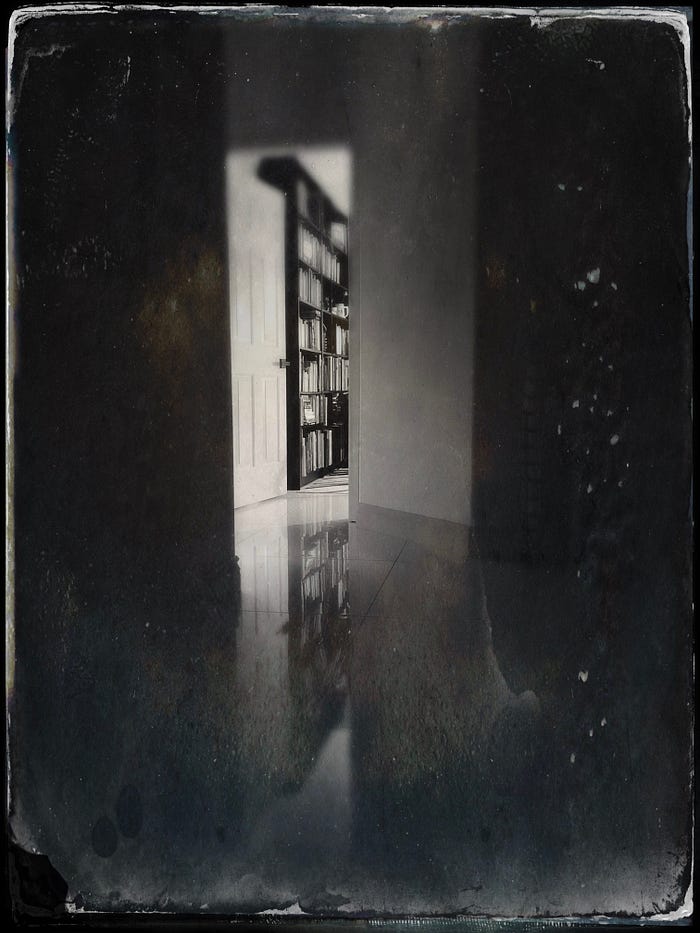
Perhaps a bit of weariness has entered my soul, and thus the solitude of my study keeps me centered and hopeful.
Hopeful, that my stories and essays will help others, and encourage them to abandon the excesses of life and find the joy of simplicity. Hopeful that this aching world rediscovers our better angels, shared humanity, and the kind of blessed solitude, love, and peace that the Carthusians know.
And I’m hopeful that you join me on this journey. Let’s simplify our lives, discard the excess, refuse to be anvils, and strive to become hammers.
What an amazing world we can shape together.
Before you go

I’m John P. Weiss. I write elegant stories and essays about life. If you enjoyed this piece, check out my free weekend newsletter, The Saturday Letters.
—
This post was previously published on Medium.com.
—

If you believe in the work we are doing here at The Good Men Project, please join us as a Premium Member today.
All Premium Members get to view The Good Men Project with NO ADS.
Need more info? A complete list of benefits is here.
Photo credit: Self-portrait by John P. Weiss

