



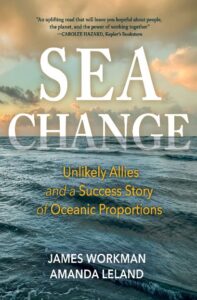
Oceans are more than bodies of water that span the distance between land. They are an eco-system teeming with life. Without healthy seas, and without sustaining life within it, humans will fail to thrive. Author and storyteller James Workman partnered with Marine Biologist Andrea Leland to pen a fascinating story about what happens when environmentalists and fishing professionals collaborate rather than compete for precious resources. The book Sea Change asks this powerful question: “What if we could reverse overfishing, protect fishermen, restore fish stocks to sustainable levels and help preserve a way of life on the open seas, all at the same time?”
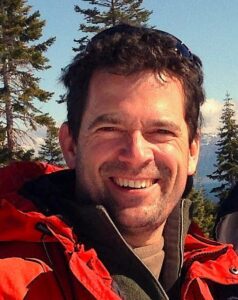
How did you each become environmental activists?
Amanda trained as a marine biologist in Maine and thought she’d spend her life studying ocean life. But the more she documented declines, the more it felt like writing the ocean’s obituary. She didn’t want to describe collapse, she wanted to stop it. So she turned to reshaping incentives so fishermen could make a good living by keeping fish in the water.
I came at it from the human side. As a reporter and speechwriter, I kept running into versions of the same story: when a resource belongs to everyone yet no one in particular, everyone hurries to use it up. My grandfather saw this firsthand in Pacific NW old growth forests; and we’ve seen it with farmers sharing a finite water source. But over time I’d also seen hunter-gatherers on land and offshore quietly work out rules so the resource and their community could last. Sea Change is our attempt to celebrate that kind of grit, conflict, and eventual cooperation.
People feel overwhelmed when they think about environmental crises. How can you simplify it for the readers?
I get it. I have a book by my bed, The Uninhabitable Earth. I know it’s good, and accurate. And yet I can’t bring myself to open it because it’s too overwhelming. If you stare at every looming crisis all at once, from deforestation, to microplastics, to warming seas and skies, you can feel paralyzed. The best way to get over, or through, that existential moment is to zoom in from the global level to the personal: local men and women making hard choices and having real impact.
So, let’s pick a problem we’ve already managed to solve, and figure out how ordinary people, heroes in plain sight, did it. Not long ago, overfishing was a classic global doom and gloom story. Reputable scientists projected the ocean would be empty of seafood by 2048. But from dock to dock, and coast to coast, fishermen, scientists, and environmentalists got together because they all wanted the same thing. They changed a few core rules shifting from competing today toward collaboration for long term recovery. And the ocean responded. That’s the lesson, if we fix and align the incentives, nature heals surprisingly quickly. For readers, especially men who grew up feeling they have to shoulder everything, this turns an ocean-sized problem into a personal choice: do I reinforce systems that destroy, or systems that restore?
Why is this an essential book for the times we are living in?
Because it’s not theory, or blind hope based on wishful thinking. Nor is it just repeating a cry, louder with more urgency, that we all must stop harming the natural world. We know that; what we need to know is exactly how to do that.
This wild but true story, personified through Buddy the ex-marine bar-owning highliner, shows an industry that hit bottom, fought like hell, changed direction, and came back stronger and at peace with the world. Not the old “man versus nature,” or “man vs man” or even “man versus the system” conflicts, but working with nature’s rhythms, trusting former rivals, getting to shape the system in a positive way. A lot of people feel stuck between anger and resignation these days. Sea Change follows a fisherman who felt that way too, but it shows how he found a way to make more money protecting a portion of the renewable resources, fishing, that he loved. The book is a reminder that collapse isn’t destiny. Turnarounds are possible. Here’s one that already happened, how and why, and what we can learn from it.
What is the narrative behind the book?
It follows the life story of Keith “Buddy” Guindon, an obsessive Minnesota “fishaholic” almost from birth, bonding with his dad over fishing together, then losing that when his dad abandoned the family. They reconnect in Galveston, but it’s still testy; he becomes a highliner (catches the most fish) who lived to fish and got so good at it he and his peers nearly wiped out the snapper and grouper they lived off. He didn’t trust regulators. He loathed environmentalists. My coauthor Amanda wasn’t exactly welcomed by fishermen either; she’s even needed a police escort just to present data. But slowly, painfully, both sides realized they all sought more fish, more stability, more prosperity, more of a future for our own sons and daughters. The book chapters track Buddy’s overhaul of his business, his worldview, and eventually the entire fishery through a new system called catch shares. It’s a salty, brawling redemption arc, that scales from the personal, to local, regional, national and global scales.
How do we address the rhetoric that climate change is a hoax?
The fishermen we spoke to and work with don’t debate whether climate change is happening through abstract models and projections. They live each day outdoors surrounded by an altered seascape, so it’s painfully real. And they talk about what they see. How the water is warmer. The fish are migrating in desperation deeper or toward the poles to seek cooler habitat, or some fish vanish because it’s too hot. Extreme weather and seasons no longer act like they did when they were kids. Whether or not someone wants to acknowledge it’s climate change, no one can deny its effects—we see it everywhere and know the risks to life and livelihood are real.
Instead of arguing about labels or timelines, we try to focus on what these fishermen already know: you manage the risk you can control, and try to build resilience to shocks that inevitably will come. To do that, we can rebuild stocks, cut waste, slash emissions, restructure the rules so that more people have a long term stake in shared resilience. They care more about adapting to climate change than arguing about what’s causing it.
What is overfishing?
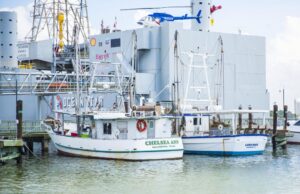
Overfishing is removing fish faster than nature can replace them. Powerful industrial technology (engines, hydraulic winches, fishfinders, etc.) let guys like Buddy pull more fish than ever. But the reckoning eventually came due: collapsed stocks, bankrupt families, lives lost, finger pointing. Then, boom: align the incentives (reward long-term stewardship instead of short-term grabs) and the same fishermen who once raced each other literally to the bottom, can help rebuild nature’s wild stock portfolio.
‘Catch shares’ is a new phrase for me. Can you please define it and how it is effective?
It’s an incentive-based approach that starts with scientists setting a science-based limit on how many fish can be caught while leaving enough for the fish population to keep growing. Fishermen receive a secure share of that limit, which gives them long-term access and a financial stake in protecting the resource. Suddenly, it pays to fish carefully, avoid waste and protect the habitat, because they can catch more and earn more as fish populations rebound.
Imagine the yearly sustainable catch as a “pie.” Science decides how much of the whole pie can be removed, leaving the rest to keep growing. In the past, each fisherman used to compete with others to grab as much of that pie as fast as he could. It was a competition. But under catch shares, he now gets a secure slice, defined by a fair formula. Once you’ve caught your slice, you stop. Fishermen decide when, where, how, and even if they want to fish. They can wait for good weather, use less fuel, land higher-quality fish, and plan their lives. They can sell in advance certain pounds of their allotted catch to supermarkets and restaurants, negotiating the best price, then go out to catch it. As the stock recovers and rebuilds, the pie grows; as the pie grows so does that fisherman’s individual share.

As I was writing these questions, what came to mind was the scene from Forrest Gump and the ‘pray for shrimp’ concept when he was out to sea during the hurricane and was able to gather the shrimp because the other boats were destroyed.
That scene is appropriately perverse. But it’s how a typical open-access fishery works: your best shot is for everyone else to fail. Man vs man; zero-sum game. It’s like the first season of “Deadliest Catch”; when a crab vessel goes down, the others mourn, but it means better prices and more for them. In the old days of flawed regulations some fishermen were pitted against each other, quietly hoping others might drop out and would thin the fleet. Buddy said he was determined to be the last man afloat in a diminished Gulf. It was a brutal way to live and fishing was the most dangerous job in America. Catch shares end that desperation. When you hold a secure share, you don’t need a hurricane to get ahead. You sit it out and stay in bed. You want safety, good science, transparency, and honest enforcement for all, for you and the others. Why? Because you aren’t competing with them for supply, and because your fortune rises with the health of the stock, not the misfortune of your neighbors. The only real friendly rivalry among fishermen now is on shore, competing for rising demand, and that is healthy for all.
What was the ‘unlikely partnership’ which you describe in the book that evolved?
It’s the unlikely alliance that grew between fishermen and environmentalists. For decades, neither trusted the other, and each side got busy “working the refs,” disputing the science, lobbying Congress to lighten up or crack down, calling for higher or lower catch limits, respectively. Then after meeting in bars (which is always and everywhere the best way a good conflict should get resolved, right?) the two sides began to realize how much they had in common, and how they could work together to co-design a better system. Guys like Buddy, who once swore he’d never trust anyone from “the green side,” eventually stood beside those same environmentalists and scientists in Washington, arguing for deep cuts to their own catch so red snapper could rebound faster. You can’t script that. It happened because they finally stopped fighting over the past and started collaborating for a future.
How can we get the US on board with this as well?
I’m happy to say that the U.S. is very much on board and 94% of U.S. fisheries are now sustainable according to the National Oceanic and Atmospheric Administration (NOAA).
For centuries, tribal communities all over may have governed themselves through informally enforced, self-managed, tenure-based fisheries based on oral traditions and unspoken codes. But this new formal legal structure and policy behind the catch shares system was born in the Great Lakes, spread from state to federal fisheries from Alaska to Florida. In the process of this bipartisan success story, over the past two or three decades our country went from a warning story of “federal disaster” declarations and overexploitation to becoming a global leader in a system that is also followed in 47 other countries from New Zealand to Namibia and Belize to Iceland. Stocks rebounded. Jobs stabilized. Safety improved. But there’s work to be done; the world still has countless fisheries stuck in the old race-to-the-bottom rules. The path forward is extending what’s already working, making sure coastal and tribal communities get a fair stake, and backing businesses that fish the right way.
For your readers: Now that we’ve got the supply side of the equation right, please buy from our well-managed American fisheries, without guilt and with pride. Reward success. That’s how we keep the turnaround going.
Is there hope for environmental resilience and revitalization?
Absolutely. This story should echo Faulkner’s point that we won’t just survive a changing climate, we will prevail. The ocean proved it. All we need is to agree on the right incentives that harness our self-interest and move toward recovery. Once fishermen stopped racing each other to the bottom and started managing, fish populations snapped back at a stunning pace. Boats fished fewer days and made more money. Families got stability. Nature is tougher than we give her credit for. Give her half a chance, and decent rules, and she roars back.
We see the same dynamic on land where forest-dependent communities have a clearly defined share of the economic benefits of keeping trees vertical they secure forests. Where irrigators have a slice of their shared aquifer, they grow more efficient crops. Where landowners get rewarded, rather than punished, for discovering rare species on their property, biodiversity flourishes.
Anything else you want to share?
When I think “environmental activist” I don’t think of myself, or Amanda, or of Buddy or any of the people in the book. When we hear “activist” there’s often this stereotype of some annoying, self-righteous person of privilege with time on their hands, who is constantly virtue signaling, defined by what they go without. What joys they deny themselves and others, and they’re busy scolding or shaming distant and invisible “others” who don’t have the same outlook or occupation.
This book is almost the opposite. Sea Change isn’t about perfect heroes. It’s about sitting down with those on the “other” side. It’s about stubborn men and women who changed their minds, who adapted when reality asked them to. If a Texas highliner and a room of furious fishermen can come around to working with scientists and environmentalists, then there’s hope for the rest of us.
Also, when you eat American wild-caught seafood, you’re voting with your fork for systems that reward care over chaos.
The cover image is “Courtesy, Torrey House Press.” The two fishing boat pics are ‘Courtesy, EDF.”
—
iStock featured image

