



He felt the same way about books.
As a young man, I thought that my father was a relic who grew up in the dark ages. Even his old family photos were in black and white.
Once in a while, a history program or movie on TV would pique my father’s curiosity. And sometimes he enjoyed shows like All in the Family and Barney Miller.
But mostly he read books.
A drunk librarian who won’t shut up
When I wasn’t watching TV as a boy, I liked to draw in my sketchbooks or go outside and adventure in the woods.
My parents encouraged me to read more, like my sister, but I found it hard to focus. Whenever I picked up a book, I’d count the pages to see how many before the end of the chapter.
I managed to get through books here and there, but I was far from being well-read. My dance with books and literature would come much later in life.
Most of the people I know in my generation are still focused on television, whereas younger folks spend their time on social media platforms like TikTok and YouTube. If the young do watch movies, they tend to pay for streaming services and watch programs on their devices.
If television’s a babysitter, the Internet is a drunk librarian who won’t shut up. — Dorothy Gambrell, Cat and Girl Volume 1
Television is starting to remind me of radio in my Dad’s day. A sort of dying entertainment. Especially cable programs.
We still have TV in our home, with a cable service plan that includes fast internet service. But I’m beginning to wonder why. Apart from the Internet connection, which I need for my work, I see less and less return on investment for cable service.
The cable programs offered are mostly older movies I’ve seen. Of course, there’s pay-per-view to watch recent films, but increasingly, the stuff coming out of Hollywood today doesn’t appeal to me. They’re either political tutorials or tired remakes of past movies.
There was a time when I used to be an information junkie, and I enjoyed news programs and discussion panels.
But not today.
Cable news shows are little more than partisan political silos and intellectual echo chambers. And the programming seems to endlessly loop, with little substance. Also, the infernal ad interruptions take up more time than the news shows. I’ve found it’s much faster, more efficient, and more informative to read a few reputable online news sources.
Last month, after endlessly clicking channels, I had a little meltdown.
“Why do I bother?” I said to my wife, adding, “There’s nothing here.”
“I know,” she said, looking up from her iPhone, where she usually retreats in the evenings to watch videos and catch up on messages. So I fetch my iPad Pro and click on YouTube, scrolling about for a video, podcast, or documentary to escape into.
But even YouTube has become a stale wasteland of repetition, advertisements, and the same old stuff repackaged in a futile effort to please the algorithms. In disgust, I exit YouTube and check my emails.
Among the ocean of messages is a newsletter from a former book editor I follow.
The newsletter mentions the Harvard Classics, which I inherited from my father. But I look closer and see that it’s not the Harvard Classics, but the Harvard Classics “Shelf of Fiction.” Reading further, I learned that the “Shelf of Fiction” is 20 selected volumes of classic fiction. The set is meant to be a complementary addition to the original Harvard Classics.
I researched a little more to see which classic authors appear in the collection. They include Henry Fielding, Jane Austen, Sir Walter Scott, William Makepeace Thackeray, Charles Dickens, George Eliot, Nathaniel Hawthorne, Edgar Allen Poe, Victor Marie Hugo, Guv de Maupassant, J. W. von Goethe, Leo Tolstoy, Fyodor Dostoevsky, Ivan Turgenev, and others.
Talk about a list of literary luminaries.
If you’re unfamiliar with or haven’t read all of these writers, don’t feel bad. Neither have I.
I casually mentioned the discovery to my wife. She did some quick sleuthing and found a used set in very good condition.
“Do you want it?” she asked.
“Absolutely,” I said.
My wife is awesome.
To fill up and live
I didn’t turn to books until my university days.
I read books in school because I had to, rarely for personal edification or enjoyment. But something changed at university. I didn’t like that others in class, including my professors, knew a great deal more than me. And being ignorant makes one sort of pathetic in classroom discussions and debates.
So I started reading more.
At first, it was hard because my focus was poor. But like anything, the more I did it, the better I got. My vocabulary and comprehension grew. I started reading a mix of fiction and non-fiction. Most of it was oriented toward schoolwork and politics. The one area I neglected was classic literature.
She read books as one would breathe air, to fill up and live. — Annie Dillard, The Living
Through graduate school and into my law enforcement career, I continued to read a variety of books. And I seemed to absorb quite a bit about structure, pacing, and how to craft a decent essay and short story.
Toward the end of my police career, I began publishing occasional essays in the local papers, and I started a blog.
At first, I wrote about art- related topics, but over time I expanded to explore personal development, and eventually life lessons. The more I wrote, the more I measured the grand expanse between my work and the work of authors I admired.
Thus began my first foray into classic literature. Which brings me back to the Harvard Classics Shelf of Fiction.
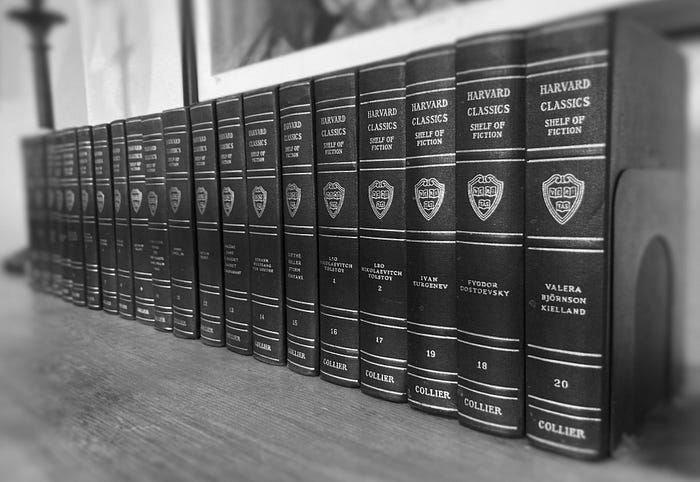
Thanks to my wife’s research and decisive action, the entire set arrived last week. I decided that my time would be far better spent diving into this curated collection of literary splendor than clicking through tired old movies and endless ads on cable TV.
I read somewhere that if one were to read a mere 15 minutes a day from the original Harvard Classics 50 volume set, one would complete the series in a year. So, I imagine the 20-volume shelf of fiction will take considerably less time to consume.
Except for one thing: old-school literature can be a slog.
For I hope my friends will pardon me
When the Harvard Classics Shelf of Fiction arrived on our doorstep, my wife removed all the well-preserved books from the box and lined them up beautifully in my office on a desk behind my father’s WWII Japanese samurai sword (given to him by an old Captain in the Japanese army).
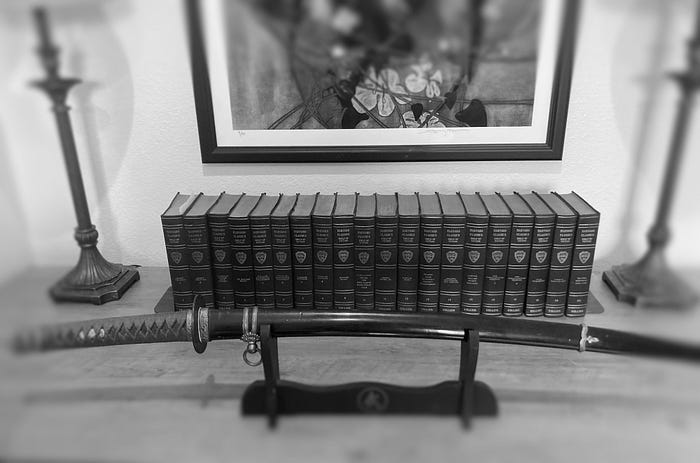
I excitedly picked up the first book, containing Henry Fielding’s “Tom Jones” novel, as well as introductory sections and even criticism. I flipped to the first paragraph of “Tom Jones” and read the following:
An author ought to consider himself, not as a gentleman who gives a private or eleemosynary treat, but rather as one who keeps a public ordinary, at which all persons are welcome for their money.
Huh?
And what the heck is “eleemosynary?”
So I looked up the strange word and found out that it basically means “charitable.”
Then I reread the first paragraph and several that followed. And the gist was that authors should consider themselves as sort of like restaurant owners or publicans and that they should outline what they have to offer to the reader much like a restaurant menu. Further in the chapter, I learned that what Fielding is going to be writing about is human nature.
“This will take some work,” I thought to myself.
Namely because of the old vocabulary words, references to books I’ve never read, and older style of writing. And yet, if one is patient, there is such beauty in Fielding’s words and wisdom.
Consider this nugget:
For I hope my Friends will pardon me, when I declare, I know none of them without a Fault; and I should be sorry if I could imagine, I had any Friend who could not see mine. Forgiveness, of this Kind, we give and demand in Turn.
I randomly flipped ahead in Tom Jones, and landed on the first page of Chapter 11, with the title: “A Short Hint of What We Can Do in the Sublime, and a Description of Miss Sophia Western.” That artful phrase, “What we can do in the sublime,” pleased me.
It held the kind of elegant phrasing I often aspire to in my writing.
Pessimism is not in being tired of evil but in being tired of good
On a random webpage for the University of Idaho, one can find the following words about sublime experiences:
Sublime experiences, whether in nature or in art, inspire awe and reverence, and an emotional understanding that transcends rational thought and words or language.
I know this is true because when I stood in the Accademia Gallery of Florence, looking up for the first time at Michelangelo Buonarroti’s famous marble sculpture “David” I felt a vertiginous sense of awe and amazement. Great art can do that.
So can great literature.
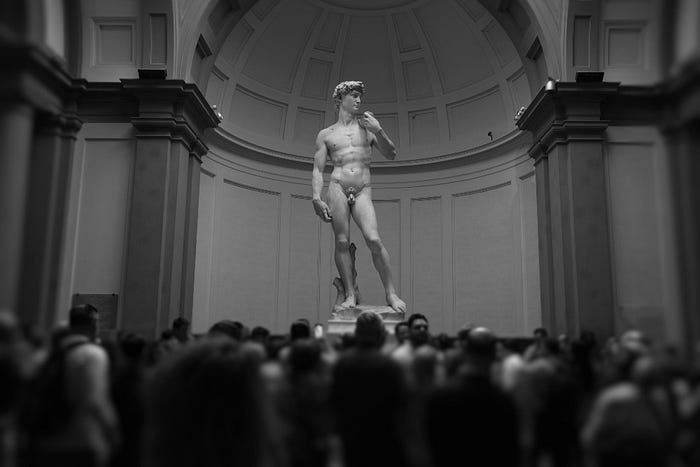
Sometimes in my reading of other books and literature, I encounter the kind of sublime writing that takes me somewhere far beyond all I know and understand. To a place of possibilities, luminous prose, divine expression, and a sense of connection with great minds and souls who have gone before us. And these souls have so much to teach us if we are willing to take the time to read and read deeply.
I was taking notes the other day as I worked on The David Foster Wallace Reader.
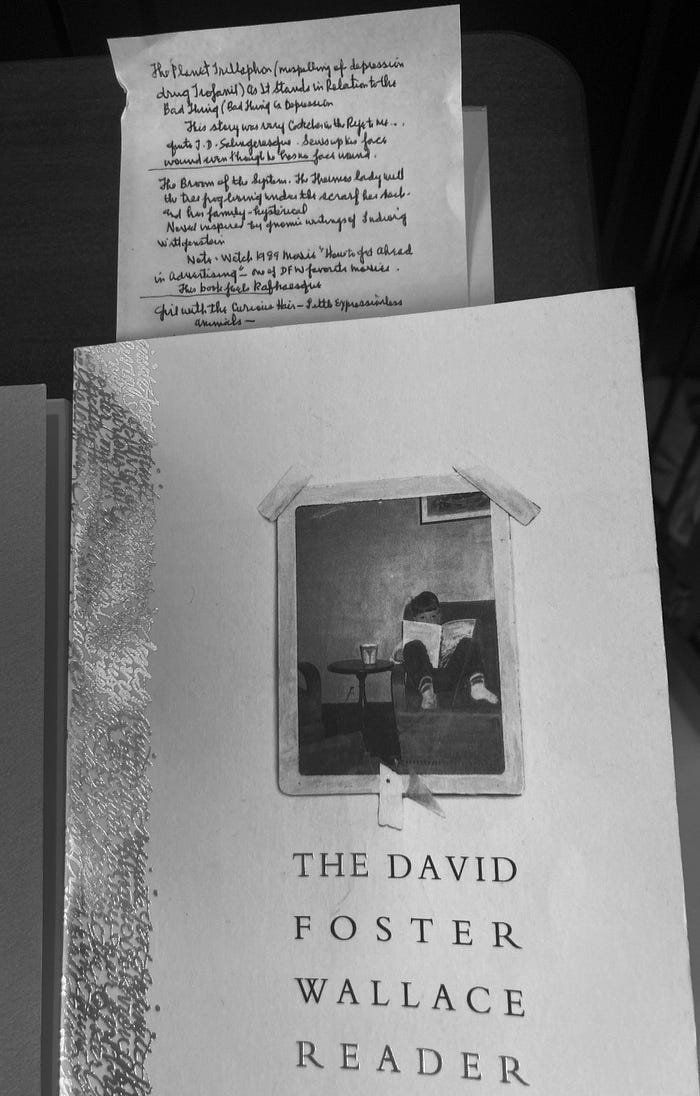
In one of Wallace’s head-spinning short stories, “The Broom of the System,” there is a story within the story about “Thermos” woman, who wears a neck scarf to hide a little tree frog that lives on her neck.
And here comes a spoiler…Thermos woman dies in a train accident and the tree frog shows up later at her boyfriend’s apartment, looking for a new home. The frog story alone sort of teleports you to, well, I’m not sure where, but it expands your mind and invites many thoughts about alienation, loneliness, and more.
And that’s the thing about literature, it has the power to transport us into the sublime.
Another very different book filled with notes in my study is “The Everlasting Man” by G. K. Chesterton.
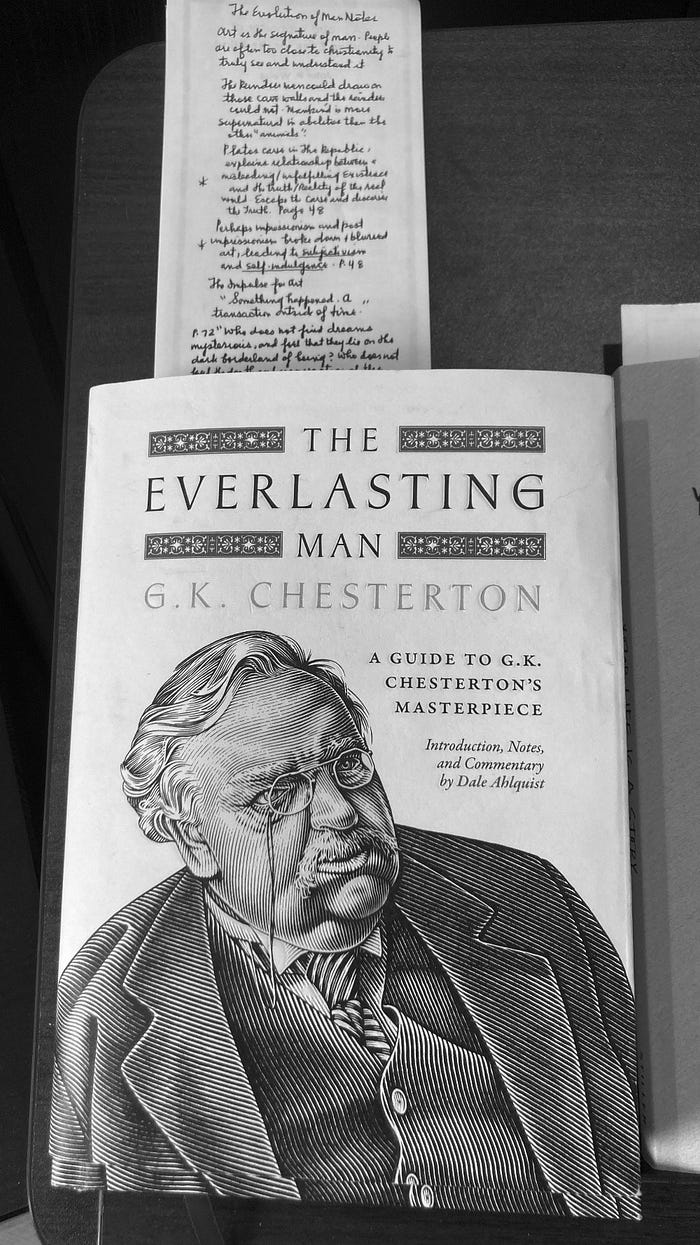
Consider the current state of affairs in the United States (and elsewhere in the world), with our polarized society, hatred on university campuses, Rome-like indifference (taking our blessings for granted), and troubled sense of something coming. And then contrast all that with Chesterton’s words:
Pessimism is not in being tired of evil but in being tired of good. Despair does not lie in being weary of suffering, but in being weary of joy. It is when for some reason or other good things in a society no longer work that the society begins to decline; when its food does not feed, when its cures do not cure, when its blessings refuse to bless.
Books and literature educate, warn, enrich, and sometimes even transform us.
Do you ever long for something deeper?
As a writer who wants to continually improve my craft, investing in good books and literature is the surest path forward.
But it’s more than that. I’m finally discovering what my father, and my sister when she was young, already knew. And that is that books and literature satisfy our souls in a way that cable television and TikTok videos are seldom likely to compete.
I don’t have to rely on algorithms or the priorities of marketers to feed me content. I can bypass all that nonsense and swim in much deeper waters.
Sometimes swimming in these deeper waters takes more effort, but the rewards are worth it.
I don’t mean to sound like a literary elitist or a tired old pedant. There are times when we all need to shut our brains off, and sometimes a silly romantic comedy on TV or a hysterical cat video on YouTube is just the thing.
But do you ever long for something deeper?
Do you ever get tired of the loud voices, comments, likes, ads, repetition, and pointlessness of so much of today’s entertainment? Do you ever wonder where the depth is? Where the answers to the great questions of life and the consolations of the soul can be found?
That is part of the beauty of all literature. You discover that your longings are universal longings, that you’re not lonely and isolated from anyone. You belong. — F. Scott Fitzgerald
You may not feel these things so much when you are younger, but time, experience, and maturity will erode the charm of childhood amusements. And then your heart and mind begin a quiet quest for answers. For companionship. For hope.
For the sublime.
If you want to know what we can do in the sublime, what awe, joy, and reverence await, pick up a good book. Get lost in the arms of great literature. Allow the words and magic prose to hug you. Feel their warmth and reassurance.
Have you seen the lovely movie Shadowlands?
At the end of the movie, the actor Anthony Hopkins (playing C. S. Lewis) says to a young student, “We read to know that we’re not alone. Do you think that is so?” The young student says that he never thought of it that way before.
Nor did I when I was younger.
But now I understand.
If I were the young student answering C. S. Lewis, I’d tell him, “Yes, Sir, I agree. Books allow us to live many lives beyond our own. They take us out of ourselves, and also within ourselves more deeply. F. Scott Fitzgerald was right, we can discover that our longings are universal. That we belong.”
That’s what we can do in the sublime world of books and literature. We can love. Laugh. Cry. Explore. Learn. Grow.
But most of all, we can belong.
Before you go
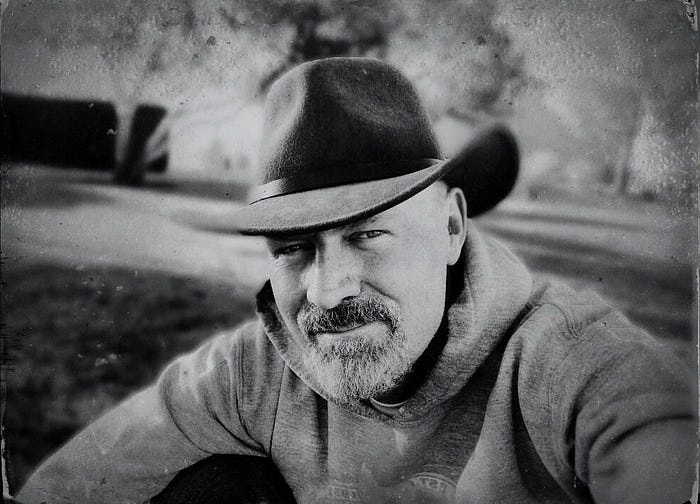
John Patrick Weiss writes stories and essays about life, often illustrated with his black and white photography. Visit JohnPatrickWeiss.com.
—
This post was previously published on Medium.com.
—
The Good Men Project is a mission-driven men’s media platform. A major platform for stories about men, identity, fatherhood, and emotional intelligence—and a trusted home for the national conversation about masculinity.
The Good Men Project accepts paid guest posts and provides bulk guest post packages for SEO agencies and resellers.

If you believe in the work we are doing here at The Good Men Project, please join us as a Premium Member today.
All Premium Members get to view The Good Men Project with NO ADS.
Need more info? A complete list of benefits is here.
Photo credit: John P. Weiss

