


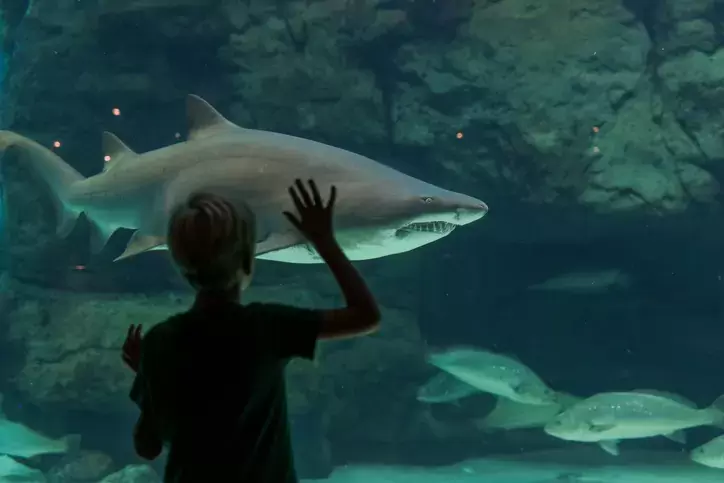
Liam was four and a half years old when he first informed me that sharks were misunderstood.
He did not say it the way most children say things at that age, as though trying on a new word to see if it fits. He said it with the calm authority of someone who had already considered the evidence and reached a firm conclusion.
Not interesting.
Not cool.
Misunderstood.
He stood there with his little chest lifted, his serious face turned up to mine, and gave me a look that seemed to say, Honestly, Nanny… how has the whole world got this so wrong?
From that moment on, every conversation somehow found its way back to sharks. Breakfast could begin with toast and end with tiger sharks. A walk along the beach could become a lesson on dorsal fins, deep water, and why people needed to stop calling sharks monsters. If a cartoon shark appeared on television with exaggerated teeth and a villain’s grin, Liam would sigh as though personally offended.
“They’re not bad,” he would tell me.
“They’re just sharks.”
Years later, that same boy walked through my door wet and sandy from the beach, a surfboard tucked under his arm, taller now, handsome, and carrying the sea with him. He had just finished his surf lifesaving training and stood there, still breathless, salt water clinging to his hair.
“Nanny,” he said, “I saw a shark today.”
I looked up quickly, because no matter how much you love the ocean, the word shark has a way of making a grandmother’s heart pause.
“A big white,” he added quietly. And there it was again.
Not fear.
Not panic.
Just wonder.
Liam has always loved sharks. Now he talks about studying marine biology, about understanding the ocean more deeply, perhaps even specialising in those ancient, elegant creatures scientists call chondrichthyans.
But before there were plans and surf rescue flags, before he learned to read the ocean with his body as well as his eyes, there was simply a four-and-a-half-year-old boy trying to make sense of something the world had decided to fear.
Wind the clock back.
He had enormous blue eyes then, bright and round as saucers, the kind of eyes that made it impossible to tell whether he was imagining things or seeing something the rest of us had forgotten how to see.
One afternoon, he came to me full of urgency.
“Nanny,” he said, “you know sharks are just the very best… but why is everyone so scared of them?”
I remember smiling, not because it was amusing, but because of how deeply he meant it.
“People think they’re all killers,” he continued, frowning. “But they’re not. They want to live their happy sea life.”
“Their happy sea life?” I asked.
He nodded seriously.
“Yes. Swimming around. Eating fish. Being sharks.”
Then he paused.
“There are good sharks, you know… and maybe the ones that eat people aren’t really bad. Maybe people get in their way when they’re hungry.”
I let that sit between us.
It was such a child’s thought — and yet not childish at all.
He was searching for fairness and trying to understand whether something could be frightening… without being evil.
That was the moment a story was born.
I looked at him, at those wide blue eyes shining with conviction, and said, “You know, Liam, I think you have magical eyes.”
“Magical eyes?” he asked, instantly interested.
“Yes,” I said. “The magic is shining out of them. I think one day you are going to meet a big shark friend… because you are a Shark Boy.”
He stared at me, his whole face beaming.
“Really? You’re going to write me a story where I meet a shark?”
“I think I might have to.”
“Oh,” he whispered, as if I had handed him something precious, “that would be my dream.”
I knew then that I was going to write that story.
I didn’t know then how long it would stay with him.
Shark Boy began as a bedtime story, shaped more by imagination than intention. But like all the best stories, it grew into something more. In that world, Liam was no longer asking questions about sharks. He belonged to the ocean. In Liam’s story, he was no longer a little boy asking why sharks were misunderstood.
He became Shark Boy.
Guided by the magical light in his eyes, he followed Dearborn, the great whale shark, into an underwater world filled with remarkable creatures. There was Goutoumi the blue-spotted stingray, Maximillian Forbes the very dignified lion fish, and little Pufferbee, whose worries were often much bigger than he was.
The ocean was no longer just a place. It had become a world of friendship, adventure, and discovery. And within it, every creature deserved to be understood.
The sea was no longer a place.
It was a world.
In the story, what Liam loved most was that Shark Boy was not a hero in the usual sense.
He didn’t fight.
He understood.
On one occasion, his older brother Joshua was swimming during a camping trip. The water had that same deceptive calm the ocean wears before it changes.
“Shark!” Pufferbee would shout.
And Liam would dive, not away from danger, but toward it.
He would slip from Dearborn’s back into the water and see what others could not yet see. A blacktip shark, fast, purposeful, moving through the water toward Joshua.
Liam knew this shark.
“It has black tips on its fins,” he once told me very seriously. “That’s how you know.”
In his world, knowledge wasn’t just information. It was protection.
And so, instead of panic, there was a response. Pufferbee puffed bravely beside him. Goutoumi moved silently through the water. Together, they were a team.
They outsmarted.
They read the moment.
They respected the ocean.
And in doing so, they changed the outcome.
Joshua reached the shore safely.
And Liam — still only four and a half years old in real life- would sit back, satisfied.
Not because he had defeated something.
But because he had understood it.
Looking back now, I realise those stories were never really about danger. They were about learning. About a small boy refusing to accept a world divided neatly into “good” and “bad,” and insisting instead on something more thoughtful, more generous, more true.
In those quiet underwater adventures, he was teaching himself something many of us take much longer to understand.
That not everything we fear is evil.
That knowledge is stronger than instinct.
And that even the most misunderstood creatures have a place.
. . .
Years passed, as they always do.
The little boy with the wide blue eyes grew into a young man who moves through the ocean with calm confidence.
And now, at fifteen, when he walks through the door carrying that same sea with him, he no longer speaks about magical eyes or secret worlds beneath the surface.
But the way he sees?
That has never changed.
“I saw a shark today,” he said again recently, casually.
“A big white.” And again… there was no fear.
Only wonder.
Standing there, looking at him, I realised something I had not fully understood before. The story had never simply entertained him. It had given shape to something that was already there.
Even as a child, Liam looked beyond fear, wanting to understand rather than judge, and searched for fairness where others saw danger.
Shark Boy had never really left him.
He had grown into it.
And now, when I look at him at fifteen, taller, steadier, carrying the ocean in the way he moves and speaks, I can still see the small boy standing before me, trying so earnestly to convince the world that sharks were not monsters.
Nothing essential has changed. What began as wonder has deepened, like the sea itself, into something vast and quietly certain. The boy who once imagined himself as Shark Boy did not leave that dream behind.
He has grown into it.
And what guided him then still guides him now:
not fear,
But understanding.
Not judgment,
but curiosity.
Not suspicion,
but love.
A love that began in innocence…
and stayed.
—
This post was previously published on The Memoirist.
***
From The Good Men Project on Medium
 |
 |
 |
 |

If you believe in the work we are doing here at The Good Men Project, please join us as a Premium Member today.
All Premium Members get to view The Good Men Project with NO ADS.
Need more info? A complete list of benefits is here.
Photo credit: iStock

