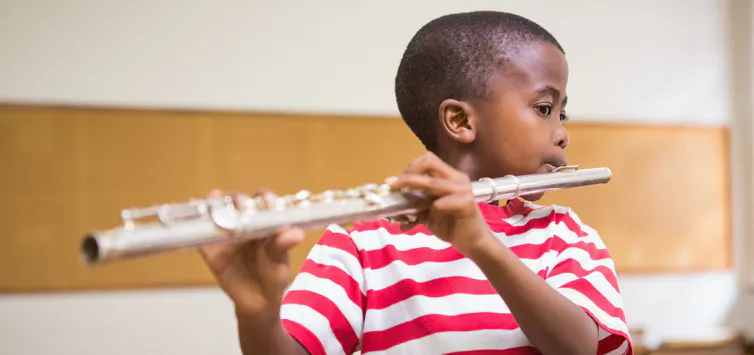
In 2019, surely we are past the days in music class where boys are shunted to drums and trombone while girls are pushed toward flute and choir? Not necessarily so.
In the 1970s, in the United States, Harold Abeles of Columbia University and Susan Yank Porter of Wilmington Public Schools began to study the effects of gender in music education. They found that both children in kindergarten to Grade 5 and adults make gendered associations with musical instruments, and that students and music teachers tend to prefer “gender appropriate” instruments.
They also found from “most feminine to most masculine,” the list looks like this: flute, violin, clarinet, cello, saxophone, trumpet, trombone and drum. Similar findings persist in studies conducted regularly since.
Don’t like ads? Become a supporter and enjoy The Good Men Project ad free
But what is the background here, and what can teachers and parents do to ensure that children are selecting musical activities based on their real desires?
Sounds like gendered history
Historical research shows that gender disparities in music have existed for a long time.
Anecdotally, in my teaching and research career I have found many music students repeat the fallacy “if there were any good women musicians we’d have heard of them.”
Of course, the corollary is that men’s musical activities, though generally broader and more prestigious, are also prescribed and restricted. As far back as the 1930s, the Music Educators Journal published a reflective essay by music teacher Inez Field Damon, “The Boys Who Would Not Sing.” Damon laments her experiences talking with the principal at a school where she’s failing at cajoling boys’ participation. The principal replies:
“You can’t make them sing. They never sing. They are heavy in everything.”
Closer to our own times, sociology of arts scholar Clare Hall of Monash University in Australia examines the “missing male” trend in singing at school. She finds that far fewer boys joining choirs or willing to sing likely finds its origins in very early childhood.
Do gendered associations with music, such as the drums being considered more ‘male,’ still influence today’s music classrooms? lindsey bahia/unsplash, CC BY
There are two approaches aimed toward greater gender equity in music education — which could also be adapted to combat gender inequity in other human endeavours — which really must be used in concert. These are known as compensatory practices and challenging practices.
Compensatory practices aim to fill in some gaps related to music history. Rather than just studying dead white European men, music educators must consciously and purposefully include women of diverse cultures or backgrounds in the story.
And, for those who scoff that we can’t just not study Beethoven, I say, “Of course we study Beethoven! He’s pretty good. But, we don’t privilege Beethoven’s work as inherently more important or a as product of musical genius exclusive to men.”
Role models
Compensatory practices used alone are not enough. Filling gaps is necessary, but alone, compensatory practices don’t take steps to combat continued gendering in music. Some challenging practices that interrupt the formation of gender stereotypes are needed. One of the most effective is providing students with a variety of musical examples or role models.
Exposing students to images of both male and female musicians playing varied instruments or in varied musical roles has been shown to be effective. But beware, because simply showing what might be thought of as counter-examples (only girls playing drums, for instance) runs the risk of creating an equally strong gender bias shifted from the prevalent one.
Any lifelong musician can tell you the benefits of making music. We talk about enhancing self-esteem and self-regulation, building community and enhancing academic achievement among the benefits. But let’s not forget the joy and needed self-expression that music making also brings.
It’s a shame when children miss out on these many benefits either because somebody pushes them in the wrong direction because of who or what they appear to be, or because encouragement and efforts to break down stereotyping are lacking or ineffective.
We are proud of our SOCIAL INTEREST GROUPS—WEEKLY PHONE CALLS to discuss, gain insights, build communities— and help solve some of the most difficult challenges the world has today. Calls are for Members Only (although you can join the first call for free). Not yet a member of The Good Men Project? Join below!
All levels get to view The Good Men Project site AD-FREE.
Register New Account
Please note: If you are already a writer/contributor at The Good Men Project, log in here before registering. (Request a new password if needed).
◊♦◊
ANNUAL PLATINUM membership ($50 per year) includes:
1. AN ALL ACCESS PASS — Join ANY and ALL of our weekly calls, Social Interest Groups, classes, workshops, and private Facebook groups. We have at least one group phone call or online class every day of the week.
2. See the website with no ads when logged in!
3. MEMBER commenting badge.
*** ANNUAL GOLD membership ($25 per year) includes all the benefits above — but only ONE Weekly Social Interest Group and ONE class.
*** ANNUAL BRONZE membership ($12 per year) is great if you are not ready to join the full conversation but want to support our mission anyway. You’ll still get a BRONZE commenting badge, and you can pop into any of our weekly Friday Calls with the Publisher when you have time. This is for people who believe—like we do—that this conversation about men and changing roles and goodness in the 21st century is one of the most important conversations you can have today.
♦◊♦
We have pioneered the largest worldwide conversation about what it means to be a good man in the 21st century. Your support of our work is inspiring and invaluable.
—
The Conversation is an independent news and commentary website produced by academics and journalists, free for the public. Follow on Twitter @CA_conversation