



On Twitter, conservative shitposter @RogueWPA writes (over several tweets):
About 5-10 years ago I noticed on sociology blogs and sociology twitter, people would occasionally object to describing statistical associations with race on grounds that a beta for race is really a racism effect. “Your race effect is really a structural racism effect” always struck me as a reasonable speculation for the conclusion, but too theory-laden for the results section if you didn’t actually measure and demonstrate mediation via racism. Yet in Ghio et al JAMA Surgery (2023) [link], they *did* measure plausible indicators for structural racism (Gini for income inequality and an entropy index for segregation), found no effect of these indicators, and still put “structural racism” in the fucking title. It’s as if a Calvinist medical journal published an article on “Association Between Signs of Election and the Industrial Revolution” that showed church membership predicted factories but there was no effect on factories from profession of faith or disciplined Christian behavior.
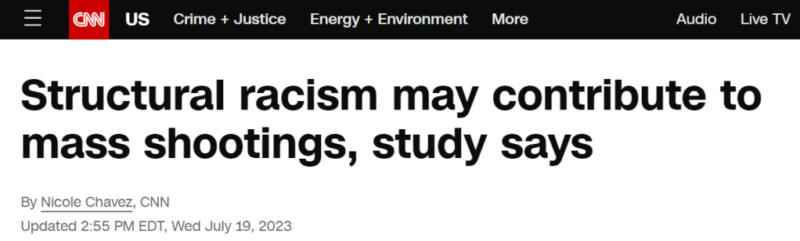
The study in question was written up by CNN as, “Structural racism may contribute to mass shootings, study says.”
The study used data on mass shootings (4 or more victims) in 51 metro areas, and reported the association between mass shootings per capita and a number of demographic variables: Black-White residential segregation index, unemployment rate, poverty rate, high school graduation rate, population 25 years and older with a bachelor’s degree, population percent Black, children in a single-parent household, violent crime rate, and Gini coefficient of income inequality. Specifically, the consider residential segregation and population percent Black to be “measures of structural racism.” The latter of these is what RogueWPA is objecting to — it’s just a measure of Black population size, not racism. In bivariate correlations, many of these variables had significant associations with mass shootings, including both segregation and percent Black.
After some statistical machinations, they decided to enter just five of these into a multivariate linear regression model: segregation, single-parents, violent crime, percent Black, and Gini. In that model, only percent Black had a statistically significant association with mass shootings per capita.
So, is CNN’s headline right? My answer is below. But first, on the crux of the matter, in their limitation section (RogueWPA would be delighted to see) Ghio et al. write:
Lastly and most importantly, measures of structural racism used in this study and other peer-reviewed articles are imperfect and cannot fully encompass hundreds of years of structural racism in the United States. Particularly, we acknowledge that percentage of a population comprising Black individuals is an imperfect marker despite its use throughout the literature and observation that it is frequently the consequence of decades of racist practices. Of note, particularly in context of this study’s analysis of MSEs [mass shooting events] in major metropolitan areas, a growing body of research shows that racial residential segregation practices are predictive of various types of shootings, in much the same way they predict poorer health outcomes, and are independent of other factors such as economic status and education. As discussed above, previous research has shown that other factors play a role, such as Black-White segregation index, but in our analysis, these were not significant. This is likely because of the complex relationships that exist in dynamic environments and urban communities that drive these MSEs.
My answer is the CNN headline is wrong. The study is reasonable, but the conclusion — based on the weaker of two measures, in a crude cross-section — is not headline-worthy. (In particular, the control for violent crime rate makes the population percent Black finding most important.) Anyway, think about it this way, if the authors of the study had framed it a little differently, the headline from the same result could have been, “Study finds the presence of Black people contributes to mass shootings.” That would seem kind of racist. On the other hand, if the outcome were lead poisoning, air quality, or something else you couldn’t attribute to individual behavior, the same result could be written up as, “Structural racism may contribute to poor health outcomes,” and we would be having a slightly different argument.
But to RogueWPA’s main complaint: Is Black population size an “imperfect marker” of “structural racism,” and are sociologists nowadays wrong to consider “race” as a proxy for “racism”? Deadric T. Williams, who writes a lot about this, recently said this: “Too many scholars want racism to be a tangible, measurable thing. History tells us that racism is a process. The best ‘proxy’ for racism is racial categorization. Instead, y’all reduced it to a ‘demographic variable.’”
Language is a virus, and it has mutated quite a bit in this area in the last 25 years. As I’m not in the middle of it now I don’t have an answer to this question (although clearly a measure of racial composition alone isn’t the state of the art in quantitative studies). However, I did write about it a lot once upon a time, in the heady Bonilla-Silva 1997 era. This is the last paragraph of my dissertation, completed in 1999, which if push comes to shove I still endorse:
Larger relative Black population size means more ”race” in the local economy, and more ”racial” inequality by definition. The basic question asked in this project has therefore been, is more ”race” good or bad for White and Black men and women at the individual level, and whom does Black-White inequality help or hurt in what ways? The unmistakable conclusion from these results is that when the Black population is larger, Black-White inequality is more salient, and more important relative to class and gender inequality. By what mechanism exactly this process develops has not been demonstrated, but I have shown in a consistent set of models that it applies to a series of labor market outcomes, and across gender and class groups – as well as within and across variation in individual-level characteristics besides racial-ethnicity. These results are consistent across distinct labor market outcomes, suggesting a depth and breadth to the relationship that has not previously been demonstrated. Black-White inequality again appears pervasive and structural to the U.S. system of social stratification.
My dissertation is available here, and articles based on it are here and here.
For the ongoing exploration and debate about structural racism, especially regarding health, here are a few recent articles (feel free to suggest more in the comments):
- Braveman, P. A., Arkin, E., Proctor, D., Kauh, T., & Holm, N. (2022). Systemic and structural racism: Definitions, examples, health damages, and approaches to dismantling. Health Affairs, 41 (2), 171–178
- Brown Tyson H., and Patricia A. Homan. Frontiers in measuring structural racism and its health effects. Health Serv Res. 2022 Jun;57(3):443-447. doi: 10.1111/1475-6773.13978.
- Dean, Lorraine T., and Roland J. Thorpe Jr. 2022. “What Structural Racism Is (or Is Not) and How to Measure It: Clarity for Public Health and Medical Researchers.” American Journal of Epidemiology 191(9):1521–26. doi: 10.1093/aje/kwac112.
- Hardeman, R. R., Homan, P. A., Chantarat, T., Davis, B. A., & Brown, T. H. (2022). Improving the measurement of structural racism to achieve antiracist health policy. Health Affairs, 41 (2), 179–186
- Wien, Simone, Andres L. Miller, and Michael R. Kramer. 2023. “Structural Racism Theory, Measurement, and Methods: A Scoping Review.” Frontiers in Public Health 11.
—
Previously Published on familyinequality with Creative Commons License
***

Join The Good Men Project as a Premium Member today.
All Premium Members get to view The Good Men Project with NO ADS.
A $50 annual membership gives you an all access pass. You can be a part of every call, group, class and community.
A $25 annual membership gives you access to one class, one Social Interest group and our online communities.
A $12 annual membership gives you access to our Friday calls with the publisher, our online community.
Register New Account
—
Photo credit: iStock

