


—
The U.S. Marine Corps is one of the most well-known and respected branches of the United States military. The Marine Corps flag is recognized worldwide, and its soldiers are often referred to as some of the world’s toughest and most skilled fighters. This elite military branch has a long and storied history, dating back to its founding in 1775.
While many people are familiar with the basics of the U.S. Marine Corps, some lesser-known facts and details may surprise you. This article will explore some interesting and perhaps unknown aspects of the U.S. Marine Corps.
Marines Affix Their Next Promotable Rank onto Their Uniforms as a Source of Motivation
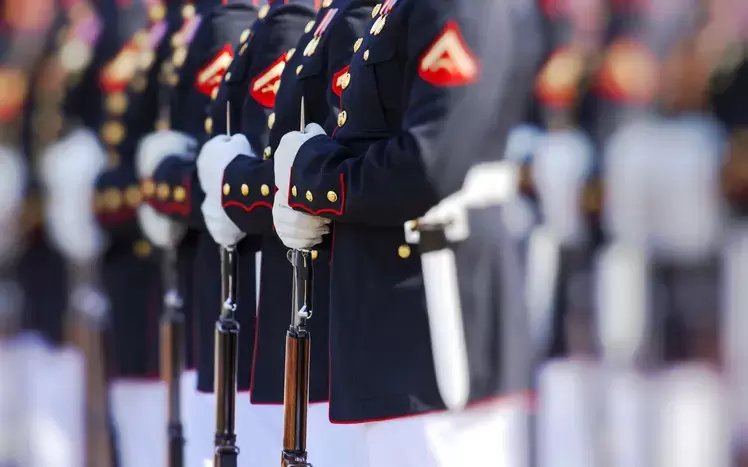
To maintain high levels of motivation and drive, Marines sometimes pin the insignia of their next promotable rank onto their uniforms. This practice is a constant visual reminder of their aspirations and the commitment required to achieve the next level. It fosters a goal-oriented mindset and encourages Marines to embody the qualities and responsibilities of the higher rank even before officially attaining it. This tradition can boost morale, instill discipline, and inspire a sense of purpose, all essential components in the rigorous life of a Marine.
The Marine Corps’ First Amphibious Raid Occurred Just Weeks After Its Inception
Incredibly, just a few weeks after establishing the U.S. Marine Corps in November 1775, these newly formed soldiers undertook their first amphibious raid. This historic event took place in early 1776, showcasing the Marines’ capacity for rapid deployment and operational readiness from the very beginning.
The raid targeted the British-held island of New Providence in the Bahamas to seize vital military supplies, particularly gunpowder and ammunition. The success of this mission highlighted the Marines’ strategic prowess and laid the groundwork for their distinguished legacy in amphibious warfare. It was an early demonstration of their adaptability, courage, and skilled execution in challenging conditions.
The Marines’ First Overseas Land Battle Took Place in Libya
The first instance of the U.S. Marines fighting on foreign soil occurred in the early 19th century in Libya. Known as the Battle of Derna, this engagement occurred during the First Barbary War in 1805. The Marines, alongside a mixed force of mercenaries and local allies, launched an assault against the fortified city of Derna to rescue American hostages and confront the Barbary pirates who had been preying on American ships. The successful capture of Derna was a watershed moment, demonstrating the Marine Corps’ ability to project power far from home.
Female Marine Corps Recruits Exclusively Train at MCRD Parris Island
Female recruits in the Marine Corps have a single location where they undergo their basic training, known as Marine Corps Recruit Depot (MCRD) Parris Island. Unlike their male counterparts, who may train at either MCRD Parris Island or MCRD San Diego, all female enlistees are sent exclusively to Parris Island.
This centralized training site ensures consistency in the training program and allows for a focused approach to developing the skills and discipline required of Marine Corps members. The environment at Parris Island is designed to be both physically and mentally challenging.
Marines Frequently Train with International Partners from over 15 Nations
The U.S. Marines routinely engage in joint training exercises with military forces from over 15 countries worldwide. These multinational exercises are crucial for fostering cooperation and enhancing the interoperability between the U.S. Marines and their international partners. Training with diverse forces allows Marines to share tactics, techniques, and best practices, improving their readiness for various global missions. These collaborative efforts strengthen military alliances and contribute to a more unified approach to addressing complex security challenges worldwide.
U.S. Marines Find Time to Relax While Training with Allied Forces
In addition to their rigorous training routines, U.S. Marines also take opportunities to relax and socialize during joint exercises with allied military forces. These moments of downtime are essential for building camaraderie. Such interactions humanize the training experience and contribute to stronger, more cohesive partnerships that extend beyond the battlefield. By balancing disciplined training with recreational activities, Marines and their allies can develop mutual respect and trust, essential for effective collaboration in global missions.
Marines Achieve Outstanding Success at Warrior Games
The Marines have exceptionally won four of the last five Warrior Games competitions. These victories highlight Marine athletes’ determination, resilience, and superior athletic skills. The Warrior Games, a multi-sport event for wounded, ill, and injured service members and veterans, provides a platform for these warriors to showcase their abilities and competitive spirit. The consistent success of the Marines at these games underscores their dedication to excellence and their ability to triumph over adversity.
Marine Recruits Must Stop Eating as Soon as Their Drill Instructor Finishes
In Marine training, recruits must cease eating the instant their drill instructor has finished their meal. This practice instills a sense of urgency, discipline, and attentiveness in recruits. It also reinforces the importance of hierarchy and respect within the corps, teaching recruits to promptly follow orders and maintain a sharp focus at all times. This seemingly simple rule is integral to the rigorous training regimen that transforms civilians into disciplined Marines.
Final Thoughts
These facts only scratch the surface of the wide-ranging and exceptional training that Marines undergo. From intense physical conditioning to specialized combat techniques, Marines are constantly honing their skills and pushing themselves to be their best. But beyond the rigorous physical demands, Marine training also instills values that go far beyond the battlefield. Values such as honor, courage, commitment, and selflessness are woven into every aspect of their training.
—

