


—
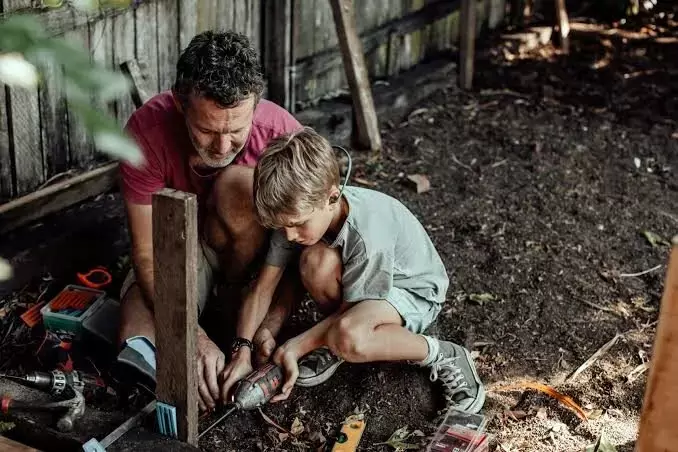
My father taught me to change a tire in a parking lot on a Saturday morning when I was twelve. He didn’t make a lesson plan. He just handed me the lug wrench and told me to figure out which way loosened and which way tightened. I got it wrong the first time. He didn’t take over. He waited.
That afternoon became one of the clearest memories I have of him — not because of the tire, but because of what it felt like to be trusted with something real.
Home maintenance doesn’t get the same cultural attention as the big emotional conversations we’re supposed to have with our kids. But there is something deeply formative about teaching a child to look at a broken thing and know what to do. It builds competence, and competence builds confidence, and confidence is something you carry with you long after you’ve left the house you grew up in.
Here are seven skills worth passing on — not as a curriculum, but as an invitation to learn something alongside your kids.
1. How to Check for Leaks — And Why Early Detection Matters
Water is patient. It will find every gap, every crack, every imperfection in a structure, and it will use them — slowly, quietly, and usually invisibly until the damage is done. Teaching your child to look for the early signs of a leak is one of the most valuable home skills you can give them.
Show them what efflorescence looks like — the white powdery mineral deposits that form on basement walls when water is migrating through the concrete. Show them water staining along the base of walls, the rust marks around floor drains, the way paint bubbles when moisture is trapped behind it. Explain that these aren’t just cosmetic issues — they’re the home telling you something is wrong before it becomes a crisis.
The team at Direct Basement Waterproofing in Hamilton regularly encounters homeowners who noticed the signs months before calling — and waited. Teaching your child to notice early, and to act on what they notice, is a form of financial literacy as much as it is home care.
2. How to Clean Gutters and Why It Matters More Than It Seems
Gutter cleaning is unglamorous enough that most people put it off until something goes wrong. Which is exactly why it’s such a good teaching opportunity — it’s a concrete example of the relationship between small, boring maintenance and large, expensive consequences.
Get your kid up on a ladder with you. Show them how leaves and debris pack down over time and create blockages that force water to overflow directly against the foundation of the house instead of away from it. Show them what a properly flowing downspout looks like, and where the water should discharge — at least six feet from the foundation wall.
Talk about why it matters. A clogged gutter during a heavy rainstorm can deliver thousands of litres of water against a foundation in a matter of hours. This is one of the most common causes of basement water damage — and one of the most preventable.
3. Understanding Drainage — The Invisible System Protecting Your Home
Most people have a vague idea that their home has some kind of drainage system. Very few understand how it actually works. Teaching your child the basics — surface grading, downspout routing, weeping tile, sump pumps — gives them a mental model of the house that most adults never develop.
Start with grading: walk the perimeter of your home with your child and look at how the soil slopes. Does it run toward the house or away from it? Water follows gravity, and if the ground around the foundation is flat or sloping inward, every rainstorm is sending water directly toward the foundation.
Then introduce the concept of weeping tile — the perforated drainage pipe that runs around the base of the foundation, collecting groundwater and directing it away from the structure. Most kids have never heard of it. Most adults haven’t either. Show them where your sump pump is and explain what it does: it collects the water that makes it through the drainage system and pumps it out before it can rise to floor level.
4. How to Spot Moisture Damage Before It Becomes Structural
This skill overlaps with leak detection, but it goes deeper — and it applies everywhere in the house, not just the basement.
Teach your child to look at wood framing for dark staining or softness that indicates rot. Show them how to check around window frames for paint that has separated from the sill — a sign that water is getting behind it seasonally. In the basement, show them what a horizontal crack in the foundation wall means (lateral soil pressure) versus a vertical crack (normal settling, but potentially a water entry point).
The skill being taught here isn’t just home maintenance — it’s observation. It’s learning to look at a surface and ask what’s behind it, what might be happening that you can’t see, what the small visible signal is telling you about the larger invisible condition.
5. How to Operate and Maintain a Sump Pump
A sump pump is one of the most important and most neglected systems in a house with a basement. Most homeowners discover their sump pump for the first time when it fails during a storm.
Show your child where it is, what the pit looks like, and how to test it: pour water slowly into the pit until the float rises and the pump activates. Listen to it run. Make sure the discharge line is clear and the water exits well away from the foundation.
Talk about battery backup — explain that the most common scenario for sump pump failure is a power outage during a heavy storm, which is precisely the moment when the pump is needed most. A battery backup system means the basement stays dry even when the power goes out.
Maintenance is simple: test it twice a year, clean the pit of debris annually, check the discharge line for obstructions or ice in winter. This is a 20-minute task that prevents a potentially catastrophic failure. Teaching your child to do it is teaching them to maintain a system they’ll likely own in their own home someday.
6. How to Read Your Home and Know When Something Is Wrong
Beyond any specific skill is the broader capacity to read a home — to notice when something has changed, when a smell is new, when a sound is different, when a surface looks different than it did six months ago.
This is something you model rather than teach directly. It comes from walking through your house with attention rather than habit, from treating the building as something that communicates rather than something you simply live inside.
Encourage your child to notice. Ask them questions when you’re doing routine maintenance: does this crack look the same as last time? Does it smell different down here than it did in spring? Why do you think there’s a watermark here but not over there?
The goal isn’t to create anxiety about the house — it’s to create a relationship with it. Homes that are paid attention to tend to stay in better shape, partly because problems are caught early and partly because attentive owners respond faster when something changes.
7. Knowing When to Call a Professional — And How to Choose One
This might be the most underrated skill on the list. There is real value in doing things yourself, and there is also real value in knowing the limit of what you should do yourself. Teaching your child to distinguish between the two is genuinely useful.
Frame it this way: the goal is to solve the problem correctly, not to prove you can do it without help. A horizontal foundation crack is not a DIY project. Active water intrusion in a basement is not a caulk-and-paint situation. Structural issues require structural assessment.
When it is time to call a professional, show your child how to evaluate one: ask for licence and insurance documentation, look for reviews that span multiple years, get written quotes with itemized scope, ask about warranty terms. Teach them that the cheapest quote is not always the best quote, and that a contractor who pressures them to decide immediately is a contractor worth walking away from.
The skills a father passes down are rarely just about the subject matter. They’re about the posture — the way you approach a problem, the patience you bring to figuring something out, the judgment to know what you can handle and when to ask for help. Those are the things that follow a child out of the house and stay with them.
The lug wrench was never just about the tire.
—

