


—
Picture a Saturday morning trailhead. The conversation is familiar — stiff joints, longer recovery times, rides that have quietly gotten shorter over the past few years. Then one man in the group mentions he rode 40 miles last weekend and is already planning something longer next month. He’s not the youngest there. He’s not trying to prove anything. He simply never found a reason to stop — partly because of the sport itself, and partly because he made one specific upgrade at the right moment.
That’s the pattern worth paying attention to.
Why Cycling Specifically Outlasts Every Other Outdoor Sport After 50
Of all the activities men pursue seriously through their 30s and 40s — skiing, trail running, team sports, high-intensity hiking — cycling shows up most reliably in the lives of men still genuinely active at 65, 70, and beyond. The reason is structural, not motivational.
A large-scale study published in Medicine & Science in Sports & Exercise, drawing on the Osteoarthritis Initiative and tracking 2,607 participants aged 45 to 79, found that people with a history of regular cycling were 17% less likely to report frequent knee pain and 21% less likely to develop symptomatic knee osteoarthritis compared to non-cyclists. The effect was cumulative — the more life periods a person cycled, the greater the protection.
That’s not a marginal difference. And it points directly at why cycling holds up when other high-output activities start building consequences: it’s a non-load-bearing sport. Where running places repetitive impact on joints with every stride, cycling distributes effort across the lower body with virtually none of that shock. The cartilage, the hip socket, the lower back don’t pay the same cumulative bill.
Add to this that cycling is almost infinitely self-regulating — no fixed pace to perform at, no opponent to outrun, no team relying on your peak output — and you have a sport that adapts naturally across decades in a way most others simply don’t.
The Ceiling Nobody Talks About
Here’s what experienced cyclists rarely say out loud: the sport has a ceiling, and it arrives quietly.
It starts looking like caution. The ambitious route gets bookmarked instead of ridden. The climb that used to be one segment of a longer day starts to feel like a full commitment. You find yourself calculating return energy before you’ve even left — not because you’re injured, but because “do I have enough left to get back?” has stopped having a comfortable answer.
Recovery takes longer. That’s real, and most men in their 50s who’ve stayed active know this and refuse to use it as an excuse — but it changes what’s possible on any given weekend. The question isn’t whether to keep cycling. It’s whether the specific way you’ve been cycling can keep scaling with you.
For most men, that answer quietly becomes: no. Rides get shorter. Plans grow more conservative. The route from a few years ago stays on the map but never makes it to the calendar.
The men still out there at 70 didn’t avoid this ceiling. They found a different way through it.
The Upgrade, Not the Exit
An e-bike doesn’t replace what cycling is. It extends what cycling can be.
That distinction matters, because the instinctive reaction — “that’s cheating” or “that’s for people who can’t actually ride” — misunderstands what the motor does. It doesn’t do the work instead of you. It covers the deficit. Your effort still counts. The motor closes the gap between what your body can sustain today and what the route actually demands.
In practice, what changes is the size of the question you’re asking before you ride. Routes that require careful energy budgeting become rides you simply plan. Climbs that used to cost two days of recovery shrink to one segment of something longer. Keeping pace with friends ten or fifteen years younger stops being a negotiation with your own limits.
For riders at the point where cycling’s natural ceiling has started to feel real, the upgrade isn’t a compromise — it’s what allows the sport to continue on your terms. For anyone starting to explore what’s available, fat-tire e-bike is a useful first step. The differences between models matter more than they appear from the outside.
What to Actually Look For
Not every e-bike extends what’s possible equally. Four things consistently separate models that genuinely open up range and terrain from those that simply add weight to the ride.
Range is the most immediate variable. At 65 miles of real-world range, planning becomes about destination rather than battery math. Below that, the anxiety just shifts from physical to electrical — a different problem, same constraint.
Full suspension — front fork and rear linkage together — is not a comfort upgrade. It’s the cumulative-impact equation across a four-hour ride. For anyone whose knees or lower back have started registering opinions, a rear suspension system that absorbs what rough terrain sends is a functional choice, not a luxury.
All-terrain tires in the 4.0-inch fat range mean the ride stops being defined by pavement. Gravel, hardpack, light trail — the geography expands when the bike can handle what’s actually out there.
Assist intelligence — specifically a mode that responds dynamically to pedaling effort, adding power on climbs and easing back on flats without requiring manual gear management — keeps the experience feeling like cycling, not operating machinery. That distinction is what makes the upgrade feel continuous with the sport, not separate from it.
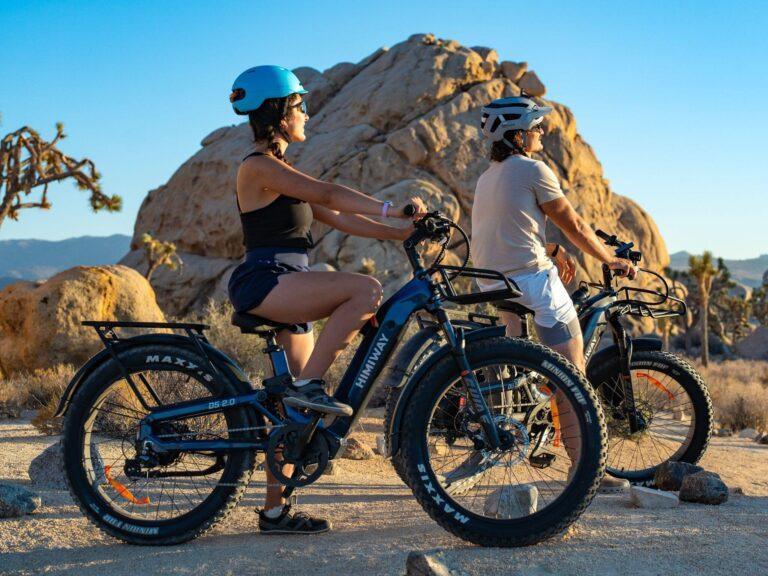
A model like the Himiway D5 2.0 ST addresses all four: 65 miles of range, full front-and-rear suspension, Maxxis 4.0-inch all-terrain tires, and an automatic assist mode built to adjust without interrupting the ride. For riders at the point where the upgrade makes sense, it’s worth a close look.
The Question That’s Actually Worth Asking
The men still riding at 70 didn’t stumble into it. Somewhere in their 50s, they made a specific decision — not to quit the thing they loved, but to change how they pursued it. They upgraded the tool before the ceiling became the endpoint.
The question worth sitting with isn’t “what can I still do at 50?” That question has a built-in limit. The better one is: What am I building the habit of doing at 70?
The answer you choose now determines whether you’re still at that trailhead then.
—
This content is brought to you by Oliver Hayes
Photo provided by the contributor.

