



—
Introduction: What Is a Rubber Tube?
A rubber tube is a flexible, hollow cylindrical component made from natural or synthetic rubber, designed to carry fluids, gases, or provide structural support across a remarkable range of applications. From the simple garden hose connection in your backyard to the precision tubing inside a blood pressure monitor, rubber tubes are quietly essential to everyday life in ways most people never stop to consider.
What makes rubber tubing so widely useful is its combination of properties that few other materials can match simultaneously — flexibility, durability, chemical resistance, and the ability to maintain a seal under pressure or vacuum. Rubber tubes stretch, bend, and compress without cracking, which makes them ideal in dynamic environments where rigid piping would fail.
This guide covers everything you need to know about rubber tubes: the different types and materials available, where to buy them, how much they cost, what they are used for across dozens of industries and hobbies, how to repair and maintain them, and how to choose the right tube for your specific application. Whether you are fixing a leaky drain, building a slingshot, sourcing tubing for a laboratory, or importing rubber products internationally, this guide has you covered.
Types and Materials of Rubber Tubes
Natural Rubber vs. Synthetic Rubber Tubes
Natural rubber, also known as latex rubber, is derived from the sap of the Hevea brasiliensis tree. It offers excellent elasticity, high tensile strength, and good abrasion resistance. Natural rubber tubes are widely used in medical applications, laboratory equipment, and general-purpose fluid transfer. However, natural rubber has limitations — it degrades with exposure to oils, ozone, UV radiation, and extreme temperatures, and it can trigger latex allergies in some individuals.
Synthetic rubber tubes have been developed specifically to overcome these weaknesses. The most common synthetic options include EPDM, neoprene, and nitrile.
EPDM (Ethylene Propylene Diene Monomer) rubber offers outstanding resistance to weathering, ozone, UV exposure, steam, and water. It handles temperatures ranging from roughly -40°C to 150°C, making it a top choice for outdoor plumbing, automotive cooling systems, and HVAC applications. However, EPDM performs poorly when exposed to petroleum-based oils and fuels.
Neoprene rubber provides a balanced combination of oil resistance, weather resistance, and moderate temperature tolerance. It handles both petroleum products and water reasonably well, which makes it popular in marine environments, refrigeration systems, and applications where the tubing may contact both oil and moisture.
Nitrile rubber (NBR) is the go-to choice when petroleum resistance is the top priority. Nitrile tubes resist oils, fuels, greases, and many hydrocarbons effectively. They are commonly used in automotive fuel lines, hydraulic systems, and industrial oil transfer applications. The trade-off is that nitrile has relatively poor weather and ozone resistance compared to EPDM.
Choosing between these materials is primarily a matter of matching the chemical environment and temperature range of your application to the resistance properties of the rubber compound.
Rubber Tube vs. Silicone: Key Differences
Silicone tubing is technically not rubber in the traditional sense — it is a synthetic elastomer based on silicon rather than carbon. However, it competes directly with rubber tubing in many applications and is worth understanding as an alternative.
Silicone tubing handles extreme temperatures far better than most rubber compounds, maintaining flexibility and integrity from approximately -60°C to 220°C. It is physiologically inert, meaning it does not leach compounds into fluids passing through it, which makes it the preferred choice for food processing, pharmaceutical manufacturing, and medical devices where contamination is a critical concern. Silicone is also highly transparent, allowing visual monitoring of flow, and it resists UV and ozone degradation extremely well.
The reasons to choose rubber over silicone come down to cost, chemical resistance, and mechanical properties. Silicone tubing is significantly more expensive than most rubber alternatives. Silicone also has poor resistance to petroleum-based oils and solvents — nitrile rubber far outperforms silicone in fuel and oil applications. Rubber tubing generally offers better abrasion resistance and tear strength for applications involving friction or mechanical stress.
In summary, silicone is the better choice for high-temperature, medical, food-grade, or pharmaceutical applications where purity and temperature range matter most. Standard rubber tubing is better for cost-sensitive, oil-exposed, mechanically demanding, or general-purpose applications.
Common Rubber Tube Sizes and Dimensions
Rubber tubes are specified by three key measurements: inner diameter (ID), outer diameter (OD), and wall thickness. Inner diameter is the most important measurement for flow applications because it determines how much fluid the tube can carry. Outer diameter matters when the tube must fit inside a connector, clamp, or housing. Wall thickness determines the tube’s pressure rating and how stiff it feels.
Common rubber tube sizes include 1/4 inch ID, 5/16 inch ID, 3/8 inch ID, 1/2 inch ID, 5/8 inch ID, and 3/4 inch ID for imperial sizing. In metric, standard sizes include 4mm, 6mm, 8mm, 9mm, 10mm, 12mm, 16mm, 19mm, and 25mm ID. Large diameter tubes for industrial use can range from 32mm up to 100mm or more.
Wall thickness in standard utility tubing typically runs from 1.5mm to 3mm for light-duty applications, 3mm to 6mm for medium-duty work, and 6mm or greater for heavy-duty pressure applications. To measure an existing tube, use a caliper to measure the ID directly if the tube is cut, or measure the OD and the wall thickness separately and calculate ID as OD minus twice the wall thickness.
Where to Buy Rubber Tubes
Rubber Tube at Home Depot
Home Depot stocks a solid range of rubber tubing in its plumbing and hardware sections. You will typically find standard utility rubber hose in 1/4 inch through 3/4 inch ID sizes, available by the foot from a spool or in pre-cut lengths. Pricing at Home Depot generally runs from around $0.50 to $2.00 per foot for standard rubber tubing, with specialty compounds or larger diameters priced higher. Home Depot is a good source for general-purpose drain connections, appliance repair, and outdoor plumbing applications.
Rubber Tube at Lowes
Lowes carries a similar selection to Home Depot with a slightly stronger emphasis on plumbing supply and automotive repair products. You will find rubber fuel line tubing, vacuum line tubing, and general utility hose in standard sizes. Lowes also stocks flexible coupling and connector products that pair with rubber tubing for drain and waste line repairs. Prices are comparable to Home Depot, making either store a convenient choice depending on your location.
Rubber Tube at Walmart
Walmart offers rubber tubing primarily through its automotive and hardware sections, with an emphasis on budget-friendly multipacks and general-purpose tubing. You are likely to find economy-grade rubber and vinyl tubing in standard sizes at prices lower than specialty hardware stores. Walmart is a practical option for small projects, household repairs, and applications where the chemical or temperature demands are modest. Larger or specialty sizes may be harder to find in store but are often available through Walmart’s online marketplace.
Rubber Tube at Bunnings (Australia and New Zealand)
Bunnings Warehouse is the dominant hardware retailer in Australia and New Zealand and stocks a broad range of rubber tubing for both DIY and trade use. Products available include rubber sleeve tubing for pipe insulation and protection, general utility hose, and specialty rubber products for plumbing and automotive applications. Mitre 10 is the other major alternative in the Australian market and carries a comparable range, particularly in rural and regional areas where Bunnings coverage is thinner.
Rubber Tube Near Me: Local and Online Retailers
To find rubber tubing locally, the most effective approach is to use the store locator tools on the websites of major hardware chains and check whether the specific size and type you need is in stock at nearby locations. For specialty compounds like EPDM, nitrile, or neoprene, local industrial supply companies such as Grainger, McMaster-Carr, or Fastenal are more likely to stock them than general hardware retailers.
Online marketplaces including Amazon and eBay offer perhaps the widest selection of rubber tube sizes, materials, and lengths available anywhere. Amazon in particular is useful for finding metric sizes, specialty compounds, and longer lengths like 50-foot or 100-foot rolls that may not be stocked locally. When buying online, pay close attention to the material specification — “rubber tube” on a marketplace listing could refer to anything from natural latex to PVC to silicone, and the difference matters enormously for your application.
Specialty Retailers: Ace Hardware, Screwfix, Toolstation, and Kent
Ace Hardware stores in the United States carry a selection of rubber and vinyl tubing for home repair and DIY use, with the advantage of locally owned stores that often provide more personalized assistance than big-box retailers. Screwfix and Toolstation are UK-focused trade suppliers with strong selections of rubber hose and tubing for plumbing, heating, and automotive work, typically at trade pricing. Kent Building Supplies serves Atlantic Canada and carries rubber tubing for general construction and plumbing applications.
Rubber Tube Price and Cost Factors

Rubber Tube Price: Average Costs by Size and Material
General-purpose rubber tubing in standard sizes typically ranges from around $0.50 to $2.00 per foot at retail for light and medium-duty applications. EPDM and neoprene compounds in similar sizes generally run $1.50 to $4.00 per foot. Nitrile fuel and oil line tubing tends to run $2.00 to $5.00 per foot at retail depending on diameter and wall thickness. Silicone tubing costs significantly more, often $3.00 to $10.00 per foot or higher for medical or food-grade grades.
Larger diameter tubing costs more per foot due to the greater material volume involved. Heavy-duty industrial tubing with reinforced walls, braided liners, or specialty compound formulations can cost $10 to $50 per foot or more.
Buying in longer rolls reduces the per-foot cost substantially. A 50-foot roll of standard rubber tubing will typically cost meaningfully less per foot than buying the same material in 1-foot increments.
Factors Affecting Rubber Tube Price
Several variables drive rubber tubing price beyond just size and material. Wall thickness affects material volume and pressure rating, and thicker walls cost more. Reinforcement adds cost — tubes with braided fiber, wire, or fabric reinforcement cost more than unreinforced tubing but handle higher pressures. Certifications also carry a price premium: food-grade, medical-grade, or NSF-certified tubing costs more than uncertified commodity tubing because of the additional testing, documentation, and production controls required.
Custom manufacturing — non-standard dimensions, special colors, or proprietary compound formulations — adds significant cost due to the tooling, setup, and minimum order quantities involved. For standard catalog sizes from stock, prices are much more competitive.
Rubber Tube GST Rate and HSN Code (India)
In India, rubber tubes are classified under HSN (Harmonized System of Nomenclature) code 4009, which covers tubes, pipes, and hoses of vulcanized rubber other than hard rubber. The specific subheading depends on whether the tubing is reinforced or combined with other materials. Under the Indian GST framework, rubber tubing and hoses generally attract an 18% GST rate, though this can vary based on specific product classification and end use. Businesses importing or exporting rubber tubing in India should verify the current applicable HSN subcode and GST rate with a customs broker or tax advisor, as classifications and rates are subject to revision.
Common Uses of Rubber Tubes
Household and DIY Applications
Rubber Tube for Water and Drainage
Rubber tubing is one of the most common solutions for flexible water connections in household plumbing. It is used to connect appliances like dishwashers and washing machines to supply lines, to create flexible drain connections under sinks where rigid pipe alignment is difficult, and to link aquarium equipment like filters and pumps. For outdoor use, rubber hose handles the movement and thermal expansion that rigid pipe cannot accommodate. In drainage applications, flexible rubber tubing allows connections at awkward angles and absorbs vibration that would eventually crack rigid plastic fittings.
Rubber Tube for Repair and Maintenance
Rubber tubing plays a central role in tire and tube repair. Bicycle inner tubes are themselves rubber tubes, and patch kits for repairing punctures use rubber patches bonded with rubber cement. The repair process involves roughing the damaged area, applying vulcanizing cement, pressing a rubber patch over the hole, and allowing it to cure. For automotive tires with inner tubes — less common today but still used on many motorcycles, bicycles, and agricultural equipment — the same patching principle applies. A well-executed rubber tube patch on a clean surface can last the life of the tube.
Rubber Tube for Sealing and Insulation
Foam rubber tubing is widely used as a door and window seal, fitting into channels around door frames to prevent drafts, moisture, and insects from entering. Under-door seals made from rubber tubing provide a flexible barrier that conforms to uneven floor surfaces. Rubber tubing also serves as pipe insulation in both hot and cold water systems — closed-cell foam rubber tube insulation prevents condensation on cold pipes and reduces heat loss from hot water lines. As a gasket material, rubber tubing can be cut to length and compressed between mating surfaces to form a watertight or airtight seal.
Automotive and Mechanical Uses
Rubber Tube for Brake Bleeding and Exhaust
Brake bleeding — the process of purging air from hydraulic brake lines — requires a short length of rubber tubing that fits snugly over the brake bleeder nipple. The tube directs expelled fluid into a catch container and prevents air from being drawn back into the system. Clear tubing is preferred for this purpose so you can visually confirm when clean, bubble-free fluid is flowing. For exhaust applications, high-temperature rubber or silicone tubing is used in flexible couplings and boot connections where the exhaust system transitions through areas subject to vibration and movement.
Rubber Tube for Tire and Valve Systems
Inner tubes for bicycle tires are the most familiar rubber tube application in personal transportation. The tube sits inside the tire casing, holds the compressed air, and bears the inflation pressure that supports the rider’s weight. Valve extensions made from rubber tubing allow inflation of tires in tight spaces where a pump head cannot reach the valve directly. In pneumatic systems and compressed air tools, rubber tubing connects air supply lines to valves and actuators, handling the pressure cycling and vibration that metal fittings alone would eventually crack.
Rubber Tube for Under Car and Vacuum Systems
The underbody of a modern vehicle contains many short sections of rubber tubing serving various functions — emissions control vacuum lines, evaporative canister hoses, coolant overflow tubing, and windshield washer supply lines among them. These tubes deteriorate over time due to heat cycling, ozone exposure, and contact with road chemicals. Vacuum line failure is a common cause of rough idle, poor fuel economy, and check engine lights in older vehicles. Replacing deteriorated rubber vacuum lines is one of the most cost-effective preventive maintenance steps for aging vehicles.
Medical and Laboratory Uses
Rubber Tube for Medical Devices
Medical-grade rubber tubing appears in a wide array of diagnostic and treatment equipment. The inflation bulb and cuff connector in a sphygmomanometer (blood pressure monitor) relies on rubber tubing to transmit pressure from the pump to the cuff and to the pressure gauge. Stethoscope acoustic tubing carries sound from the chest piece to the earpieces. Tourniquets used to constrict blood flow for blood draws or surgical procedures are often made from flat rubber tubing that can be tightened and locked in place. Medical rubber tubing must meet stringent standards for biocompatibility, freedom from extractable compounds, and dimensional consistency.
Rubber Tube for Laboratory and Chemistry Lab
Laboratory rubber tubing is a staple of chemistry and biology labs worldwide, used to connect glassware, direct gas flows, create water seals, and build custom apparatus. In a typical chemistry lab, rubber tubing connects Bunsen burners to gas supplies, links condensers in distillation setups, and creates flexible connections between round-bottom flasks and collection vessels. The tubing must resist the solvents, acids, and bases commonly encountered in lab work, which is why natural latex tubing — despite its limitations — remains popular for its broad chemical compatibility at low cost. For stronger solvents, neoprene or silicone lab tubing is substituted.
Rubber Tube for Nasogastric and Nasal Applications
Nasogastric (NG) tubes are specialized medical rubber tubes inserted through the nose, down the esophagus, and into the stomach for feeding, medication delivery, or gastric decompression in patients who cannot swallow normally. These tubes are manufactured to extremely tight specifications using medical-grade rubber or silicone compounds, with precisely controlled outer diameters, smooth surfaces to minimize tissue trauma, and appropriate stiffness to allow guided insertion. While these are specialized medical devices rather than commodity rubber tubing, they illustrate the medical reliance on rubber tube technology at the critical care level.
Fitness and Exercise
Rubber Tube for Exercise and Workout
Resistance tube training has become one of the most popular forms of portable fitness equipment. Exercise rubber tubes are typically made from natural latex or EPDM rubber and are designed to stretch to several times their resting length under the tension of resistance exercises. They are used for upper and lower body strengthening movements, physical therapy rehabilitation, and as assistance tools for bodyweight exercises like pull-ups. The resistance level is determined by the tube’s diameter and wall thickness — thicker tubes provide greater resistance. Sets of resistance tubes with multiple resistance levels allow progressive training as strength improves.
Rubber Tube for Gym and Stretching
In gym and flexibility training, rubber tubing serves as both a resistance tool and a mobility aid. Stretching straps made from rubber tubing allow users to assist passive stretching of the hamstrings, hip flexors, and shoulders. Physical therapists use rubber tube resistance for low-load, high-repetition rehabilitation exercises that rebuild strength in injured joints without the compressive load of free weights. The portability and low cost of rubber tube exercise equipment make it a common recommendation for home exercise programs and travel fitness routines.
Rubber Tube for Swimming and Pool
In swimming and aquatic training, rubber tubing appears as drag resistance tools, where a harness connected to a rubber tube tethers the swimmer to the pool wall or a fixed point, providing resistance that builds power and technique. Rubber tubes are also used in pool flotation devices and water toy applications, though in these contexts the “tube” is typically a large inflated ring rather than a continuous hollow cylinder.
Sports and Recreational Uses
Rubber Tube for Slingshot and Compound Bow
Slingshot elastic tubing is one of the oldest recreational applications of rubber tubing. The elastic bands on a slingshot are typically round or flat rubber tubes selected for their stretch ratio, rebound speed, and durability under repeated cycling. Natural latex tubing is the traditional choice for slingshot bands because of its exceptional elasticity and energy return. For compound bows, rubber tubing is used as a vibration dampener attached to the bow string or limbs — the rubber absorbs the shock and noise of the shot, reducing both felt recoil and acoustic signature.
Rubber Tube for Water Guns and Toy Projects
Many water gun designs use rubber tubing as the internal plumbing connecting the water reservoir to the pump mechanism and nozzle. The flexibility of rubber tubing allows it to accommodate the moving parts of the pump without creating rigid joints that would crack under the physical stress of use. In DIY toy projects and maker community builds, rubber tubing is a versatile component for creating pneumatic launchers, water rockets, and similar pressure-based devices.
Rubber Tube for Boat and Bike
On boats, rubber tubing serves multiple roles — as fuel line connections, cooling water hoses, bilge pump discharge lines, and as protective bumper material on dock fenders. The marine environment demands excellent weather, UV, and salt water resistance, making EPDM and neoprene the preferred compounds. On bicycles, rubber tubing beyond the inner tube includes handlebar grip covers, cable housing protectors, and frame protection wraps that prevent cable rub marks on the paint.
Craft and Jewelry Making
Rubber Tube for Jewelry and Necklace
Rubber tubing has a long history in jewelry making as a structural component for necklaces, bracelets, and other wearable designs. Hollow rubber tubes serve as the body of cord necklaces, threading systems for beads and pendants, and as a soft, lightweight alternative to metal wire in certain designs. Black rubber tubing is particularly popular in contemporary jewelry for its minimalist aesthetic and comfortable wear against the skin. It can be cut to precise lengths, glued or crimped to metal end caps, and combined with sterling silver, gold, or gemstone elements.
Rubber Tube for Knitting and Textile Crafts
In knitting and crochet, rubber tubing is used as point protectors on needle tips to prevent stitches from sliding off during storage, and as cord connectors in circular knitting needle sets. Some knitters use rubber tubing to create custom cable lengths for interchangeable needle systems. In other textile crafts, rubber tubing appears as a weaving element, as the core material in wrapped cord jewelry, and as a structural component in sculptural fiber art.
Rubber Tube for Glasses Holder and Earring Backs
Small sections of rubber tubing are used as eyeglass retainer grips — the small rubber tubes that slide onto the temples of eyeglasses and attach to a cord or strap to prevent the glasses from falling off during physical activity. In jewelry repair, short sections of rubber tubing cut from fine-diameter tubing serve as improvised earring backs when the original clutch backs are lost. These are functional, temporary solutions that hold earrings securely until proper replacement backs are sourced.
Industrial and Specialized Applications
Rubber Tube for Manufacturing and Extrusion
In manufacturing environments, rubber tubing is used in compressed air distribution systems, vacuum lines, fluid transfer circuits, and as protective sleeving over cables and mechanical components. Rubber tube extrusion is the manufacturing process by which rubber compound is forced through a shaped die to produce continuous lengths of tube in a specified cross-section. Extruded rubber tube can be produced in round, oval, square, D-shaped, or custom profiles depending on the die geometry, making it adaptable to an enormous range of industrial sealing and flow applications.
Rubber Tube for Heavy Duty and Large Diameter
Heavy-duty rubber tubing for industrial applications uses thick walls, reinforced construction, and high-performance rubber compounds to handle the pressures, temperatures, and chemical exposures of demanding environments. Large-diameter rubber tubes — from 50mm up to several hundred millimeters — are used in slurry transfer, mining dewatering, agricultural irrigation, and industrial exhaust ducting. These products are typically sold as hose assemblies with end fittings already attached, rather than as bulk tube, and are specified by pressure rating and temperature range rather than just diameter.
Rubber Tube for Gas, Oil, and Air Applications
Gas and oil service rubber tubing requires careful material selection and adherence to safety standards. Not all rubber compounds are safe for use with flammable gases or petroleum products — using an incompatible tube material in a gas application creates a serious fire and explosion hazard. For natural gas and propane, only tubing specifically rated and certified for gas service should be used. For oil and fuel applications, nitrile rubber is the standard choice. Air shaft applications in printing and converting equipment use inflatable rubber sleeves to grip and hold cylinders and mandrels during operation.
Rubber Tube Connectors and Accessories


Rubber Tube Connectors and Joints
Connecting sections of rubber tubing requires fittings designed to create a leak-free joint while accommodating the tube’s flexibility. Barbed fittings are the most common connector type — a tapered barb on the fitting inserts into the tube end, and the tube’s elasticity grips the barb tightly. For higher-pressure applications or permanent connections, a hose clamp is added over the tube at the barb to increase the pull-out force. Push-to-connect fittings are an alternative that allow quick assembly and disassembly without tools. For joining two sections of the same diameter tubing end-to-end, a straight barbed coupling is used.
Rubber Tube with Clamp and End Caps
Hose clamps are the standard accessory for securing rubber tubes onto fittings and preventing blowoff under pressure. Worm-drive stainless steel clamps are the most common type and provide adjustable clamping force across a range of tube diameters. Spring clamps are used in automotive applications where quick installation and consistent clamping force are prioritized. End caps and plugs for rubber tubing are used to seal open tube ends temporarily during repairs or permanently in dead-end applications. They are available in push-in barbed styles, screw-on styles, and compression-fit styles depending on the tube diameter and pressure requirement.
Rubber Tube for Nozzle and Grip
Short sections of rubber tubing serve as tool handle grips on pliers, screwdrivers, files, and other hand tools, providing insulation, cushioning, and a non-slip surface. The tube is typically slid over the handle and held in place by friction and the slight compression of the rubber against the handle. Rubber tubing is also used as a flexible nozzle extension on spray equipment, allowing directional control of the spray output in tight spaces where a rigid nozzle cannot reach.
How to Choose the Right Rubber Tube
Choosing for Specific Applications
The first step in selecting rubber tubing is defining what the tube needs to do. A tube carrying drinking water has completely different requirements from a tube carrying diesel fuel, compressed air, or laboratory acid. For water and aquarium applications, general-purpose rubber or silicone tubing in the appropriate diameter is typically sufficient. For fuel and oil, nitrile is the required choice. For outdoor or weathering-exposed applications, EPDM is the best compound. For medical, food, or pharmaceutical applications, silicone or appropriately certified latex tubing is the correct choice.
Choosing for Material Compatibility
Chemical compatibility is the most critical selection factor in industrial and laboratory applications. Rubber compounds vary enormously in their resistance to specific chemicals. Natural rubber resists water, weak acids, and bases well but is attacked by oils, ketones, and concentrated acids. Neoprene handles oils and weather but is attacked by strong oxidizing acids. Nitrile resists petroleum products but is damaged by aromatic solvents. EPDM handles water, steam, and many chemicals but is incompatible with petroleum products. Always verify chemical compatibility against a manufacturer’s resistance chart before committing to a tube material for chemical service.
Choosing for Shape and Thickness
Round tube is the standard for flow applications because it provides the most efficient cross-section for a given outer envelope. Square and rectangular profiles are more common in sealing applications where the tube is compressed between two flat surfaces to form a gasket-type seal. Wall thickness determines both the pressure rating and the stiffness of the tube. For pressure applications, thicker walls handle more internal pressure. For vacuum applications, thicker walls prevent collapse under external atmospheric pressure. For flexibility applications like peristaltic pump tubes or exercise bands, thinner walls with higher elongation compounds are preferred.
Rubber Tube Repair and Maintenance

How to Repair a Rubber Tube
The general process for rubber tube repair begins with identifying and cleaning the damaged area. For punctures or small tears, a rubber patch kit is the standard repair method. Clean the area around the damage thoroughly and roughen it with sandpaper to improve adhesion. Apply a thin layer of rubber cement or vulcanizing compound to both the patch and the tube surface, allow it to become tacky as directed by the product instructions, then press the patch firmly onto the damage. Apply pressure and allow the repair to cure completely before returning the tube to service. Larger tears or sections of severe deterioration are best cut out and replaced rather than patched.
Rubber Tube for Patch and Tire Repair
Bicycle inner tube repair is the most widely practiced rubber tube patching task for ordinary consumers. The standard process involves removing the inner tube, inflating it slightly to locate the puncture by listening or submerging it in water and looking for bubbles, marking the puncture, deflating, roughing the area with the sandpaper in the patch kit, applying vulcanizing cement, and pressing a rubber patch over the hole. Holding pressure on the patch for at least a minute and allowing the cement to cure fully before reinflating dramatically improves repair success rates. Glueless patches are available for quick roadside repairs but are generally considered less permanent than traditional cemented patches.
Rubber Tube for Braces and Dental Use
In orthodontics, small sections of rubber tubing are used in conjunction with braces wiring. Power chains and elastic ties made from rubber and elastomeric compounds apply force to move teeth, and short rubber tube segments are sometimes used as stops or bumpers on archwires to prevent the wire from sliding through brackets. Orthodontic rubber components are made from biocompatible materials specifically tested for intraoral use and are replaced at each adjustment appointment as the elastics degrade and lose their force over time.
Rubber Tube Manufacturers and Suppliers
Suconvey: Custom Rubber Tube Manufacturer for Industrial Applications
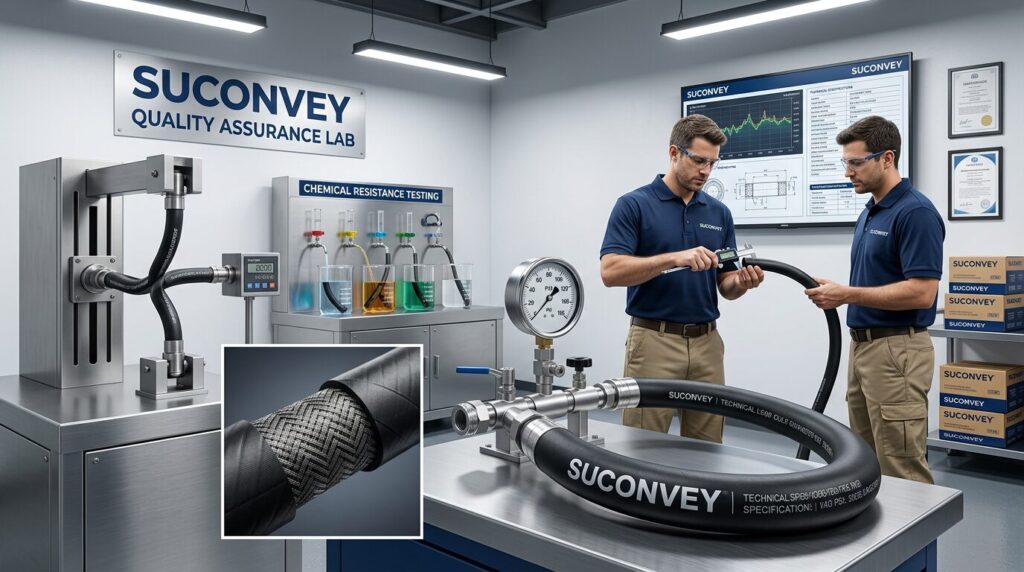
Suconvey is a specialized manufacturer of custom rubber tubes, rubber hoses, silicone tubing, and industrial elastomer products serving industries such as mining, manufacturing, food processing, marine, automotive, and material handling. The company provides both standard and custom-engineered tubing solutions designed to meet specific requirements for temperature resistance, chemical compatibility, abrasion resistance, and pressure performance.
Suconvey’s product range includes:
● EPDM rubber tubes for outdoor and weather-resistant applications
● Nitrile rubber tubes for oil and fuel transfer systems
● Silicone tubing for food-grade and high-temperature environments
● Heavy-duty industrial rubber tubing for mining and manufacturing
● Custom extruded rubber tube profiles and specialized dimensions
● Large-diameter rubber tubes for industrial fluid handling
● Vacuum-resistant and pressure-rated rubber tubing solutions
One advantage of working with Suconvey is the ability to produce custom rubber tube specifications, including unique inner diameters (ID), outer diameters (OD), wall thicknesses, colors, hardness ratings, and material formulations tailored to specific operating conditions.
For OEM manufacturers, industrial maintenance teams, and bulk purchasers, Suconvey also offers custom production services, technical consultation, and international supply capabilities for large-volume projects.
Rubber Tube Manufacturers in India
India has a substantial rubber tube manufacturing sector, with major production clusters in Maharashtra, Gujarat, and Tamil Nadu. Indian manufacturers supply both domestic industrial markets and international export markets with a wide range of general-purpose and specialty rubber tubing. Key quality standards applicable to Indian-manufactured rubber tubing include BIS (Bureau of Indian Standards) certifications and, for export products, ISO 9001 quality management system certification. Pricing from Indian manufacturers is generally competitive on commodity grades, making India a significant sourcing destination for bulk rubber tubing procurement.
Rubber Tube for OEM and Custom Orders
For applications requiring non-standard dimensions, specific rubber compounds, custom colors, or special certifications, OEM rubber tubing orders are placed directly with manufacturers or specialist distributors. Custom rubber tube manufacturing typically involves a tooling or setup charge for new dies, minimum order quantities to justify production runs, and lead times of several weeks from order to delivery. Rubber tube molding produces custom-shaped parts beyond simple extruded profiles — molded rubber components can incorporate integral flanges, bends, or features impossible to produce by extrusion.
Rubber Tube HS Code and IMPA Code
For international trade and customs documentation, rubber tubes and hoses are classified under Harmonized System (HS) code 4009, covering vulcanized rubber tubes, pipes, and hoses. The specific four or six-digit subcode depends on whether the tubing is reinforced, fitted with end attachments, or made from hard rubber. The IMPA (International Marine Purchasing Association) code system is used in the maritime industry to standardize the procurement of marine supplies, and rubber hose and tubing products have designated IMPA codes within the deck and engine room supplies categories. Correct HS and IMPA code usage ensures accurate customs declarations, tariff calculations, and streamlined international procurement processes.
Frequently Asked Questions
What is Rubber Tube?
A rubber tube is a hollow, flexible cylinder made from vulcanized natural or synthetic rubber, used to carry fluids or gases, provide cushioning or sealing, or serve as a structural elastic element. Rubber tubes are distinguished from rubber hoses by their generally simpler construction — hoses often include reinforcement layers — and from silicone tubing by their rubber compound base material. They are manufactured in an enormous range of sizes, materials, and performance levels to serve applications from basic home repair to critical medical devices.
Rubber Tube Meaning in Hindi
In Hindi, rubber tube is commonly referred to as “रबर ट्यूब” (pronounced rubber tube, as the English loanwords are widely used). In the context of bicycle or motorcycle tires, the inner tube is often called “ट्यूब” (tube). The question “रबर ट्यूब कैसी होती है” (rubber tube kaisi hoti hai) translates roughly to “what is a rubber tube like?” — the answer being that it is a hollow, flexible cylinder made from rubber material used across a wide range of applications as described throughout this guide.
Rubber Tube in Project Zomboid and Sandrock
In Project Zomboid, the survival crafting game, rubber tubes appear as a craftable or scavengeable item used in constructing water collection systems and connecting rain barrels to plumbing infrastructure. Players need rubber tubes to build functional base plumbing for water access without reliance on municipal supply. In My Time at Sandrock, the crafting and simulation game, rubber tube is a manufactured material produced from rubber compounds at the player’s workshop. It is used as a component in numerous mechanical assemblies, machines, and upgrades throughout the game’s crafting trees.
Rubber Tube in OSRS and Tamiya
In Old School RuneScape, rubber tube is a quest item obtained and used during the One Small Favour quest, one of the game’s more famously convoluted chain quests. The rubber tube is obtained from a specific NPC and used to complete a step in the quest chain. In the Tamiya model car and hobby context, rubber tubing in very small diameters is used in scale model detailing — as cooling hoses, fuel lines, electrical conduit, and other fine detail elements that add realism to finished model builds. Tamiya and other hobby suppliers sell fine-diameter rubber and vinyl tubing specifically sized for 1:10 and 1:24 scale modeling applications.
Conclusion
Rubber tubes are among the most quietly essential components in modern life. From the inner tube in a bicycle tire to the tubing in a hospital blood pressure monitor, from the vacuum lines under your car’s hood to the elastic resistance band in your workout kit, rubber tubes perform reliably across an almost incomprehensible range of applications.
Choosing the right rubber tube for any application comes down to three fundamental decisions: selecting the right material compound for your chemical environment and temperature range, specifying the correct dimensions (ID, OD, and wall thickness) for your flow or structural requirements, and choosing the appropriate accessories (clamps, fittings, end caps) to make reliable connections.
Whether you are shopping at a local hardware store, sourcing bulk industrial tubing from a manufacturer, or selecting a specialty medical or laboratory grade product, the principles in this guide give you the foundation to make an informed choice. Match the tube material to the environment, match the size to the application, maintain and inspect regularly, and your rubber tube will serve its purpose reliably for as long as the application demands.
—

