


—
After years of photographing wildlife across Africa, I have come to recognise that not all animals hold attention in the same way. Many are beautiful. Many are technically interesting to photograph. But elephants consistently create a different reaction. In the field, their presence changes the atmosphere around you. On a gallery wall, the effect is similar. I have seen people pause unexpectedly in front of a large piece of elephant wall art, stepping back first to take in the scale before moving closer to study the detail. The subject alone seems to slow people down.
Lions create a slightly different response. Where elephants impress through mass and texture, lions engage through structure and gaze. A strong piece of lion wall art tends to draw viewers inward rather than push them back. They move closer, almost unconsciously, studying the eyes and the framing of the mane. The symmetry of the face and the forward facing stare give the composition a natural anchor. When a lion looks directly into the lens, the photograph becomes relational. The viewer does not just observe the animal. The viewer feels observed.
From a photographic perspective, both animals carry visual gravity, but in different ways. An elephant offers scale and weight. The folds of skin, the arc of the tusks, the way the body occupies space against open landscape all demand careful composition. A lion offers clarity of form. The mane frames the face almost like a compositional guide, and the eyes sit naturally at the centre of attention. In both cases, the challenge is not to exaggerate what is already powerful. It is to translate it honestly.

What interests me most is not action but presence. Social media tends to reward extremes, roaring lions, charging elephants, dust clouds and spectacle. Those moments exist, but they are not the majority of what you witness in the wild. Elephants move with steady intention, often in silence, communicating through subtle shifts in posture and spacing within the herd. Lions spend much of their time resting, conserving energy, watching their surroundings without drama. Photographing them well requires patience more than speed.
With elephants, I often work from a low angle with a medium to wide lens to emphasise scale without distortion. When a large bull walks slowly toward the camera in Amboseli, each step carries rhythm. If the head is slightly lowered and the trunk relaxed, the image communicates calm authority rather than threat. The background matters as well. A clean horizon or distant mountain range can give context without distracting from the subject. The balance between animal and environment is crucial.
With lions, eye contact becomes central to the frame. When a lion looks past the camera, the image feels observational. When it locks eyes with the lens, the photograph shifts in tone. The connection is direct. Light becomes critical here. Too harsh and the mane loses detail. Too flat and the face loses depth. I look for light that shapes the features while preserving clarity in the eyes. A slight turn of the head can change the entire mood of the image.
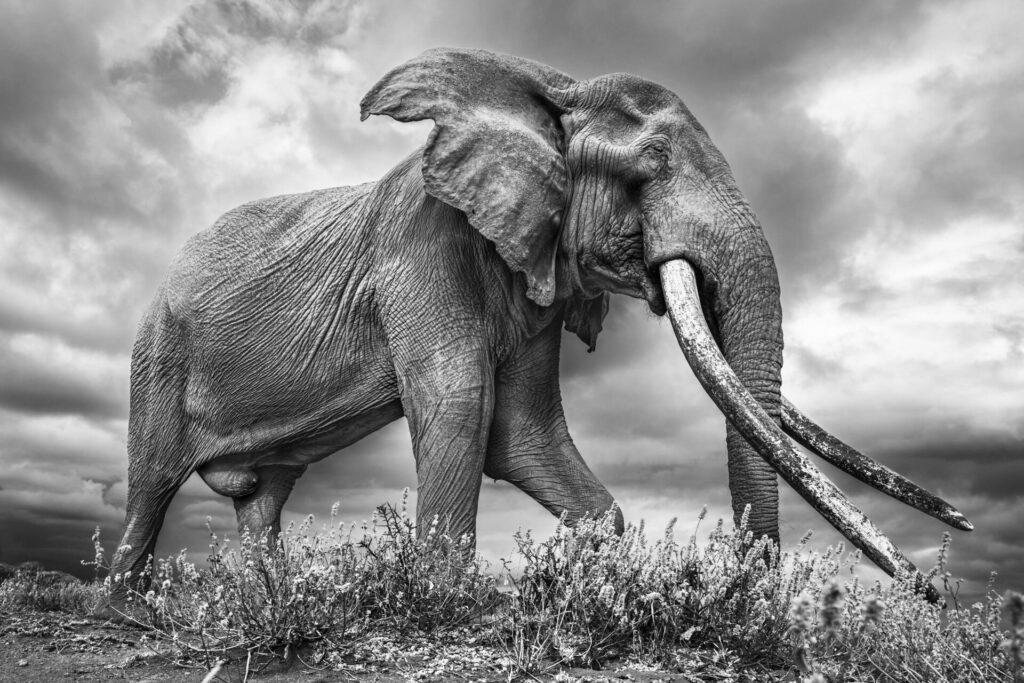
Over time, I have gravitated toward creating black and white wall art from many of these photographs. An elephant’s skin becomes almost architectural in its complexity. A lion’s mane takes on sculptural qualities. Without the distraction of green grass or blue sky, the viewer focuses entirely on structure and presence. In print, this becomes even more apparent. Subtle tonal transitions that might be lost on a screen become visible on fine art paper.
The shift from digital file to physical print is significant. Online, wildlife photography is consumed quickly. Scroll, pause, move on. Even technically strong images blur together over time. In print, especially at larger sizes, scale alters perception. A large elephant image commands space in a room in a way that a small screen never can. A lion portrait at eye level changes the atmosphere. You do not swipe past it. You live with it. Over days and months, new details reveal themselves.
I have watched viewers respond differently to each subject in exhibitions. With elephants, there is often an initial awareness of proportion, followed by curiosity about texture and detail. With lions, the focus goes immediately to the eyes. People lean in slightly, as if testing the intensity of the gaze. The reactions are distinct, yet the sustained attention is the same. Both animals hold it.
Perhaps that is why lions and elephants continue to stop us, even in an era saturated with imagery. They carry scale, structure, and presence that translate powerfully into photography when approached with restraint. They do not need theatrical moments to be compelling. They require thoughtful composition, careful use of light, and respect for natural behaviour. When those elements align, the resulting image feels steady and grounded.
In the field, standing eye level with a lion or low in front of an approaching elephant, you are reminded of proportion. You are not the centre of the landscape. You are part of it, briefly. Translating that awareness into a photograph is the challenge I return to repeatedly. When it works, whether encountered in Africa or printed large on a wall far away, the image retains that quiet weight. And that is what makes people stop.
Johan Siggesson – Fine Art Wildlife Photographer
—
This content is brought to you by Atif Sharif
Photos provided by Johan Siggesson

