


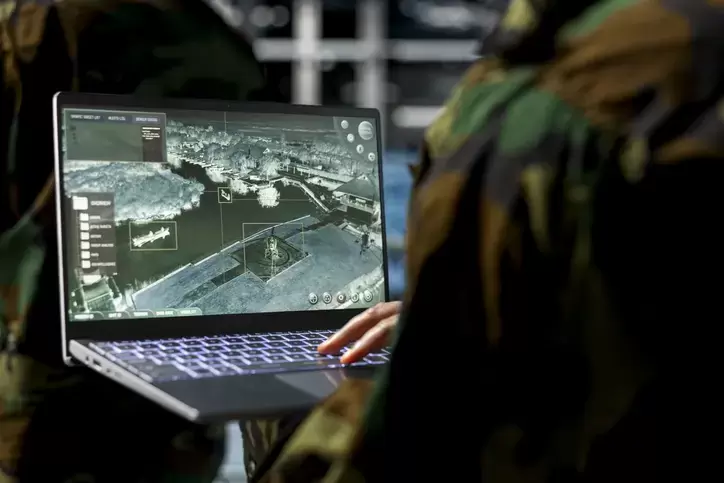
The wars of the last few years in Ukraine, Gaza and now Iran illustrate a disturbing trend that goes beyond the use of technology to destroy military units or win territory, and instead to identify, locate and eliminate specific individuals within the adversary’s chain of command, the scientific apparatus or government.
The novelty is not in “decapitation” as such, which has been part of military and intelligence doctrine for decades, but in the possibility of industrializing it through data, sensors, ubiquitous surveillance and algorithmic systems capable of cross-referencing information at an unprecedented speed and scale.
Gaza is the most visible laboratory for this evolution. The Associated Press investigation into the Israeli military’s us of AI models and cloud services describes how those tools are used to process intelligence and intercept communications and surveillance in order to generate targets faster. The commercial infrastructure of companies such as Microsoft, Google, Amazon or OpenAI are now an integral part of the operational cycle of a war, in other words, Silicon Valley is now part of the military industrial complex. Human Rights Watch documents Israel’s use of digital tools such as Lavender, The Gospel or Where’s Daddy?, warning that they work with flawed data and inaccurate inferences that can exacerbate the risk to civilians, breaking international humanitarian law and the rules of war.
The key to this approach is individual identification. The expansion of facial recognition and biometric systems in Gaza, explained by The Guardian based on previous reports and interviews with human rights experts: it is no longer just a matter of policing a territory, but of turning everybody in it into an exploitable piece of data. When a war learns to see faces, to correlate them with histories of calls, movements, kinship, or patterns of behavior, the enemy ceases to be a force and becomes a concrete identity. The battlefield is no longer just on the map: it’s in the database.
Israel’s war in Lebanon showed another derivative of that same transformation: the ability to penetrate supply chains, communications networks and circuits of the adversary’s trust until they become weapons. The Hezbollah pagers, also documented by AP, demonstrated that contemporary technological superiority also consists in contaminating the enemy’s material ecosystem. You don’t have to imagine a dystopia of hacked cameras around every corner to understand the logic: a very sophisticated combination of intelligence, infiltration, surveillance, and precise attack capability is enough to turn the adversary’s routines into lethal vulnerabilities.
The US and Israeli war against Iran takes things to the next level: the extension of this logic of decapitation to the heart of a state. AP summarized the impact of the Israeli strikes in June 2025, pointing out how they shattered the leadership of the Revolutionary Guards, as well as hitting scientists and critical infrastructure. AP has also warned that while the systematic elimination of leaders offers immediate tactical success, it rarely resolves the underlying conflict and often ends up reinforcing radicalization, martyrdom or succession by even more extreme figures. That is the central paradox of this precision war: technically it impresses, strategically it does not always work.
The most important consequence is that war is compressed. If previously detecting, validating, and attacking a target required relatively slow processes, AI promises to reduce all that to an accelerated sequence of data ingestion, correlation, recommendation, and action. The ICRC has formulated it clearly: the problem is no longer just autonomous weapons, but the hasty deployment of AI systems to support the selection and elimination of targets. SIPRI highlights how these support systems shape the human role at different stages of the targeting cycle, posing very serious regulatory gaps. In other words, the final decision may still be human, but the environment in which that decision is made is increasingly pre-configured by machines.
This has obvious political effects. Once leaders understand that they can become targets at any time, the temptation will be to shield themselves, hide, disconnect and delegate to increasingly small and opaque circles. You don’t necessarily get more deterrence: instead, more paranoia. And paranoia, in politics and in war, rarely leads to moderation. Brookings warns precisely of the risks of military crises accelerated by AI and of the urgent need for governance mechanisms that reduce the likelihood of harm to civilians and uncontrolled escalation. The faster the system moves, the less room there is for doubt, verification, and accountability.
And there is a second, perhaps even more important consequence: proliferation. Today these campaigns seem to be associated with actors backed by ecosystems of intelligence, air superiority, privileged access to satellites, cloud and advanced analytics such as the United States and Israel. But the technology that makes them possible is, to a large extent, commercial, modular and increasingly accessible, so the simple dynamics of technological diffusion means that the advantage does not remain in the hands of a few for long. The normalization of this form of warfare may push the world toward a scenario in which more and more states, and eventually non-state actors such as terrorist groups, attempt to turn people into coordinates and coordinates into targets.
Underlying the lucrative contracts with governments of technology companies lies a very easy to understand logic of increasingly common use of weapons capable of eliminating people, decapitating regimes and turning assassination into a simple target shot. And when that happens, war will cease to be a dispute over territory and will become a systematic hunt for individuals. That is the historical leap unfolding before us in real time.
—
This post was previously published on Enrique Dans’ blog.
***
You Might Also Like These From The Good Men Project



If you believe in the work we are doing here at The Good Men Project, please join us as a Premium Member today.
All Premium Members get to view The Good Men Project with NO ADS.
Need more info? A complete list of benefits is here.
Photo credit: iStock

