



By Steffen Hurka & Yves Steinebach, The Loop
Steffen Hurka and Yves Steinebach reveal that EU climate legislation has become so complex that even well-resourced member states struggle to put it into practice. Longer, more detailed laws create implementation failures regardless of administrative capacity, suggesting the EU’s climate ambitions may be undermined by how laws are written
The European Union is a global leader in climate action. Over recent decades, it has built an impressive portfolio of policies addressing emissions trading, renewable energy, and energy efficiency. The 2019 European Green Deal further intensified these efforts, setting ambitious targets for climate neutrality by 2050.
But there’s a problem: EU climate laws are becoming so complex that member states cannot implement them properly. This complexity is associated with implementation failures, and even countries with strong administrative capacities cannot overcome these challenges.
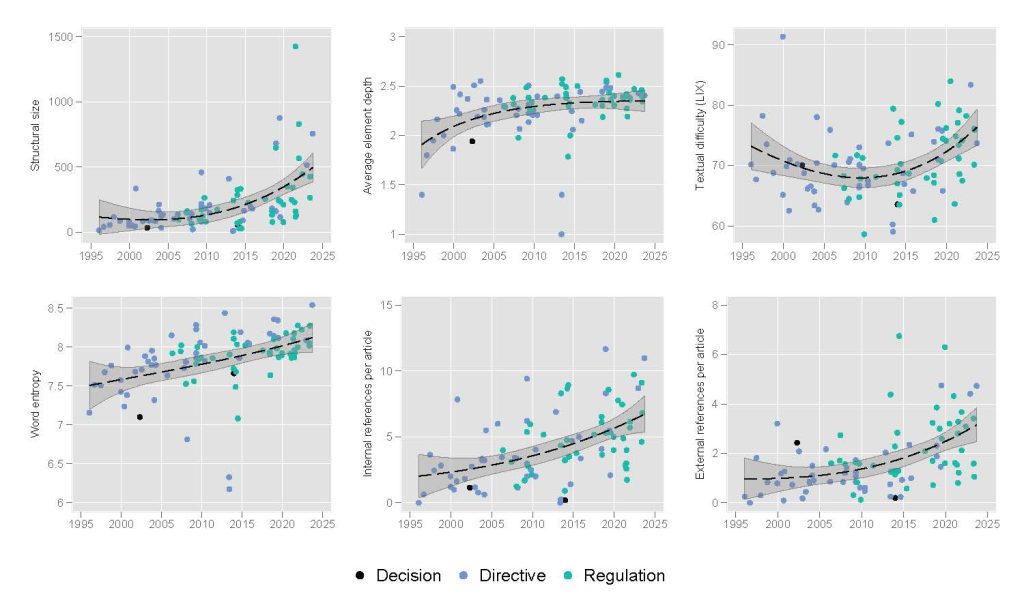
Legal complexity of EU climate laws is on the rise
We examined nearly three decades of EU climate laws and systematically tracked how complex they have become over time. The pattern is clear: since 2017, almost every new law exceeded the long-term average complexity. Laws have become more detailed, use more difficult language, contain more diverse concepts, and connect to each other in increasingly intricate ways.
Complexity of EU climate laws over time, per complexity indicator
Why complexity kills compliance
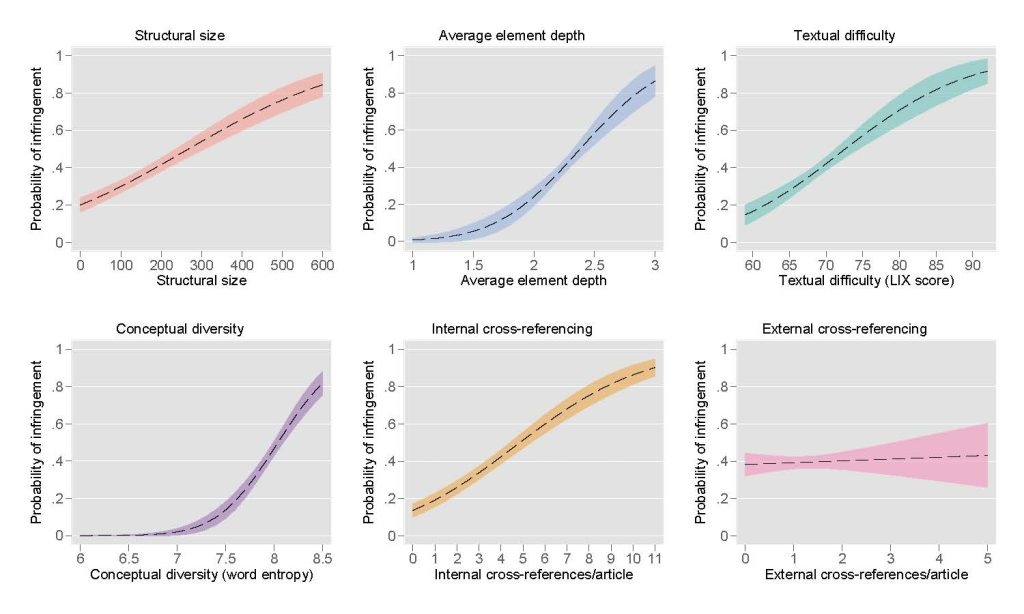
Complex laws create real implementation problems. We examined 44 climate directives requiring transposition into national law and tracked whether the European Commission opened infringement proceedings against member states for non-compliance.
The relationship is clear: more complex directives generate significantly higher rates of implementation failure. For a directive of average complexity, the probability of non-compliance sits at 38%. When complexity increases by one standard deviation, that probability jumps to 65%. For highly complex directives, two standard deviations above average, the failure rate reaches 86%.
Our research found that more complex directives generate significantly higher rates of failure to implement climate policies
Crucially, this problem affects all countries. We tested whether states with higher administrative capacity could overcome complexity challenges. They cannot. While better-resourced states perform slightly better overall, they struggle just as much with complex legislation as less capable states. Neither general administrative capacity nor having a dedicated climate ministry helps countries to cope with legal complexity.
The relationship between legal complexity and infringement probability
What drives the complexity?
Part of the problem is unavoidable. Climate change is genuinely complex, and policies must address interconnected challenges across energy, transport, agriculture, and industry. But much complexity is added during negotiations to accommodate diverse interests and build political support.
Five specific features proved most problematic. Implementation failures increase when laws are:
- Longer (more policy elements to process)
- More detailed (provisions buried at deeper levels of legal structure)
- Harder to read (complex sentence structures and technical language)
- Conceptually diverse (many different concepts requiring interpretation)
- Highly cross-referenced internally (provisions dependent on other provisions)
Interestingly, external cross-references to other laws appear to not significantly affect compliance. Bureaucrats with legal training seem capable of consulting external legislation. The problem arises when the law itself becomes difficult to interpret and apply.
The hidden cost of ambition
This creates a troubling paradox. Policymakers often add complexity to make policies more legitimate and politically acceptable. Accommodating different stakeholder interests, addressing edge cases, and providing detailed implementation guidance all seem like responsible lawmaking.
Policymakers often add complexity to make policies more legitimate and politically acceptable. But these good intentions backfire at the implementation stage
But these good intentions backfire at the implementation stage. When laws become too complex, even well-intentioned administrators struggle to apply them correctly. Different regions may interpret the same provision differently, creating inconsistencies that undermine public trust. And most importantly, complex laws fail to achieve their climate objectives, however well-intentioned their design may be.
What should policymakers do?
The European Commission has increasingly emphasised simplification, but there’s a real danger that ‘simplification’ becomes code for weakening climate ambition. The challenge is simplifying policies without compromising their environmental goals.
We propose several concrete steps. First, establish automatic warning systems to flag problematic draft laws, particularly those that are excessively lengthy, rely on convoluted cross-referencing, or use unnecessarily complex language. The measures we’ve developed can serve as benchmarks.
The European Commission must challenge itself to simplify policies without compromising environmental goals
Second, conduct implementation impact assessments before adopting legislation. If a proposed law scores high on complexity metrics, policymakers should either simplify it or ensure that adequate resources, training, and support systems are in place for implementation.
Third, resist the temptation to simply shift from directives to regulations. Some argue that regulations, which apply directly without national transposition, avoid implementation problems. But this just moves the burden from ministerial bureaucracies to street-level administrators. The fundamental problem remains: if laws are too complex to be interpreted consistently, citizens will experience arbitrary enforcement regardless of the legal instrument used.
Beyond Europe
While our research focused on the EU, the mechanism linking complexity to implementation failure is universal. The EU may be particularly vulnerable because its consensus-based system, requiring agreement across 27 member states, acts as a complexity multiplier. Each veto point enables actors to demand policy additions. Similar dynamics likely affect other federal systems, though centralised systems may face different challenges.
The stakes are clear
As the climate crisis intensifies, the EU cannot afford implementation failures. Well-designed policies that sit unimplemented on paper help no one. The solution isn’t lowering ambition, it’s writing laws that frontline implementers can actually apply.
The good news: complexity is measurable and therefore manageable. By flagging problematic laws before adoption and ensuring implementation capacity matches legislative ambition, policymakers can maintain high environmental standards while actually achieving them.
This article was originally published at The Loop and is republished here under a Creative Commons license.
—

If you believe in the work we are doing here at The Good Men Project, please join us as a Premium Member today.
All Premium Members get to view The Good Men Project with NO ADS.
Need more info? A complete list of benefits is here.
—
Photo credit: unsplash

