



One million deaths and counting.
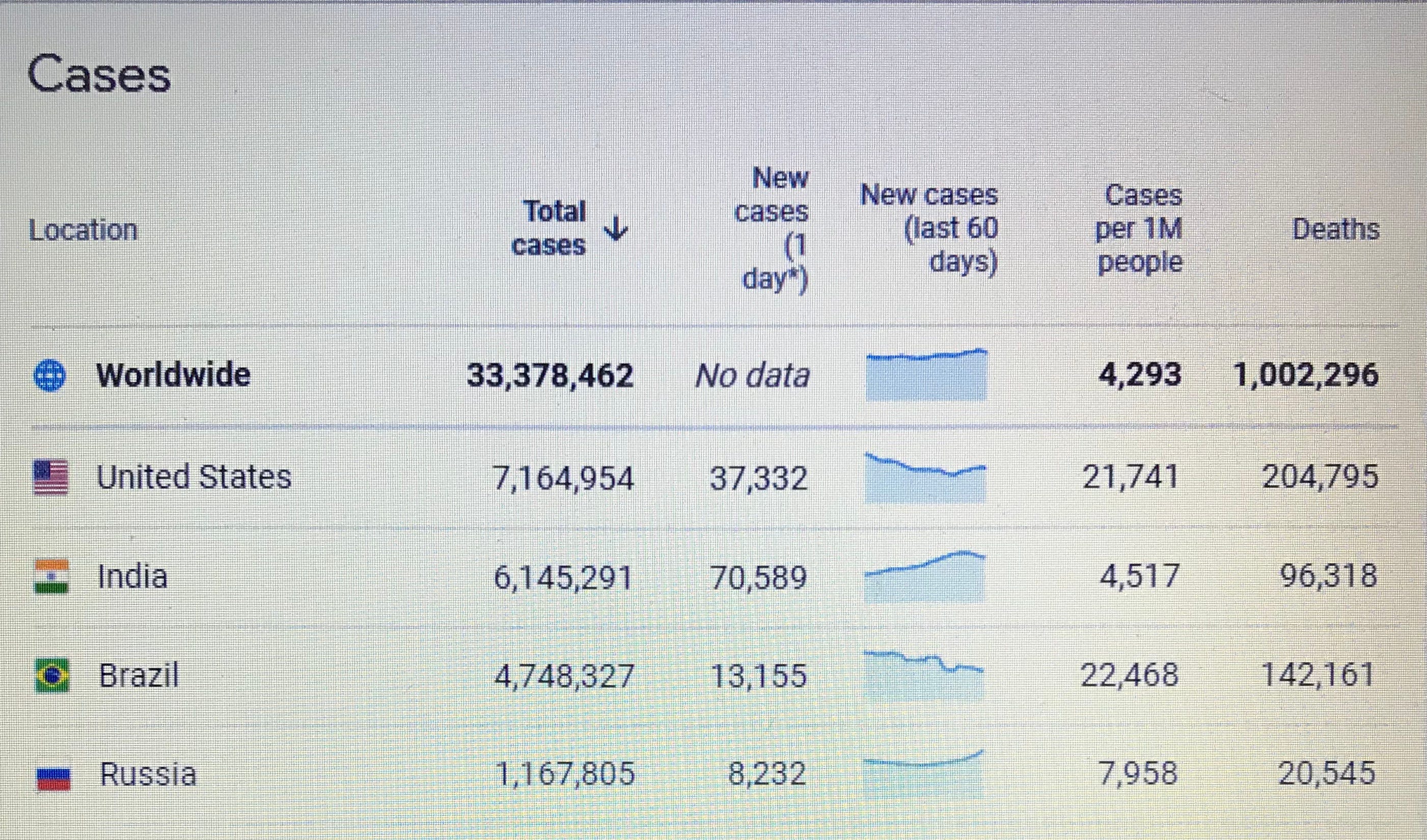
Although the ‘counting part’ is not straight forward, it is more likely there are even more COVID-19 deaths related by now than official numbers reveal, it is undisputed that the Covid-19 pandemic is a major tragedy. America’s numbers are dismal, Europe is facing a second wave, Brazil and India are full-blown never-ending tragedies. And there’s Africa, where the lack of numbers produces more discomfort than security that the worst is gone.
What’s wrong with us? I mean, shouldn’t we be focused on the problem ahead, especially because it is a very straight-forward matter? Don’t go idly partying, always wear masks, try not gathering too many people in the same place. Avoid crowds, keep yourself and others safe. Normal is not feasible, but some degree of normality is achievable, if only we face our lives as a daily duty-routine.
And yet we don’t.
During the first months of the pandemic, when lockdowns became a rule, news outlets around the world published series on ‘stay at home’ things to do. There were tv shows, recipes, browsing videos, live concerts from living rooms, and books.
Among the many books published, reviewed, or recommended, The Plague, by Albert Camus, was one of the most sought. It is evident why.
I read The plague (Albert Camus), and The diary of the Plague (Daniel Defoe), and End of October (Laurence Wright). But the plague related book that shows how poorly we are dealing with this moment is a Brazilian novel entitled Tereza Batista: Home from the Wars (Jorge Amado).
I’ll try to summarize it without giving too much of the plot.
The book is not about a plague, but it’s the tale of a poor woman — Tereza Batista. She is enslaved, sexually abused (and more, she’s portrayed as a long-living heroine). Her story is told in long parts of more or less independent happenings, and this one time, she moves to Brazil’s dry hinterland as the lover of a doctor.
When they are there, a plague of smallpox hits the community. The young doctor and the only nurse flee the town. The old doctor fights the spread of the disease but ends up dying. Tereza stays. Not only that, while every rich person in town and the farms are turning away sick employees or peasants alike, Tereza gathers the local prostitutes and organize them into a group of caretakers.
As a group, they fought and won the plague. They did what was expected of a community to do: tender and treat the sick, bury the dead. Meanwhile, the rich fled.
That’s the major difference in a community: the members of a group relate to each other, help each other. Those that are apart from the group, act individualistically. They are selfish, not by moral grounds, but by necessity.
Whenever someone in those novels understands it doesn’t stand alone, but as a part of a group, which means being together among equals, this character starts to help the community.
In the Brazilian novel, what sets people apart is money, so the poor and the workers help each other in fighting the disease.
What is setting us apart now?
—
This post was previously published on Medium.com.
***

If you believe in the work we are doing here at The Good Men Project and want a deeper connection with our community, please join us as a Premium Member, today.
All Premium Members get to view The Good Men Project with NO ADS. Need more info? A complete list of benefits is here.
—
Photo credit: mostafa meraji on Unsplash

