



Who Is Charles Darwin?
Most of us know that Charles Darwin for his contribution to the science of evolution.
Less is known about his early work as a naturalist and an author.
Very few books by naturalists or about nature come to mind that could rival Charles Darwin’s The Voyage of the Beagle.
But even back then when it was published, The Voyage of the Beagle, a memoir of Charles Darwin’s journey of discovery abroad the HMS Beagle was a bestseller. It was published multiple times in different versions by the publisher, who was hoping to eke out as much profit as possible.
Today, given the importance of evolution, the book’s prominence has been relegated to the background. To many who know the work, it is the book that documents the travels that led Darwin to write the book, On the Origin of Species, containing his groundbreaking thesis.
But that severely understates the importance of The Voyage of the Beagle.
HMS Beagle was circumnavigating the globe and along for the ride was Darwin, then a very curious young naturalist, who bought back to an adoring European reading public back fantastic stories of new lands, new species and different people. Darwin’s excitement in describing these new species, new lands and encountering new people is palpable and contagious.
More importantly, for the theory of evolution and Darwin, the popularity of The Voyage of the Beagle made Darwin a household name.
Darwin described the five years voyage as the most critical event in his life.
Could Darwin have published the On the Origin of Species and survived accusations of heresy without the successful publication of The Voyage of the Beagle? Without the European intellectual class already familiar with The Voyage of the Beagle, would his theory have gained as much currency?
I doubt it.
…
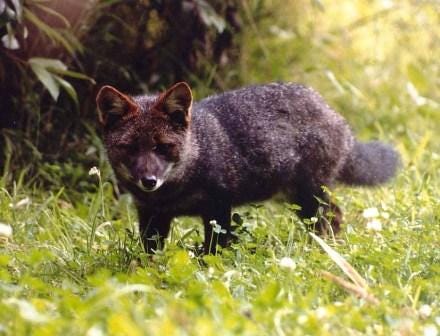
By Fernando Bórquez, uploaded by Lin linao — Cedida por el autor., Public Domain,
https://commons.wikimedia.org/w/index.php?curid=1000338
How This Very Rare and Endangered Fox Got Its Name
In chapter 13 (Chiloe and Chonos Islands) of The Vovage Of the Beagle, the following entry for 6 December 1832 described the above photographed fox:
A fox (Canis fulvipes), of a kind said to be peculiar to the island, and very rare in it, and which is a new species, was sitting on the rocks. He was so intently absorbed in watching the work of the officers, that I was able, by quietly walking up behind, to knock him on the head with my geological hammer. This fox, more curious or more scientific, but less wise, than the generality of his brethren, is now mounted in the museum of the Zoological Society.
That was how Darwin discovered a unique species of fox.
Poor fox. Described as more curious or more scientific than his brethren, this entranced fox was unceremoniously, but undoubtedly necessary for the advancement of science, killed (but not disposed of) by Charles Darwin.
I am not familiar with how animal species were collected or recorded. So it was surprising to me that you had to literally knock the animal out cold.
Anyhow, so much for the stereotype of the cunning fox.
Fortunately for the other members of Darwin’s fox, Darwin became a household name.
If Darwin’s fox was named Linneaous’ fox, I wonder if the poor fox would have been extinct by now. Poor Linneaous.
In 1837, five years after that fateful day for the fox, William Charles Linnaeus Martin, a naturalist who was the curator of the museum at the Zoological Society of London named the fox after his human discoverer (and killer), Charles Darwin.
From then on, this species has been known as Darwin’s fox.
He was so intently absorbed in watching the work of the officers, that I was able, by quietly walking up behind, to knock him on the head with my geological hammer.
…
The Status Of Darwin’s Fox
Estimates vary. Numbering most likely less than a total of 1,000 with about 500 individuals on Chiloé and about 100 on mainland Chile, it remains one of the rarest and most elusive creatures on the planet.
Elusive. That is the word most often used to describe foxes. From a conservation perspective, being elusive does not serve foxes well. Unlike penguins, koalas, elephants, and other cute species that are not elusive, there is much less attention paid to foxes’ conservation. Out of sight and out of mind, they say.
People also tend to describe foxes as cunning. Foxes are opportunistic hunters, but that does not make them cunning. They would adapt to eat available food, including food thrown out by humans. That does not make them dangerous.
Fortunately for the fox, many people still find foxes ‘cute’. In a way, that makes sense because foxes are not dangerous to humans unless they are suffering from rabies, which is rare. Moreover, the fox’s instinct is to retreat rather than to engage.
In February 2010, Canon featured Darwin’s fox as part of its advertisement campaign “Wildlife As Canon Sees It” in the National Geographic Magazine.
In 2010, the advertisement described the challenges facing Darwin’s fox: “But faced with the smallest distribution of any known canid, habitat loss due to deforestation, and predation by domestic dogs, only about 125 breeding pairs are left of this branch of the family tree.”
In 2010, Darwin’s fox was still believed to be only found on Chiloé, an island off mainland Chile’s coast. As there was only a small population left, it meant that it was considered to be ‘critically endangered’. The Darwin’s fox now is listed as an endangered species in International Union for Conservation of Nature’s red list. This listing is considered an improvement The ‘upgrade’ in its status from ‘critically endangered’ to ‘endangered’ was due to discovery of additional foxes in mainland Chile around 2014. Having two sub-populations is much better than just having one.
However, Darwin’s fox’s population trend is still ‘decreasing’, and this species of fox remains endangered.
The reasons? They are still the same as those mentioned in the Canon’s advertisement (“habitat loss due to deforestation, and predation by domestic dogs”).
There is a lot of pressure to convert native forests to timber farms to serve the Chilean forest products industry.
The fox’s survival is also threatened by domestic dogs and the diseases that domestic dogs carry.
The Threat of Domestic Dogs
People like their pet dogs a lot. They bring them everywhere. They are known as humankind’s best friend for good reasons.
Even in nature parks where dogs are prohibited, some people would still bring their dogs along.
Some people have the impression — probably due to cartoons — that foxes are more dangerous than dogs. That is a wrong impression. Foxes are generally smaller than dogs. Also, they tend to be solitary and do not hunt in packs.
At the same time, like dogs, foxes are territorial creatures. That is why dogs and foxes will fight when they are in the same territory. For better or worse, foxes are poorer fighters compared to dogs.
And unlike the popular notion that wild animals carry more diseases, the fox is at threat of getting diseases from domestic dogs and not vice versa.
Chilean authorities are planning to build a land bridge connection Chiloe island with mainland Chile. The bridge will likely facilitate the arrival of more tourists and increase the resident human population as well, bringing with it more domestic dogs, their ferocity and associated diseases.
…
Deforestation of The Habitat
In The Voyage of the Beag;e, Darwin describes the island where he found the first named Darwin’s fox in these words:
“The land is hilly, but not mountainous, and is covered by one great forest, except where a few green patches have been cleared round the thatched cottages. From a distance the view somewhat resembles that of Tierra del Fuego; but the woods, when seen nearer, are incomparably more beautiful. Many kinds of fine evergreen trees, and plants with a tropical character, here take the place of the gloomy beech of the southern shores.”
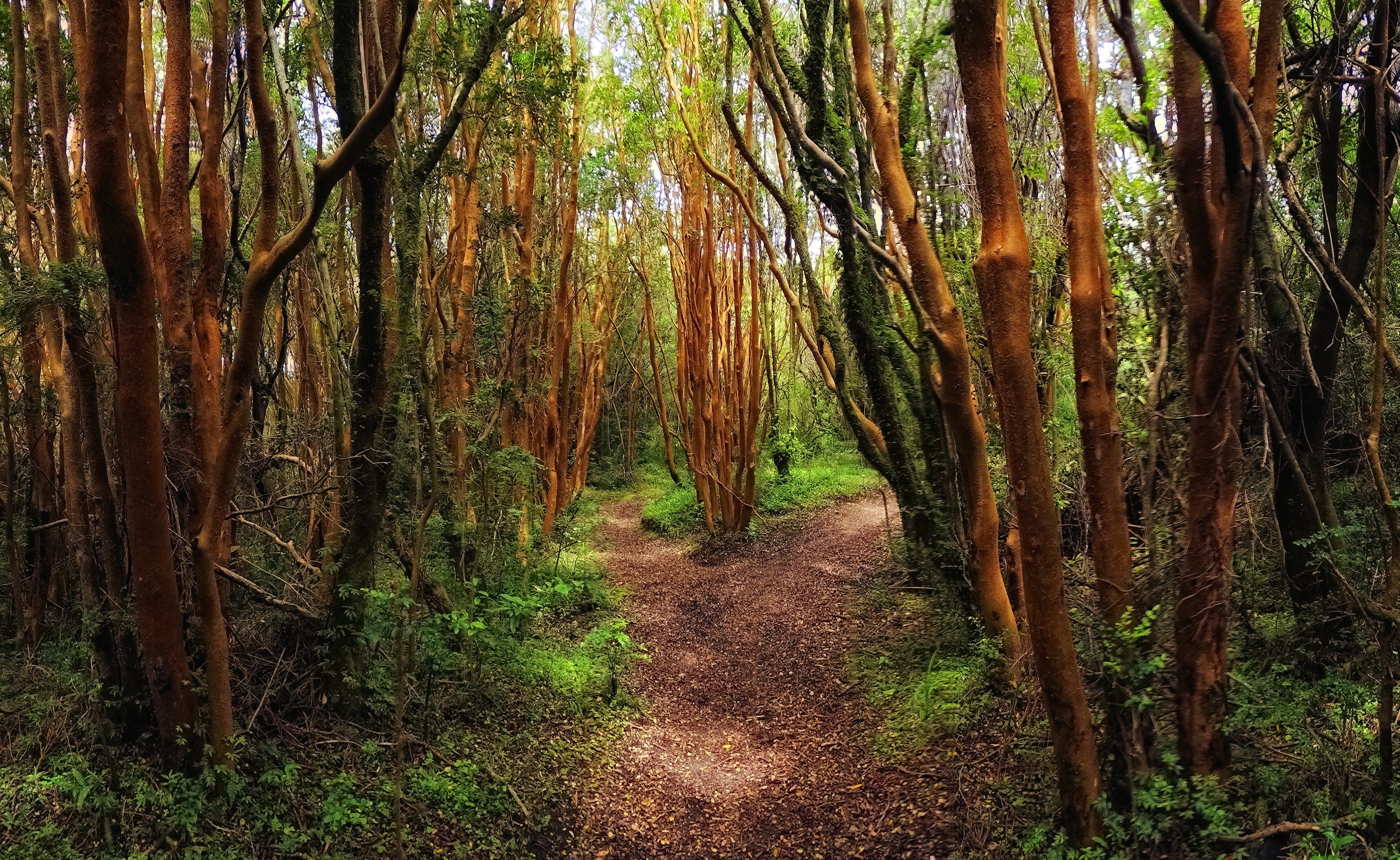
By Bjørn Christian Tørrissen — Own work by uploader, http://bjornfree.com/, CC BY-SA 4.0,
https://commons.wikimedia.org/w/index.php?curid=63329474
What Darwin described (“fine evergreen trees and plants with a tropical character”) was the Valdivian temperate rain forest. This is the habitat of Darwin’s fox. The Valdivian temperate rain forest can only be found in South America’s west coast, a very tiny strip running alongside the coast. It is home to many plants and animals found nowhere else in the world.
Yet, there is a lot of pressure in Chile to further convert native forest to timber plantations, to serve the forestry industry.
Chile has introduced commercial plantations of radiata pine and eucalyptus in the 1950s under a dictatorship.
These plantations serve the forest product industry making up about 14% of all exports in Chile and at least 3% of Chile’s total gross domestic product. Tens of billions of dollars and many jobs are at stake.
In Chile, there are now more than 2 million hectares of tree farms. As of 2017, the forestry industry also employed at least 300,000 workers.
These tree plantations have already displaced many of Chile’s native forests, and its growth is the greatest threat to Chile’s native forests and the unique animals and plants that live there, including Darwin’s fox.
The economic pressure to further expand these tree plantations is incessant.
…
What Can We Do?
We can reduce consumption, including consumption of wood products. Reduce the use of paper products. Try to use wood that is sustainably source, but that isn’t easy. What counts as sustainable in the timber market is suspect. Pinewood furniture is ubiquitous. Pinewood from plantations is often said to be more sustainable because they are considered “fast-growing” and are grown on plantations that have been around for a long time.
However, if those plantations were a result of displacing native forests 60 years ago, should pine wood from that plantation count as ‘sustainable’?
The truth is tree plantation reduces the demand of wood from native forests, particularly for good quality wood. Sadly, most of these plantations are grown on lands that were once native forests. In so doing, biologically diverse lands are replaced with monoculture that is minimally habitatable for wildlife.
Eucalyptus plantations are similar in that regard.
Ultimately, to ensure Darwin’s fox’s survival, there must be a compelling economic reason for the Chilean government to take steps to conserve these habitat.
In other words, it is crucial to convince the Chilean government that it is better not to allow the expansion of pine and Eucalyptus plantations.
Due to climate change, there are more and more intense forest fires in Chile. Eucalyptus plantations not only use a lot of water, but Eucalyptus wood is also highly flammable (‘eucalyptus oil, anyone’). Due to the large economic incentives to expand the plantations, tree plantations have expanded to the edge of urban communities. During a fire, this was devastating. Their proximity to human communities meant that fires involving Eucalyptus wood in Chile had resulted in massive urban devastation and loss of lives.
Yet, this means there is now more pressure to clear native forests away from human habitation.
Also, some people think that it is not so bad from a carbon dioxide emission perspective that native forests are replaced by tree plantations. This is very short sighted. Rewilding nature is important from a conservation, environmental as well as a climate change perspective:
Also, native forests (which are left alone) absorb a lot more carbon dioxide and are better carbon sinks:
Africa is not a significant contributor to greenhouse gas emissions, yet it is the most vulnerable…
The possibility of long-term climate change is linked to an increase in gases that trap heat in the atmosphere — called…
nwaigbonnamdi.medium.com
Also, how do we provide economic incentives for Chile to conserve Darwin’s fox’s habitat?
This question is important because this is the question that the Chile government has to answer.
Governments have to balance different priorities and justify how any action is good for their countries.
Is the Darwin fox more important than the expansion of the Chilean’s gross domestic product? How distinct is the Darwin’s fox from a genetic perspective? Are they that unique? Is the conservation of Darwin fox more important than the livelihood for thousands, which families depend on? Why should the Chilean government spend millions of dollars to conserve animals when they can use the money to help alleviate human suffering in Chile? Is the Darwin fox actually critical to its ecosystem?
How do we incentivize the Chilean government to take steps to conserve Darwin’s fox?
Some people may balk at this talk about incentives.
Many conservationists believe there is a duty to future generations to manage the natural systems so that the ecosystems can persist. This approach focuses on the sustainable use of resources to maintain the ecosystem and maintain biodiversity for the future. It is idealistic, but it is a philosophy that remains human-centric. These resources are ours, and it is wise for us to ensure that we can continue to use and sustainably enjoy them. Inherent in this philosophy is also the implicit suggestion that sustainability can be encapsulated and contained with a capitalist framework forever. It is a matter of ensuring the health of the entire biological system, including humans, for generations to come.
However, this is also not a message likely to convince any forestry industry executive or members of the elected Chilean government.
Local groups whose income may be entirely dependent on work involving extractions of natural resources may perceive such views as impractical.
What is sustainable to you may not be sustainable for Chile.
What is sustainable to us will be considered unprofitable for the forestry industry.
That is why, ultimately, economic incentives matter a lot.
Chile is the first Latin America country to sign an agreement with the Forest Carbon Partnership Facility (FCPF) (which is a global partnership housed at the World Bank) in 2019 which enables Chile to be paid up to to $26 million if carbon emission goals are met.
These goals include helping communities implement sustainable land management practices and improving systems of monitoring of Chile’s forest system. In effect, the FCPF fund has committed to make payment for reductions of 5.2 million tons of carbon dioxide emissions.
International organizations can do a lot more. Conservation tied to economic incentives can work very well.
If you care for conservation, it is important to raise awareness on how the clearing of native forests do not make economic sense for Chile. It is important to explain how the native forests can help the Chilean economy. With climate change, the truth is tree plantations are a sucker bet in Chile.
I hear the idealists amongst you shrieking. But I will say this again: incentives matter a lot, and the almighty dollar works.
Increasing healthcare in rural Borneo decreased illegal logging because farmers do not have to resort to illegal logging to pay for their healthcare. (https://www.pnas.org/content/117/45/28515). Douglas Tompkins and his second wife successfully preserved huge tracts of wilderness in Chile by literally buying and conserving over 2 million acres of wildland. Some of these lands were previously earmarked for timber plantations.
But how can we help from this perspective?
You can lobby your own government to participate in global partnerships that pay countries to conserve natural habitats.
You can spend money wisely. Apart from avoiding forestry products, you can visit Chile (and especially Chiloe) as an ecotourist. The other direct way you can help shift economic incentives from exploitation to preservation is to donate to causes committed to the preservation of wildlife. You can support entities committed to protecting wildlife, including the following
- Defenders of Wildlife
- International Union for the Conservation of Nature (IUCN)
- Melimoyu Foundation
- Tomkins Conservation
- WWF
…
Sources:
Darwin’s fox:
- https://www.biographic.com/darwins-fox/
- Silva-Rodríguez, E, Farias, A., Moreira-Arce, D., Cabello, J., Hidalgo-Hermoso, E., Lucherini, M. & Jiménez, J. 2016. Lycalopex fulvipes (errata version published in 2016). The IUCN Red List of Threatened Species 2016: e.T41586A107263066. https://dx.doi.org/10.2305/IUCN.UK.2016-1.RLTS.T41586A85370871.en. Downloaded on 16 January 2021.: (https://www.iucnredlist.org/species/41586/107263066)
Extracts from the voyage of the Beagle:
Darwin, C. 1962. The voyage of the Beagle. London: Doubleday. Available on Gunterberg Project (http://www.gutenberg.org/files/944/944-h/944-h.htm). A similar book is The Malay Archipelago, the classic account of Victorian naturalist Alfred Russel Wallace’s travels through the Malay Archipelago. I am mentioning this is because while many people know who Darwin is, Alfred Russel Wallace independently conceived of evolution through natural selection. Arguably, Alfred Russel Wallace was first to discover it but was slower to publish. And on William Charles Linnaeus Martin (https://en.wikipedia.org/wiki/William_Charles_Linnaeus_Martin)
Forestry Industry in Chile:
- https://en.wikipedia.org/wiki/Forestry_in_Chile
- https://digital.lib.washington.edu/researchworks/handle/1773/35427?show=full
- https://www.mapuche-nation.org/english/html/environmental/enviro-23.htm
Paying for reduction in carbon emissions:
—
This post was previously published on medium.com.
***

If you believe in the work we are doing here at The Good Men Project and want a deeper connection with our community, please join us as a Premium Member today.
Premium Members get to view The Good Men Project with NO ADS. Need more info?
A complete list of benefits is here.
—
Photo credit: Reprinted in Charles Darwin: His Life Told in an Autobiographical Chapter, and in a Selected Series of His Published Letters, edited by Francis Darwin. London: John Murray, Albemarle Street. 1892. (Public Domain)

