


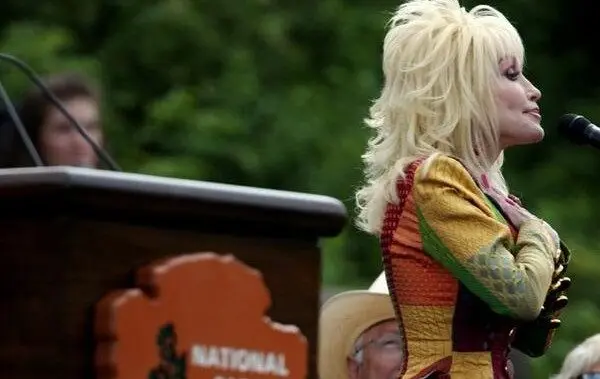
I found myself asking that question after unexpectedly running across a video on YouTube of Dolly Parton singing Led Zeppelin’s “Stairway to Heaven” live.
I have known the song most of my adult life. Its mystery and deeper questions were there long before Dolly sang it. But watching her perform, this familiar song suddenly carried a poignance I had never quite felt before. Dolly didn’t change its meaning. She made me feel its meaning differently.
Part of it was watching her—the expressions on her face, the warmth in her voice, the way she inhabited the words. Her warmth, tenderness, faith, history, and heart seemed to enter the lyrics with her. She brought her soul.
Through a great interpreter, familiar words can arrive carrying another life. With Dolly, the mystery became more intimate. What could sound like a warning became almost tender. When she sings about the woman searching for something she believes she can acquire, I don’t hear judgment. I hear recognition.
Dolly knew something about wanting more. She left the Tennessee mountains with enormous ambition, determined to sing, succeed and be heard—and became one of the world’s most famous entertainers. She knew poverty and abundance, obscurity and fame, a small Appalachian church and some of the largest stages in the world.
Yet watching her perform “Stairway,” I am struck by how much of the person who began that climb remained present in the woman on stage. Beneath the enormous hair, rhinestones and wonderfully exaggerated Dolly-ness was someone who could laugh at herself. She could be glamorous without seeming above anyone, talk about faith without using it against anyone, and be unmistakably herself without requiring everyone else to be like her.
Perhaps that is the source of the poignance. We are watching a woman who traveled an extraordinary distance up the stairway our culture calls success sing a song that asks what we ultimately seek.
Dolly acquired wealth, fame and influence beyond anything that Tennessee mountain girl could have imagined. Yet what we remember is not simply what she acquired, but what she gave. Her Imagination Library placed books into the hands of millions of children, inspired in part by the father she adored who could not read or write. She reached extraordinary heights and kept reaching back down.
Her life does not tell us that climbing is wrong. Dolly was ambitious, driven and a remarkably successful businesswoman. Her performance feels especially relevant to our fractured world. We need to climb—to make a living, succeed, provide for those we love and find our place. There is nothing inherently wrong with that. Dolly climbed as determinedly as anyone.
But somewhere along the way, climbing can become the destination. More wealth, more influence, more attention, more power, more certainty that our side is right. We begin measuring what can be counted and mistaking those measurements for what matters.
Dolly seemed to understand the difference. She climbed without appearing to leave herself behind. She carried the mountains and the church, the father who couldn’t read, humility and faith, ambition and generosity. Somehow, amid enormous celebrity, she carried a heart that remained visible.
Perhaps that is what moves me most. Dolly doesn’t tell us not to climb. Her own life would contradict that message. She makes us wonder what we are becoming as we climb. And she does it without a lecture. She simply sings.
Her voice carries the accumulated experience of a life—from poverty to abundance, from a mountain church to worldwide celebrity—into words written decades earlier. Her personality softens them. Her faith deepens them. Her humanity keeps them grounded. Her tenderness removes the judgment. Her heart gives them soul.
Now that Dolly is gone, watching that performance carries another layer of poignance. A woman who traveled such an extraordinary journey stands before us singing about a stairway to heaven. Her journey would end, but the performance would remain.
And there she still is—the mountain girl and the superstar, the believer and the businesswoman, the rhinestones and the tenderness—all inhabiting those familiar words.
Led Zeppelin gave us an extraordinary song. Dolly didn’t change its message. She did something only a deeply soulful interpreter can do: she allowed the song to pass through the fullness of who she was and gave it back to us carrying something of herself.
She put herself inside it.
And watching Dolly Parton sing “Stairway to Heaven,” I find myself returning to the question I began with.
What if the stairway isn’t upward toward more, but inward toward what matters?
Perhaps the measure of the climb is not how high we rise, but how much of ourselves we manage to bring with us—and how much we give back along the way.
Dolly climbed very high.
And somehow, she never seemed to leave the mountain behind.
—
Image
This United States Congress image is in the public domain. This may be because it was taken by an employee of the Congress as part of that person’s official duties, or because it has been released into the public domain and posted on the official websites of a member of Congress. As a work of the U.S. federal government, the image is in the public domain.

