



It won’t be long now, and my son will be leaving us.
I always knew this time would come, but the close proximity of his departure is growing in weight. An inevitable burden I must accept, shoulder, and adapt to.
Last summer he won a university scholarship to study Arabic in Morocco, and so for several months he was away and I experienced the unfamiliarity of his absence. The quietude emanating from his bedroom was odd and disorienting. My son’s confused cat prowled the house in search of his favorite person, to no avail.
My son has left us in the past.
In the 8th grade, he joined classmates and teachers for an east coast field trip to explore New York City, the Amish country in Pennsylvania, and places like Arlington National Cemetery and the Lincoln Memorial. But on that trip, my wife collaborated with a teacher, we flew to New York, and surprised my son at the top of the Empire State Building.
But this time is different.
He’s a young man now, almost done with his university degree in computer science, about to be commissioned as a 2nd Lieutenant in the military, and then off to advanced training out of state. After that, he’ll be assigned to a base somewhere, to embark on his career.
And we will be empty nesters.
Something is pushing them to the side of their own lives
There’s a poem titled “Afternoons,” by the postwar English poet and novelist Philip Larkin, that has always resonated with me.
It’s not a cheerful poem, and while I’m not given to melancholy, for some reason its stanzas seem to capture something that I have grown to understand with parenting and the passage of time. Perhaps it’s a begrudging acceptance that the early luster of life gives way to a kind of settling in.
The shine of hopes and dreams still glint in our eyes, but they are less blinding now, as we focus more on the quotidian rhythms of daily life, livelihood, and raising our children.
Here’s the poem “Afternoons” in its entirety:
Summer is fading:
The leaves fall in ones and twos
From trees bordering
The new recreation ground.
In the hollows of afternoons
Young mothers assemble
At swing and sandpit
Setting free their children.
Behind them, at intervals,
Stand husbands in skilled trades,
An estateful of washing,
And the albums, lettered
Our Wedding, lying
Near the television:
Before them, the wind
Is ruining their courting-placesThat are still courting-places
(But the lovers are all in school),
And their children, so intent on
Finding more unripe acorns,
Expect to be taken home.
Their beauty has thickened.
Something is pushing them
To the side of their own lives.
A brief commentary about Larkin’s poem in Litcharts.com notes the following:
The poem presents a melancholy portrait of families at a playground, centered on ‘Young mothers’ who have transitioned from their romantic younger years into a life of parenting and adult responsibility. As they watch their kids playing, the moms feel (according to the speaker) that ‘Something is pushing them / To the side of their own lives.’ The poem invites readers to question whether family life, and raising children in particular, demands more sacrifice than it’s worth.
It’s the last two lines of the poem that devastate: “Something is pushing them/To the side of their own lives.”
Seems to me that, sooner or later, we are all driven to the margins of our existence. Yes, we hold dreams and ambitions in our hearts. But we have children to raise. Careers to pay the mortgage and car loan. And the years click by.
We age. Skin sags. Hair grays, or thins. Our beauty “thickens.”
And then one day, the kids move out.
Absorbed into oblivion
What will become of us now?
When the kids have bid us farewell to chase their own destinies, the house grows quiet, and we are alone with our closed chapters, aging reflections, and fading dreams.
How do we stave off the weight of waning dreams, aging bodies, and the sense that we have reached the margins of our lives? The edge of existence where we hold fast until time eventually swallows us whole.
They were people whose lives were slow, who did not see themselves growing old, or falling sick, or dying, but who disappeared little by little in their own time, turning into memories, mists from other days, until they were absorbed into oblivion. —Gabriel García Márquez, Love in the Time of Cholera
In the case of Philip Larkin, we must understand that his writing reflects his past. An essay in Poetryfoundation.org notes:
In his poetry and essays, Larkin remembered his early years as ‘unspent’ and ‘boring,’ as he grew up the son of a city treasurer in Coventry. Poor eyesight and stuttering plagued Larkin as a youth; he retreated into solitude, read widely, and began to write poetry as a nightly routine.
Larkin never married and had no children.
His mother was a depressive who underwent shock treatments, and his father was an admirer of Adolf Hitler. Clearly, Larkin suffered early wounds that no doubt informed his writing.
Larkin found the perfect literary voice for expressing our worst fears. But what are we to do with our fears? As we confront the vicissitudes of aging and the loneliness of empty nests, how should we navigate these splinters under the skin of our lives?
Perhaps the Roman statesman and orator Cicero can provide an answer.
A softness that ends in bitterness
One night after a few hours of reading my focus began to fray and so I clicked on my iPad to explore the endless rabbit holes of YouTube.
I landed on a podcast interview with Bishop Robert Barron, a Catholic intellectual and founder of the ministerial organization “Word on Fire.” Bishop Barron was discussing the meaning of life, faith, and other lofty ideas. And somewhere in the discussion, he introduced Cicero’s notion of “Summum Bonum” which is a Latin expression meaning “the highest or ultimate good.”
It doesn’t matter whether you’re a person of faith or not.
The question is, what’s the point of it all? Why are we here, where have we come from, and where are we going? How do we survive the indignities of life, and find meaning beyond the margins of our existence?
And one answer that makes a lot of sense is summum bonum, “the highest or ultimate good.”
Whenever we orient our lives toward virtue, truth, and pursuing the highest or ultimate good, we are invariably happier and more at peace than when we behave selfishly and focus solely our ourselves.
Life is hard.
For most of us, modernity has made so many aspects of our lives easier. We don’t have to farm or hunt for our food. Washing machines replace the drudgery of washing dishes and clothing. Thanks to the digital age, we have instant information, communication, and opportunities to work from home.
But still, we cannot escape the realities of children leaving the home, aging, illness, and the sense that we have been driven to the margins of our existence. We cannot escape our quest for meaning, and the weight of mortality.
How do we face life’s hardships? How do we age gracefully? How do we defeat despair?
The answer is summum bonum.
A softness that ends in bitterness
Cicero’s concept of summum bonum and “The Highest Good” was adopted by the great Roman Emperor Marcus Aurelius and other notable stoics of that era.
Marcus Aurelius teaches us to always act by virtue, which is often considered to be the highest good.
Virtue is among the main human values that include happiness or contentment, which include love, duty, justice, and peace. As the website Stoicstore.uk.co states, “Aiming for the highest good in any and every circumstance is considered a sure — but not always easy — path to these qualities and states.”
Lately, I’ve been reading “The Complete Stories” by Flannery O’Connor.
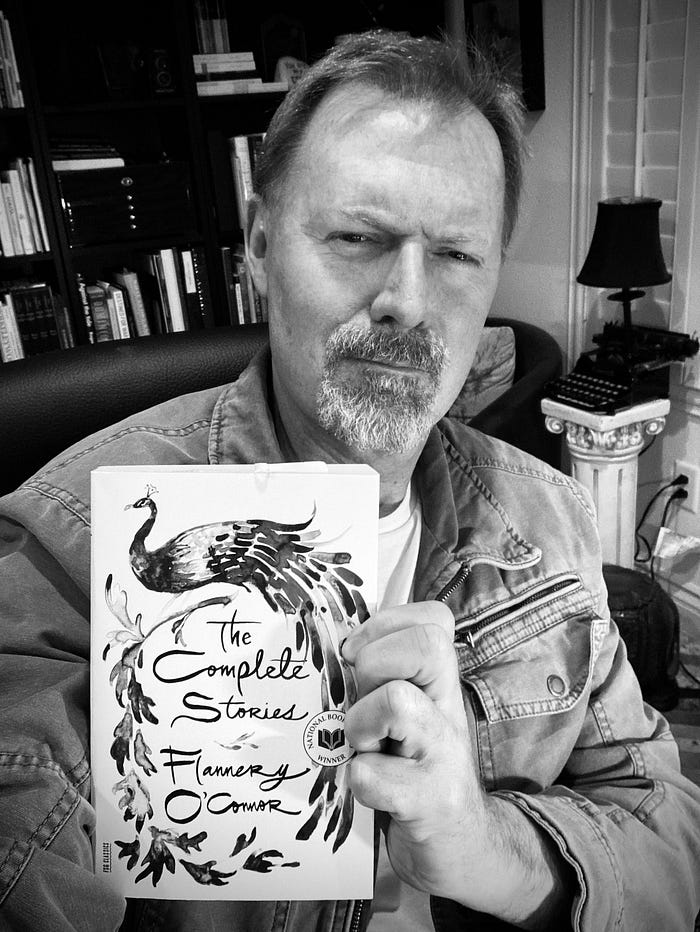
As described in Wikipedia, “Flannery O’Connor was an American novelist, short story writer and essayist. She wrote two novels and 31 short stories, as well as a number of reviews and commentaries.”
A southern writer, O’Connor explored issues of morality and ethics.
She was diagnosed early in her life with systemic lupus erythematosus. A devout Catholic, she’d attend mass in the mornings, then write, and spend the remainder of her day resting and reading. And yet, she made over sixty lecture appearances to read her works.
To expect too much is to have a sentimental view of life and this is a softness that ends in bitterness. — Flannery O’Connor
Somehow, despite the cards that life dealt her, Flannery O’Connor managed to find her summum bonum. She embraced her highest good. She may have died at the tender age of 39, but she pursued her highest good. She crafted great literature that informs and moves people even today.
Steal a page from Cicero and Flannery O’Connor.
Embrace summum bonum, the antidote to despair. Chase your highest good. Help yourself by continuing to love your family and friends. Produce great creative work, help others, and seek virtue and the highest good in your life.
Don’t succumb to the thing in Philip Larkin’s poem that is pushing people to “The side of their own lives.”
My son may be out of the house soon, but he will always be in my life. And while he’s chasing his summum bonum, I’ll be pursuing mine, via my creative work and efforts to help and inspire others.
Don’t allow yourself to be driven to the margins of your existence.
Love your family, friends, and those around you. When challenges come, as they do for us all, face them with dignity and grace. Keep fighting to do the things that matter to you. Embrace your summum bonum.
Do this, and the grace in your life will drive despair to the margins of eternity.
Before you go
—
This post was previously published on Medium.com.
—
The Good Men Project is a mission-driven men’s media platform. A major platform for stories about men, identity, fatherhood, and emotional intelligence—and a trusted home for the national conversation about masculinity.
The Good Men Project accepts paid guest posts and provides bulk guest post packages for SEO agencies and resellers.

If you believe in the work we are doing here at The Good Men Project, please join us as a Premium Member today.
All Premium Members get to view The Good Men Project with NO ADS.
Need more info? A complete list of benefits is here.
Photo credit: The author with wife and son inside the Empire State Building


Reading this was like sitting down with a thoughtful friend who’s staring down one of life’s big transitions and inviting you to ponder it with them. The author reflects on becoming an empty nester as his son prepares to leave home for good — familiar emotional territory for many of us. There’s a quiet melancholy in watching the everyday rhythms of life shift, and the way he uses Philip Larkin’s poem to frame that subtle “push to the side of our own lives” really hits home. But what makes the piece resonate isn’t just the nostalgia — it’s the turn… Read more »
I visited Larkin in 1977. He made me laugh, told wonderful stories and surprised me with his knowledge of American literature. He wanted Bukowski’s papers for his library. He built a fabulous library. He showed me the Queen mum’s guest signature — with wax and ribbons. And solved a library problem that I loved. And he filled his life with women. He left a world a joyful treasure house of quality work. He left this world to “gallop for what must be joy.”