


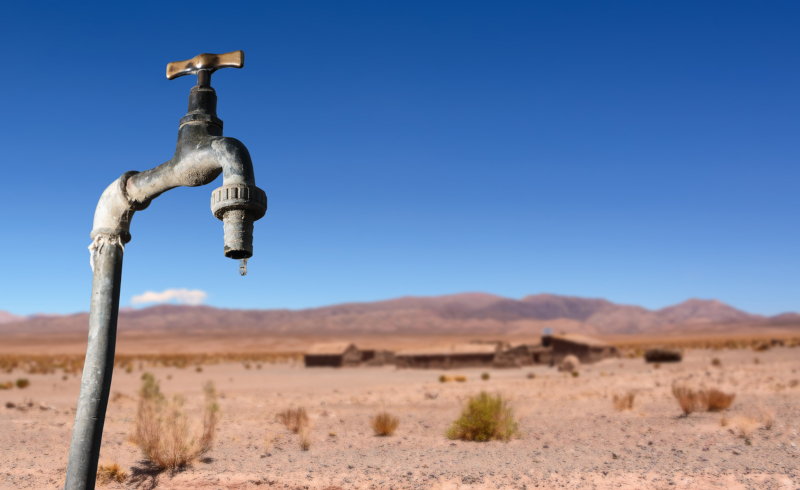
“More and more people will suffer from extreme droughts if a medium-to-high level of global warming continues and water management is maintained at its present state,” says lead author Yadu Pokhrel, associate professor of civil and environmental engineering in the College of Engineering at Michigan State University
“Areas of the Southern Hemisphere, where water scarcity is already a problem, will be disproportionately affected,” he says. “We predict this increase in water scarcity will affect food security and escalate human migration and conflict.”
The team, including Farshid Felfelani, a postdoctoral researcher at Michigan State, projects a large reduction in natural land water storage in two-thirds of the world, also caused by climate change.
Land water storage, technically known as terrestrial water storage, or TWS, is the accumulation of water in snow and ice, rivers, lakes, and reservoirs, wetlands, soil, and groundwater—all critical components of the world’s water and energy supply. TWS modulates the flow of water within the hydrological cycle and determines water availability as well as drought.
“Our findings are a concern,” Pokhrel says. “To date, no study has examined how climate change would impact land water storage globally. Our study presents the first, comprehensive picture of how global warming and socioeconomic changes will affect land water storage and what that will mean for droughts until the end of the century.”
“Recent advances in process-based hydrological modeling, combined with future projections from global climate models under wide-ranging scenarios of socioeconomic change, provided a unique foundation for comprehensive analysis of future water availability and droughts,” Felfelani says.
“We have high confidence in our results because we use dozens of models and they agree on the projected changes.”
The researchers based the study on a set of 27 global climate-hydrological model simulations spanning 125 years and conducted it under a global modeling project called the Inter-Sectoral Impact Model Intercomparison Project.
“Our findings highlight why we need climate change mitigation to avoid the adverse impacts on global water supplies and increased droughts we know about now,” Pokhrel says. “We need to commit to improved water resource management and adaptation to avoid potentially catastrophic socio-economic consequences of water shortages around the world.”
The paper appears in Nature Climate Change.
—
This post was previously published on Futurity.org and is republished here under a Creative Commons license.
***

If you believe in the work we are doing here at The Good Men Project and want a deeper connection with our community, please join us as a Premium Member today.
Premium Members get to view The Good Men Project with NO ADS. Need more info? A complete list of benefits is here.
—
Photo credit: iStock

