



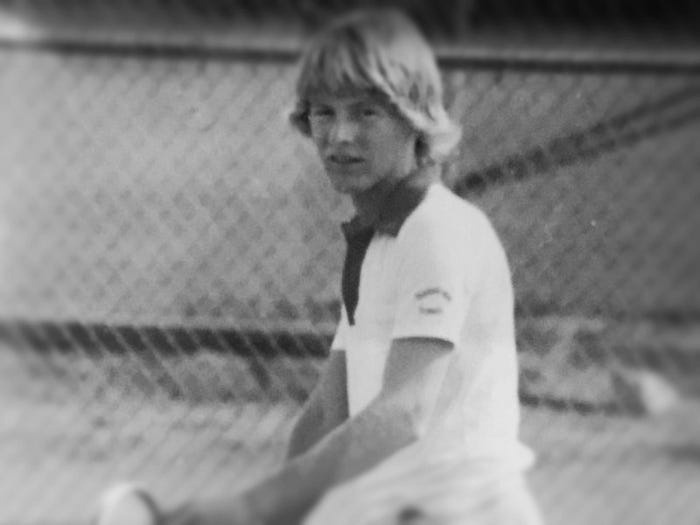
During my freshman high school year, I tried out for the varsity tennis team but ended up on the junior varsity team. My father saw my disappointment and realized that I needed to improve my game. He offered to pay for private lessons and I suggested Charlie.
That’s how Charlie became my tennis coach.
Something that makes you want to live
For an entire summer I met Charlie every weekend at the private tennis courts adjacent to the condos where he lived.
Charlie rallied with me for a while and then had me serve repeatedly. Next he hit balls to me while I stood at the net, volleying returns. Charlie studied my game. Then he pulled out his notebook and jotted stuff down.
In the many weeks that followed there were countless exercises, grip adjustments, visualizations, and modifications to my game. He even used one of those machines that repeatedly fires balls across the net.
I improved significantly.
That Fall I tried out for the varsity team and was accepted. No doubt, my summer with Charlie made all the difference. He had a unique ability to diagnose the deficiencies in a player’s game, and he found the refinements and solutions that led to improvement.
During the rest of my high school years I bumped into Charlie, sometimes at tournaments but mostly at the public tennis courts. He was aging and moving slower, but his passion for tennis never waned.
Charlie seldom talked about family. Someone once told me that he was divorced. I could detect a sadness in his eyes sometimes. I got the impression that life had not been easy for him.
It’s no accident, I think, that tennis uses the language of life. Advantage, service, fault, break, love, the basic elements of tennis are those of everyday existence, because every match is a life in miniature. Even the structure of tennis, the way the pieces fit inside one another like Russian nesting dolls, mimics the structure of our days. Points become games become sets become tournaments, and it’s all so tightly connected that any point can become the turning point. It reminds me of the way seconds become minutes become hours, and any hour can be our finest. Or darkest. It’s our choice. —Andre Agassi, Open
Once I saw Charlie coaching a kid.
The kid teased Charlie and said, “Hey old man, why are you still out here chasing tennis balls around?”
“Tennis is my life, kid. It’s what I live for,” Charlie said.
Charlie may have taught me how to improve my tennis game, but unwittingly, he taught me something else.He taught me that life is sweeter when you have something you love to do.
Something that makes you want to live.
Must get on with life
The late author Ivan Doig had just turned six years old when his mother died from asthma.
He was raised by his father, a Montana ranch hand/sheepherder, and his grandmother. Doig once described his family as the Western equivalent of sharecroppers.
An article about Doig in the Mountain Journal notes:
Doig’s recollections of those years figure prominently in his work, hailed for giving voice to everyday people who struggled to get by and who found meaning and hardship in the absence of material wealth.
Losing his mother so early, and growing up in the hardscrabble open country of Montana meant that Doig understood hardship and the vicissitudes of life.
So it’s not surprising in 2006 that Doig, who was given a diagnosis of “smoldering” myeloma, faced the bad news calmly. The disease is progressive, unstoppable, and hard to predict.
Doig didn’t just accept the bad news, he used it in his writing.
As the Mountain Journal article notes, Doig “…rather than trying to flee from reality or become hobbled by depression, used it as yet another opportunity to explore revelation and introspection.”
The article adds:
For more than eight years, from diagnosis until his death in 2015, Doig accelerated his methodical, workmanlike devotion to composing words on the page, producing five more books capped by the finale Last Bus to Wisdom. Those works joined a corpus which includes the book that established him as a giant, This House of Sky: Landscapes of a Western Mind (finalist for a National Book Award) and the earlier Dancing at the Rascal Fair.
Imagine that.
Doig managed to write and publish five more books, over eight years, after his diagnosis. The slow progression of the disease no doubt helped, but the real story was Doig’s determination.
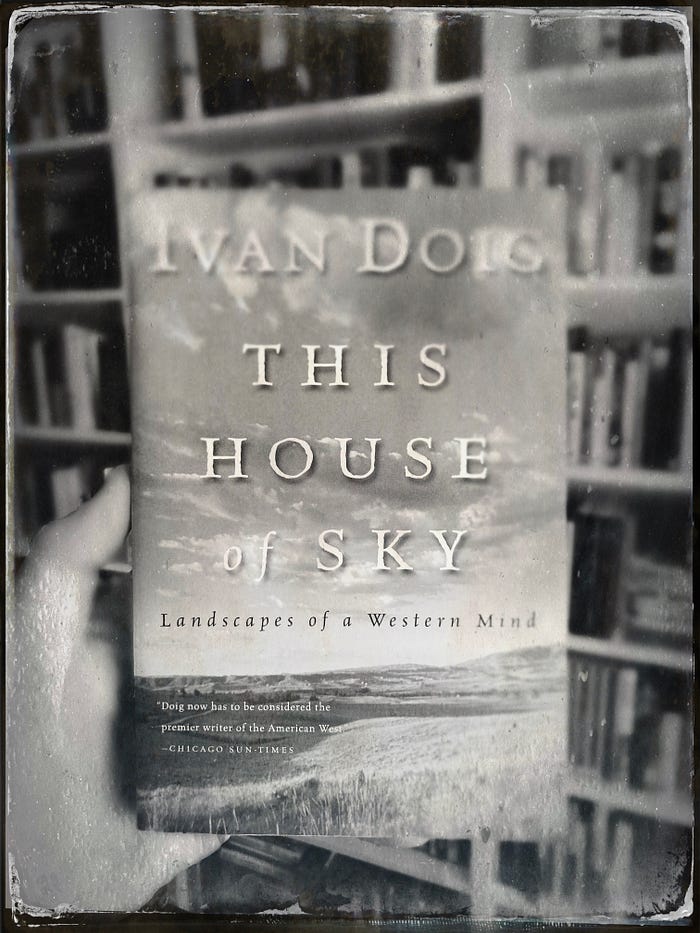
Doig wrote in his personal journal on April 8, 2006:
…the point I must keep reminding myself of is that I am otherwise healthy and feeling fine, and therefore must get on with life. Told Carol when we were both typing up our notes…that I don’t have any ‘why me?’ at all, because I’ve always figured life asks back, ‘why the hell not you?’ Did tell her, in choked up fashion, that what daunts me about the possibility ahead is going through the end of life from one cancer treatment to the next. So we know that’s daunting, and now to work through it in the meantime.
I love that last line: “…and now to work through it in the meantime.”
Ivan Doig loved to write, and it was his love of writing that sustained him for eight years post diagnosis. His love of writing resulted in the publication of five books. Who knows how long Doig would have lived without his writing passion.
It’s so important in life to find the thing that quickens your heart.
The thing that makes you feel alive. The thing you love to do. The thing that makes you smile.
Find the thing that never abandons you, and hold it close all your life.
Believe in yourself despite the evidence
The author Kent Haruf loved writing as much as Ivan Doig.
And like Ivan Doig, Haruf’s literary career would be cut short by a terminal diagnosis. In Haruf’s case, it was an incurable lung disease.
Haruf knew he was dying, but he told his wife Cathy that he felt well enough to try and write one last book. An article in the Wall Street Journal about Haruf and his last novel notes:
Normally, it took him six years or more to write a novel. But in a rush of creative energy, he wrote a chapter a day. Roughly 45 days later, he had finished a draft of his final novel, ‘Our Souls at Night.’
Haruf’s slender novel “Our Souls at Night”is a tender and poignant story about Addie Moore and Louis Waters, two widowed people in their senior years who are neighbors and both extremely lonely.
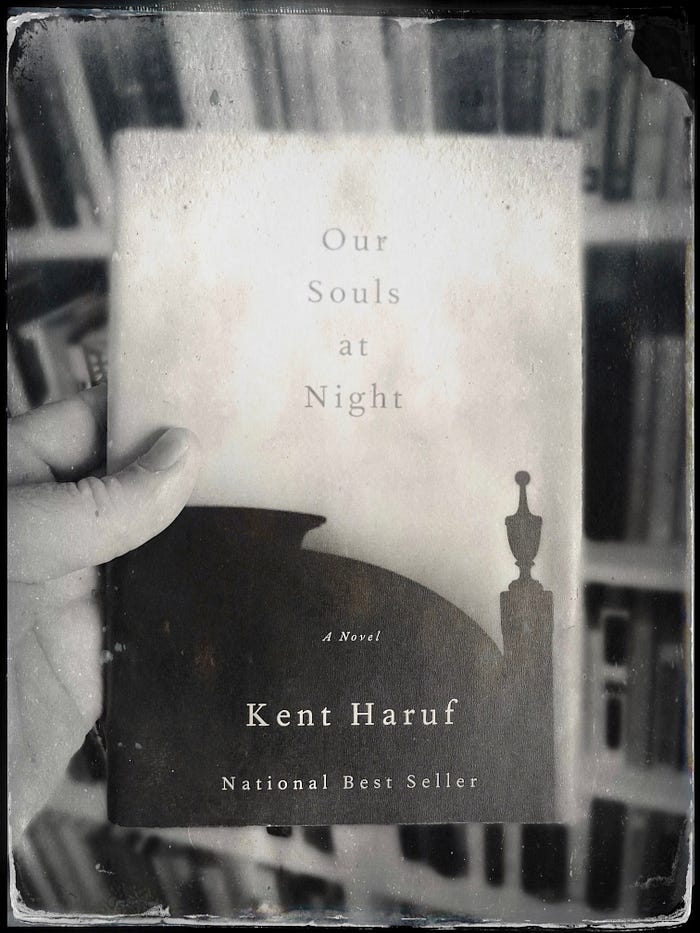
The story, written in Haruf’s spare style, is filled with love, sadness, loyalty, and loneliness. The book was made into a movie starring Robert Redford and Jane Fonda.
Haruf lived long enough to complete his final novel, no doubt sustained by his love for writing.
You have to believe in yourself despite the evidence. —Kent Haruf
How about you?
What songs still dance in your heart?What muse still whispers in your ear? What lifelong passion has never abandoned you?
For my old coach Charlie, tennis was the elixir that took away the slings and arrows of life. Tennis was Charlie’s muse and salvation.
For men of letters like Ivan Doig and Kent Haruf, it was their love of writing and storytelling that set them free. Even in the face of illness and mortality.
Your creative muse and deepest feelings are like a magnifying glass, enlarging and making clear for you the thing that really matters. The thing that truly resonates in your heart and soul.
Don’t neglect it.
Find the thing that never abandons you, and hold it close all your life.
Before you go
I’m John P. Weiss. I write elegant stories and essays about life. If you enjoyed this piece, check out my free weekend newsletter, The Saturday Letters.
—
This post was previously published on Medium.com.
—

If you believe in the work we are doing here at The Good Men Project, please join us as a Premium Member today.
All Premium Members get to view The Good Men Project with NO ADS.
Need more info? A complete list of benefits is here.
Photo credit: mari lezhava

