



There will be a virtual screening of Fortunate Sons on November 19th in time for International Men’s Day. Free, Virtual, On-Demand screening for International Men’s Day and Men’s Health Month
Dates: Beginning 11/15/25 and continuing through 11/22/25
Register at: https://www.filmplatform.net/events/fortunatesons-2/
Use Invitation Code (case-sensitive): FSI-IMD
As a child of the 60s and 70s with hippie sensibilities, I was fascinated by anything related to peace and was appalled by the workings of war and violence. I watched reports about the Viet Nam War, the campus protests, the Kent State Massacre, the assassinations of JFK, RFK, MLK and Malcolm X, the Civil Rights Movement and the March on Washington. I asked my parents to explain what I was seeing on the tv screen and they did their best to help me make sense of it all. To this day, I am ‘getting into good trouble,’ as a peace and social justice activist. When I heard about new film called Fortunate Sons which debuted at the Dances With Films Festival , I knew I needed to watch it.
The full length feature highlights a pivotal experience that shaped the lives of the filmmakers and became fodder for their creative endeavor. When John Manulis and Peter Jones entered The Harvard School in LA in the seventh grade, they went from a life of privilege to one of military discipline with the expectation that they and their classmates would be the leaders of the future. A heavy mantle for a 12 year old to bear. The bonds that formed between them and their classmates, extended decades into the future. During the pandemic, they decided to gather together, via the marvels of modern technology, as many as were willing to reconnect and not merely reminisce, but review what that time in their lives meant to them, and how it shaped the men they had become. For some, the journey was not easy. For all of them, it revealed the challenges they faced as men in a culture that is sometimes fueled by the desire to succeed at all cost, toxic masculinity, vulnerability as complete human beings, mental health, relationships and addiction. As a therapist, I appreciated the willingness for those in the film to peel off the layers to reveal the real. The participants, now seasoned men were getting to know each other again as they planned their 50th reunion. I found myself at turns, smirking, cheering, smiling and crying as they spoke about the meandering paths each participant took since being groomed to be a certain kind of man.
This was my immediate reaction after watching it:
“Holy sh#t, this is spectacular! The world needs to see this film.”
– Edie Weinstein, Mental health professional, and journalist
I invite you to get to know Peter and John as they share their stories.

Was creativity in your blood?
John: I suppose so, but only one generation deep. My father was a well-known television and film producer, a key figure in what is known as the Golden Age of Television, and my mother was an actress, but their parents were primarily in business and a bit of politics and looked askance at the entertainment community. I fought against my parents’ path all the way to being a pre-med, majoring in government at college, but eventually, unavoidable facts like working 8 hours a day in the theater for no academic credit forced me to recognize my truth, which is a passion for working in collaboration with talented folks to make cool things happen.
Peter : My grandfather on my mother’s side was an actor on the Broadway stage before coming to Hollywood in 1919 to make silent pictures. He successfully transitioned to talkies because he had a great voice. My father designed and built airplanes so creativity is definitely in my blood.
How did you enter into the field of filmmaking?
Peter: I became a journalist and filmmaker to learn about the real world, having had such a privileged upbringing. I was a TV reporter for several years, working in Virginia, Texas, and then, coming home to tell stories about Hollywood’s rich history. That led to biographical documentaries about major icons from Charlie Chaplin to Judy Garland to Johnny Carson. I credit my efficient filmmaking style to my background in journalism.
John : I never really had a career plan. I was working in the theater in New York, mostly as a director and casting director Off-Broadway, and one summer, when theater jobs in the city pretty much dry up, I took a job to pay the bills as an assistant at a small television production company. I thrive on learning by doing vs. learning by training, and managed to put together a “bankable” cast for a script they had on the shelf, “A Case of Libel”, which enabled it to get green lit for production. So, they asked me to stay on… offering me very little money, but the opportunity to be a producer on shows I put together. In theater, the director tends to be the force that puts projects together, so the transition into producing for television was natural for me. After producing a critically-acclaimed series and a commercially successful movie-of-the-week, a legendary producer named Edgar Scherick wooed me to come out to Los Angeles and take over his film division…and then, I was suddenly producing film projects.
From the perspective of an avid movie watcher, it seems like magic. Does it feel that way to you?
John: There’s magic when you’re watching it – the Cinema Paradiso experience of sitting in a dark theater, surrounded by other humans, being transported into other cultures, other worlds on emotional journeys. The making of movies is much more of an industrial process…but it IS quite miraculous when that number of people and that amount of collaboration results in something that actually works, let alone sings. We always set out to make a good movie, but there are just so many moving pieces, so many egos and opinions and pressures and currents in the mix, that when emotional authenticity, human truth, dramatic impact, talent, generosity of spirit, and luck come together, as it did in Fortunate Sons, it just blows your mind.
Please tell us about Peter Jones Productions and Forward Fortune
Peter: I started Peter Jones Productions in 1987, after having cut my teeth as a broadcast journalist. Stories I produced for Showtime and The Movie Channel led to a job hosting AMC in Hollywood with Peter Jones – where I made sixty short-form documentaries about my hometown’s homegrown industry. A contract with A&E allowed me to produce nearly ninety editions of its iconic Biography series. I’ve always focused on character development with every subject profiled. I hired kids straight out of college and taught them how to make films by making films on day one.
Why is ‘giving back,’ or ‘paying it forward,’ important to you?
John: Like many things, the roots are deep and widespread…and largely invisible. But somewhere in the nexus of growing up with privilege and being influenced at a young age by a charismatic doctor who broke the rules and managed to save my mother from what had, until then, been a terminal disease, I developed a strong sense of the remarkable humanity and value and potential in every person. Out of that evolved a desire to wrangle my own, admittedly healthy, ego to help other folks achieve their dreams and power the amazing potential of collaborative endeavors.
You grew up in a time of civil unrest- the Viet Nam War, the assassinations of JFK, RFK, MLK and Malcom X, the Civil Rights Movement, the Kent State Massacre, the Cold War, the budding feminist movement. Did those events shape the men you became?
John : Definitely. I was just a little too young to really be an active participant in the movements of the late ‘60s and early ‘70s, but as a teenager, the passion and moral outrage and revolution for humanity at their core was very influential. From that point on, the social/cultural changes came thick and fast, and while sometimes confusing, and even threatening at times, in general I found them invigorating and a real opportunity both personally and professionally. They definitely shaped my tendency to listen and learn and adapt, to be a willow rather than an oak, as the storms rolled through. In 2008, I jumped out of my career and into working for Barack Obama’s Campaign for Change, to some extent because he was the first politician who sparked the same kind of feelings I’d gotten from Bobby Kennedy in the ‘60s, but was too young to act on at that time.

And a culmination of those times and influences, became your film called Fortunate Sons. Who were these compatriots of yours?
Peter: We happened to have entered Harvard School in the cultural watershed year of 1968. We happened to start making Fortunate Sons during the watershed year of Covid quarantine, 2020. Zoom technology allowed me to talk to my classmates as they sheltered in place at home. I think that created the intimacy you see on the screen. I have been humbled by the trust these men gave to me so freely. Each of us was on a journey of self-discovery during a specific moment in time. Circumstances and how each of us responded to those circumstances created the film.

Please share the process of the documentary’s creation.
John: Basically, we saw a rare opportunity and grabbed at it. Early in Covid, one of our classmates asked if guys wanted to get together on Zoom, just to see some familiar faces. It was a great experience, so we did it again. Our classmate, John Saliba, had been talking about doing something special fort he 50th Reunion and asked me to think about how we could capture it for posterity. But, by our second class Zoom, it became clear that the potential was here for a fascinating documentary -I mean, it’s difficult to get two guys to talk openly about life, let alone 70. I wanted to approach Peter, the award-winning documentarian in the class, to take it on; but to help goose the pitch, I asked a couple of other entertainment industry classmates to join in so he’d have a small support group behind him.
Peter: My first reaction was essentially “Who is going to care about a bunch of middle- aged white guys?” But, then I agreed to give it a shot, and two years later, when it had become so powerful for me personally, I had to apologize to everyone for that initial comment! We spent a while developing the concept and trying to get traditional industry support – but then we decided to control our own destiny and just started making it, raising funding privately for each next step of the process, on a rolling basis – angel investors, a friends and family crowdfund, Kickstarter, it kind of never stopped. It’s interesting, because we didn’t just produce the documentary – John basically produced the 50th reunion event itself, as well. They were separate “productions”, but obviously very synergistic, and having our hands in the planning of both was instrumental for building and maintaining the engagement and enthusiasm of the class, as well as making sure the content of the reunion served the documentary as well as possible. So, after almost 5 years of class Zooms, dozens of individual interviews, deep dives into archival and historical material, a year and a half of editing and post-production, and with the support of a remarkable village of talented film professionals, investors and contributors, we were able to complete the movie.
John : And now we’re kind of starting the process again, as we plan and fund our impact campaign! There are good films and bad films, but some films have the stuff of story and thematics that can influence people, help them look at themselves and the world differently, to have real impact. We’re incredibly excited about using Fortunate Sons, in partnership with schools, groups, and organizations across the country, to convene vital conversations around personal development, masculinity, and the healing power of connection and vulnerability.
What were you taught about being a man?
Peter: My role model was my father who I saw as a master of the universe before I saw him as a man. He was a monument on a pedestal. Only as I grew up did I see my dad as an imperfect human being – just like me and everyone else. He stole a line from Shakespeare when he wrote me a letter on my 21st birthday, “Peter, be true to yourself.”
John: It’s difficult to parse where I learned about being a man from the myriad personal and cultural influences, but among the positive values of consideration, respect, and generosity of spirit, there was the darker pressure to perform, in every area of life, and to absorb any stresses that come your way calmly and with dignity.
What have you learned since then?
John: Diversity is enriching, humility is a blessing, vulnerability is courageous, and responsibility and accountability are essential. Everyone does it differently and we can all learn from each other – recognizing, silently applauding, and gently appropriating traits and behaviors.
What melted your hearts about this experience?
John: Peter’s generosity of spirit and deep emotional connection to the incredibly cool happening of us reconnecting and rekindling our friendship after many years, through this project.
Peter: I feel exactly the same way about John. It’s been the best collaboration of my career. I would want to be with John on that proverbial desert island or dingy in the middle of the ocean.
How was the reunion?
John: It was amazing. We’d put a lot of thought and planning into the settings and activities that would create emotional openness and connection, but when those guys actually saw each other in person after years of Covid lockdown and class Zooms, the sense of friendship, and camaraderie, and trust was just overwhelming.
If you had the attention of the world, what message would you like the film to send?
Peter: Listen to one another and be kind.
How was the debut at the Dances With Films festival?
Peter: It exceeded all expectations because the audience was made up of so many classmates, friends and family spanning the course of my life. We all laughed and cried together, I’ll cherish that for the rest of my life.
Check out the trailer for this spectacular film!
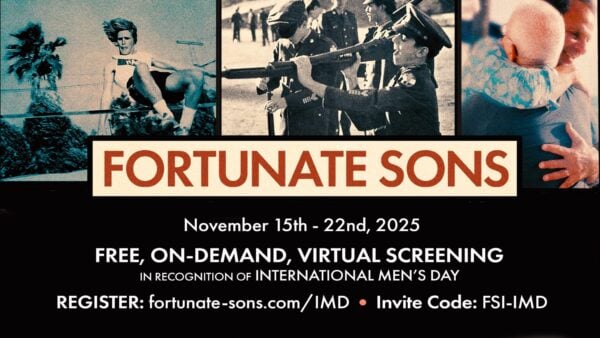
YOU’RE INVITED! Join us for a special FREE, ON-DEMAND, VIRTUAL SCREENING being hosted by The ManKind Project, along with The Good Men Project, and Consciously Unbiased, in recognition of International Men’s Day and Men’s Health Awareness Month. And please share it with those you’re close to.
Screening dates: Starting November 15th and continuing through November 22nd.
Register at: fortunate-sons.com/IMD
Use Invite Code: BFI-IMD

Join our community – here are some ways you can help!
- Watch the movie! Click here to see our broadcast dates and online public screenings.
- Host your own screening for your school, group, organization, or company. Just fill out our Screening Inquiry Form – it’s an easy process, designed to support groups from neighborhood book clubs, to churches, schools, or national non-profits – the folks at ROCO Films, who are coordinating our impact campaign, will do everything they can to support you.
- Join our mailing list.
- Follow us on Facebook, Instagram, or TikTok @fortunatesonsmovie – and share our posts and your thoughts!
- Recommend schools and organizations in your community that you think would resonate with our mission – write us with their info at [email protected] and we’ll get in touch.
- Contribute to support our impact campaign. Your support is critical – enabling us to bring the message of Fortunate Sons to even more communities.
Together, we can make a difference in people’s lives!
Together, we can flip the narrative about strength and vulnerability.

To join their mailing list and/or support the impact campaign go to https://www.fortunate-sons.com/

