


Wherein I attempt to argue that three current events in particular are better understood if you understand the relevant history.
Is it sexist to address the incoming class as “freshmen?” The manifest clumsiness of “freshperson” might dispose of the question if you gave no thought to the term “co-ed,” which made sense only because higher education was thought to be a male pursuit.
Sit right over there, little lady. Just keep quiet and don’t touch anything. The guy next to you is training to fly the plane and your IQ has gotten you into a target-rich environment for husband-hunting. You will get what you want and so will the guys.
I retired as Associate Professor Emeritus from Indiana University, the second school where I was tenured. The first was the University of Texas at San Antonio, and I turned down the tenure offer to accept an untenured position at Indiana. Teaching was my second career, and I took it seriously enough that I offer it to explain why I was appalled to watch an anti-intellectual bonehead embarrass himself and the country for four years.
The president we just survived came with zero experience of public service and an undergraduate degree in business. (No, government does not run and cannot be run like a business.) Donald John Trump, who coined the term “The Donald” as a self-description, said that he was a graduate of the Wharton School of Business at the University of Pennsylvania, a graduate school of excellent reputation. I confess I was taken in by how he described his undergraduate degree.
What grounds do we have to complain? According to the former president, we had a chief executive who we just re-elected but for stolen votes who:
Knows more about diplomacy than any career foreign service officer
Knows more about dealing with a pandemic than any medical doctor
Knows more about law than any sitting judge, and
Knows more about warfare than any of the generals and admirals that the Constitution placed under his command.
Normally, when the White House is taken over by the opposing political party, there is a raid on universities and think tanks, as the new Chief hires the best and brightest advisors who are likely to share his general philosophy and some who will not.
To Mr. Trump, government jobs are just jobs, offered to repay favors or express friendship. Need a Surgeon General? The President’s personal physician. Need to fill a seat on the Federal Aviation Administration? The President’s personal pilot.
I leave it to Medium readers whether Mr. Trump’s lack of a personal historian is a bad thing or a good thing, but his disdain for education stands out when he tries to discuss history.
He spoke of Frederick Douglass, who died in 1895, in the present tense to a Black History Month gathering.
He averred that Andrew Jackson (1767–1845) could have avoided the Civil War (1861–1865). If only Old Hickory had the same time machine Barack Obama’s parents used to plant birth announcements in Hawaiian newspapers.
In a conversation with Canadian Prime Minister Justin Trudeau, he claimed that Canada had burned down the White House in the War of 1812. Maybe he was just testing Trudeau to see if he knew Canada became an independent nation in 1867.
In a conversation with Panamanian President Juan Carlos Varela, Trump appeared to be taking personal credit for the construction of the Panama Canal. If he meant the United States, he was just being rude — not necessarily ignorant.
Still, he seems ignorant of history that is so recent he was involved in it. That leads me to speculate that it might be like the wild gyrations of the stock market he caused with the Twitter machine before he understood the connection.
People interested in history are capable of looking up the number of people at his inaugural address and comparing that to other inaugurals. His barefaced lies about his polling numbers are also to no avail because it’s all written down.
What am I saying? Written down? He lies when the truth is on video and it’s possible to put up a split screen with the lie and the instant rebuttal.
When he was the POTUS, everything he did made history. So why does he not pay attention to the history others have made? I sometimes wonder if he would have tried to use his commander in chief power to change the curriculum in the U.S. military academies if he knew they all require history.
Critical Race Theory is a way of explaining actual events, historical and current. I have taught it, but only to graduate students. I cannot imagine use for theory on that level in K-12, and the allegations being made about what it has caused in K-12 are absolute nonsense. On the graduate level, it will be part of the debate until it prevails or is decisively debunked.
Even if the Republican jihad against Critical Race Theory lacks a tether to reality, it has become the third of three bits of current news that inspired me to rewrite some things I originally published when I thought history needed no defense. Now, I’m afraid the last four years have left the study of history another of those things that get left behind when you evaluate schools by how long it takes to get employed and at what salary.
The other two events are the cancellation of the Dakota Access Pipeline and, most critical of all, the attempted insurrection in Washington on January 6.
Two wars are simmering in the Western United States, both thought to have ended long ago and both making a job with the federal government a potential assignment to the front lines. An interactive map, published by High Country News, shows how dangerous it is these days to work for one of the government agencies managing public land.
The older war is known by a collective description, the Indian wars. The newer war is the one so far causing more danger to government employees. It’s a continuation of the bloodiest conflict in the history of the nation, the Civil War.
Conventional wisdom holds that the Indian wars ended in 1890, with the U.S. Army’s massacre of noncombatants at Wounded Knee Creek in South Dakota. The nascent technology of photography robbed the soldiers of deniability, if not of their fanciful Medals of Honor, and public opinion turned as stomachs turned viewing the stacks of frozen bodies.
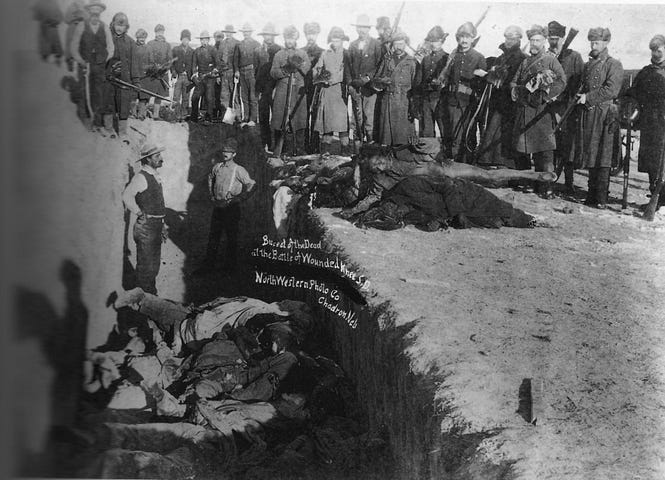
The United States ended the mass killings of noncombatants after 1890. The Plains Indians had ended offensive operations in the Northern Plains after Sitting Bull was “shot while resisting arrest” the same year. Armed resistance in the Southern Plains had ended with Quanah Parker’s surrender in 1875. Geronimo’s war against both the U.S. and Mexico ended with his surrender in 1886, and the old Apache leader died at Ft. Sill, Oklahoma, in 1909 — still officially a prisoner of war.
The American Civil War is supposed to have ended with the surrender of the last Confederate forces under Cherokee Gen. Stand Watie on June 23, 1865. The precipitating issue — chattel slavery — was papered over, but the exploitation of the former slaves continued with the Black Codes and the Jim Crow laws.
The former Confederacy did not accept the supremacy of the federal union and the Indian nations did not accept the trampling of their sovereignty and continuing theft of their remaining resources. Both of these wars proceed today, by differing means.
U.S. settlement of the West was a government project, subsidized and protected every step of the way, starting with the military part of the Indian Wars. In addition to suppressing Indian opposition, the government funded the transcontinental railroad and the Homestead Act of 1862 promised “free” land (only lightly used by the Indians recently evicted) to settlers who lived on it for five years and produced crops, requirements that varied slightly in different iterations of the homestead laws.
While the Civil War was still going on and before the shooting part of the Indian wars ended in 1890, it became federal policy to encourage and subsidize settlement in the West. Between 1850 and 1871, the government granted railroads 1.31 million acres of land for rights of way, some of which bisected Indian treaty land. Federal loans to railroads to fund construction totaled almost $65 million.
Under the Pacific Railway Act of 1862, in addition to the rights of way and the loans, the railroads got a grant of up to 20 sections of land for every mile of track laid. A section is a square mile or 640 acres, and the grants were made in a checkerboard pattern for 40 miles on each side of the right of way.
When some of the western lands proved too dry for farming, settlers began to agitate for federal irrigation projects. The railroads supported the idea with enthusiasm because water would increase the value of the land they had been granted to encourage construction. Federal involvement began in 1902 and in 1923 irrigation and flood control were centered in the Bureau of Reclamation, which sold water to farmers at a fraction of fair market value.
Irrigation was a boon for farmers like the railroads were for ranchers. The great cattle drives of the 19th century were undertaken by rounding up a herd from the open range and driving it to a railhead for shipment to the eastern cities where the consumers of the beef waited. No rail — no sale.
In 1850, the U.S. had about 9,000 miles of railroads. By 1885, there were 87,000 miles. Ranching in the West was made possible by the federal government forcing the Plains Indians to reservations, allowing free grazing on the open range, and funding the railroads to get the cattle to market.
The Homestead Act was amended many times, and the last state to encourage settlement with “free land” was Alaska, where the Supreme Court refused to recognize aboriginal land titles in Tee-Hit-Ton Indians v. United States in 1955. The last homestead deed was issued for land in Alaska in 1988.
Another law that was a people magnet was the General Mining Act of 1872 that allowed mining on public land, first come-first served, without having to split the income from public lands with the government or the dispossessed former owners.
Ranching, like farming and mining, was subsidized by the government. Until 1934, when the Taylor Grazing Act changed the rules, federal land was available to graze livestock free for the taking. Since then, ranchers are supposed to get permits from the Bureau of Land Management (BLM) and pay a fee that is typically under fair market value. A similar law allows for grazing permits on land controlled by the Forest Service.
The ranchers, like the miners to a lesser degree, were born with government largess they take for not only a birthright but also a constitutional principle. Their constitutional ideas proceed on two fronts.
First, they take the Tenth Amendment principle that the federal government is one of enumerated powers to mean that the Confederacy was right. There is no enumerated power to preserve the union by force or — more to the point — to maintain and manage an inventory of public lands. Those lands, they maintain, are subject to state sovereignty. They are correct about only one state, Texas, which retained title to public lands in its annexation treaty. (Which was never ratified. Texas was annexed by congressional resolution, with implications that go far beyond even my ability to digress.)
Second, they take the Second Amendment right to keep and bear arms to be not primarily for hunting or home defense, but for armed insurrection against federal tyranny, the outcome of the Civil War notwithstanding. This is radical American exceptionalism when most of the world considers imprisonment without charges or government control of the media to be tyranny — and some ranchers in the American West find tyranny in grazing fees.
It is not a crime to fail to pay grazing fees, so the government relies on the common law rule that one who provides necessary food for an animal has a lien on the animal. The BLM hires cowboys to round up the livestock being grazed on public lands and sells the livestock to cover the grazing fees.
Luther Wallace “Wally” Klump, an Arizona rancher, got put in jail for contempt of court during a BLM action to collect grazing fees. Klump’s 2004 statement to The New York Times put together the issues in a manner as clear as it is frightening:
The Second Amendment is my ace, and they know it’s my ace. The founding fathers gave the individual a gun to fight the tyranny of the government. What’s that mean? The bearer can kill someone in government if the reason is justified. But it’s never been tested. I told them, you take those cows, I’ll kill you as mandated by the Second Amendment.
In 2014, Nevada rancher Cliven Bundy was the target of BLM enforcement action because he had failed to pay grazing fees for 20 years. Bundy claimed that if he owed grazing fees, he would owe the state of Nevada rather than the federal government in spite of a Civil War era “paramount allegiance” clause in the Nevada constitution. Bundy’s determination to continue fighting the Civil War intersected with the continuing Indian wars.
In 1979, the Indian Claims Commission awarded the Western Shoshone $26 million in compensation for Shoshone lands lost to “settler encroachment” in violation of the Treaty of Ruby Valley. The Shoshone refused the money because they had never agreed to sell the land at any price.
Shoshone elders Carrie and Mary Dann grazed their cattle on Shoshone treaty land without paying fees to the BLM, based on the Treaty of Ruby Valley, Art. VI of the Constitution, and a report by the Inter-American Commission on Human Rights of the Organization of American States.
In 1992 and again in 2002, the BLM rounded up the Dann sisters’ cattle and sold them for grazing fees. In 2014, the BLM rounded up 400 head of Cliven Bundy’s cattle for the same reason.
Before the cattle could be sold, the armed “patriots” of the militia movement invoked their 2nd Amendment remedies. They appeared on video sighting their assault rifles on BLM employees.
Facing some 400 armed men promising a bloodbath, the BLM wisely decided that some grazing fees were not worth anybody’s life. The federal agency gave the cattle back and stood down, resulting in major encouragement for the militia movement.
The next battle in the militia movement’s refighting of the Civil War also had a subtext of the Indian wars. Steven Hammond and his father Dwight Hammond were due at the beginning of 2014 to report to the U.S. Marshal to begin serving five years for arson on federal lands.
Cliven Bundy announced that the Justice Department “has no jurisdiction or authority within the state of Oregon.” Bundy’s son Ammon posted a video on YouTube appealing to the militia movement to come to Oregon and defend the Hammonds.
After a rally in support of the Hammonds in Burns, Oregon, a number of individuals claimed by the organizers to be 150 began an unopposed but armed occupation of Malheur Wildlife Refuge. Ammon Bundy pleaded for reinforcement and for supplies, claiming,
We’re going to be staying for several years.
Cliven Bundy chimed in with a video urging his supporters to go to Malheur and go armed.
The site of the occupation, which the occupiers claimed should be Oregon land rather than federal land, was established by President U.S. Grant as the Malheur Indian Reservation for the Northern Paiute. As retribution for having sided against the U.S. in the Bannock War of 1878, most of the Northern Paiutes were removed to Washington Territory.
A tiny remnant of the Malheur Indian Reservation is now the Burns Paiute Reservation, and the tribal government of the Burns Reservation has reached a modus vivendi with the park rangers at Malheur to protect Paiute sacred sites and allow any necessary ceremonies. Should the government close the wildlife refuge, possession does not revert to Oregon, but to the Paiutes.
Bundy’s call for reinforcements was in vain and the occupation ended with one militiaman dead, the leaders in custody, and the Bundy clan facing federal indictments for the previous actions taken against federal officers.
Years later, another call for reinforcements went out on social media. The Standing Rock Sioux tribe claimed that the Dakota Access Pipeline was crossing treaty lands and the Standing Rock water supply without the consultations to which the tribe was entitled.
The Sioux and their allies began what they called the Sacred Stone Spiritual Camp on land owned by a Standing Rock citizen, LaDonna Brave Bull Allard, starting in April 2016.
Construction near Standing Rock started on August 10, and the next day about a dozen demonstrators were arrested trying to block the project, including Standing Rock Chairman David Archambault II. The call for reinforcements went out and, within a week, the Sacred Stone Spiritual Camp swelled from a few dozen people to over 2,500.
Archambault made clear repeatedly that while direct action was necessary, he and the rest of the leadership wanted nonviolent direct action. No weapons were allowed in the Sacred Stone Spiritual Camp.
The Indian wars continue as tribal peoples work to defend what little land and resources they have left. The Civil War continues because the descendants of settlers who could not have come west without government subsidies have now convinced themselves that the government that set them up in business now lacks authority to manage public lands.
The warriors for reversing the outcome of the Civil War and the warriors in defense of Standing Rock’s water supply and treaty rights chose very different tactics.
The frustrated Confederates stand on the Second Amendment.
The Indians stand on their own laws and international treaty law, but they point at the Fourteenth Amendment guarantee of equal protection of the law and wonder how the tacked on and inconsistent doctrines of federal Indian law can ever allow the American Revolution to grow into the terms of its promise.
Are those still fighting the Indian wars and those still fighting the Civil War just lunatic fringes refusing to turn loose of lost causes? Maybe and maybe not. The differences go much deeper than tactics.
There’s nothing fringe about the Civil War still being central to a very powerful political tendency in the U.S., and the insurrection on January 6 of this year came behind confederate battle flags. The Confederacy lost the war but won the peace by propagating the nonsense that the Civil War was not about slavery but about “state’s rights.”
We know it’s nonsense because the South was perfectly willing to hammer state’s rights when that was the best way to protect slavery, advocating, for example, federal laws against producing anti-slavery literature and banning it from interstate commerce.
We know it’s nonsense by reading the secession resolutions. Most of the states were not shy about stating why they went to war.
The Confederacy beat back the first attempt at Reconstruction, helped by a Democratic Supreme Court that declared the laws passed to enforce the 13th, 14th, and 15th amendments unconstitutional.
The Civil Rights Movement was the second coming of Reconstruction, this time aimed at the Jim Crow laws. When LBJ signed the 1964 Civil Rights Act and the Voting Rights Act, the Confederate sympathizers (known as Dixiecrats) decamped the Democratic party of LBJ to become Republicans. They did not disappear.
Bundy had a regular parade of former and current Republican elected officials supporting his armed standoff. The 10th Amendment argument is as mainstream as losing ideas get. The industrial strength 10th Amendment argument ignores 200 years of law explaining the words “necessary and proper,” but it remains mainstream enough that it is not the electoral kiss of death.
Still, the Civil War is over.
The 10th Amendment argument may be as mainstream as losing ideas get, but it’s the merger with the Second Amendment that puts militias on the fringe. Not just the Second Amendment but the insurrection theory of what the Second Amendment means.
The idea that the Constitution was drafted contemplating the violent demise of the new nation is even sillier than the idea that a state could withdraw from the nation in a disagreement over policy. The document protects many ways to disagree short of destroying the created nation.
The Civil War is not going to be refought and the advocates of a different outcome are not going to get the votes to have their way with amendments under Article Five. The Constitution is here to stay.
Of course, the Constitution does not apply to Indians. It’s a created government under which we had no rights. We did not assent to it then or at any other time. Even now, the Constitution has no force on Indian land and the Supreme Court has no power to review decisions of tribal courts.
The American Indian Movement was our fringe, engaging in actions better than which they ought to have known but at least they were doing something and then when the government counterattack hit them they had to be defended. Hell’s bells, I helped defend them by covering the dockets of the lawyers our firm sent and I knew at the time they were nuts. There was no choice.
As to the “diehards among a defeated people” analysis, that’s a real cause of the body count on the reservations. Throw people into a pit of hopelessness and despair and they kill themselves and each other.
There’s no divide over what happened to us. The divide is over what can be done, if anything. It doesn’t really matter whether it’s a losing cause. The odds are what they are, but we have no choice just like I had no choice but to defend AIM.
We can win — however unlikely it is — and the contemporary Confederates can’t. We have assets they lack, and those assets don’t come in .223 caliber. One of the primary assets is that we have no choice when our peoplehood is on the line. Assimilation in the pejorative sense is giving up that asset, the necessity to resist.
The mainstream Civil Rights Movement passed us by. It’s as if, with AIM, we skipped SNCC and CORE and went directly to the Black Panther Party, with all the inherent weakness that had Panthers and AIMsters killing each other.
The armed struggle folks were sitting ducks for agents provocateurs and the fate of such organizations was — as John Trudell said of AIM — to start out to serve the community and end up as criminal defense committees.
We never fit in a movement about the right to integrate because our goals are tied to a right to segregate, to exist as separate peoples on what is left of our land. Because the Civil Rights Movement goals never fit with ours, and because most reservations are out of sight, out of mind, and off the media radar, we never picked up militant nonviolent tactics as a pan-tribal commitment.
Because the tribal differences that prevented long term effectiveness in the shooting part of the Indian wars are still with us, we’ve never stood united when unity was a minimum requirement, necessary but not sufficient.
Did the Standing Rock Sioux turn that around? They have been militant and nonviolent. They attracted support from other tribes far and wide.
Those of us who want to turn away from hopelessness and despair supported the Standing Rock Sioux any way we could. We had no choice.
The Standing Rock Sioux, to maintain their peoplehood, must protect their treaty lands and their water supply. They have no choice.
Indians have improved their tactics, improved their unity, and the whole world is watching if not paying attention. Is there a chance of turning around over 500 years of ethnic cleansing?
The chances are at least as good as they were for turning around slavery and Jim Crow. Our best chance requires making allies of those people who do not want to be tagged with responsibility for the ethnic cleansing of North America because it happened before they were born.
Some settlers — the majority of them — never owned slaves. All settlers benefitted from the theft of Indian land and resources. Those who do not want to get their hands dirty should understand that it’s better to do the right thing late than never.
The Standing Rock Sioux resorted to militant nonviolence to assert control over a tiny sliver of their treaty lands in a manner that the settlers take for granted when it’s their property and their drinking water.
The pipeline fight could have been styled as about climate change or fracking but it’s really about settler descendants escaping moral culpability for wrongs that have directly benefited them.
Should white people have supported the Standing Rock Sioux? Many did. Those who wanted to claim innocence for the evils that resulted in the original occupants of this continent confined to concentration camps with inadequate resources, innocence for the unemployment rates, the alcoholism rates, the homicide rates and the suicide rates — if these things are not what you intended, that was your chance to speak up. There will be more chances to speak up, and I am confident that many of you will, and a few will even join us in jail. You have no choice.
—
Previously Published on Medium
—
Ivan Radic on Flickr

