



I asked several cutting-edge Artificial Intelligences to visualize the future of urban survival. I gave them specific, vivid instructions that could be summarized as: “Create a building shaped like a croissant. Thick in the middle, tapering at the ends, curved, organic.”
Every AI failed. Again and again.
They produced C-shaped office blocks. They generated cylinders with rounded corners. They made kidney-bean-shaped glass monoliths. But none could capture the organic, swelling irregularity of a croissant. Why? Because even our most advanced algorithms are trained on the past. And our past is a graveyard of rectangular boxes. The AI “thinks” in concrete grids, in ninety-degree angles, in the brutal efficiency of the industrial age. It struggles to conceptualize a building that mimics the biology of a pastry because it has learned that buildings are boxes.
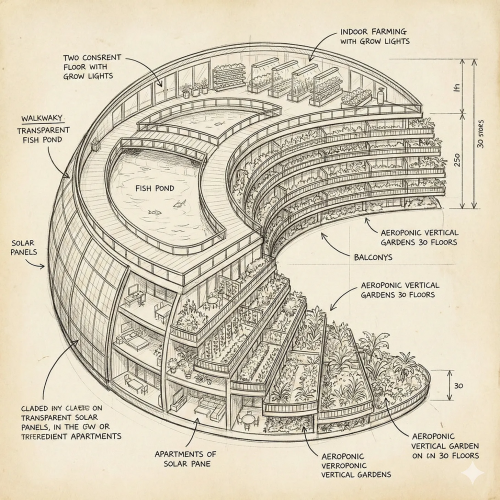
Gemini’s attempt on a crossaint shaped farmscraper. It is getting better.
This failure of imagination is exactly where the vision of Amatea begins.
In the world of the novel Amatea — Memoirs of the Last City, the city is not just a backdrop; it is a desperate, brilliant answer to a collapsing world. It is a Solarpunk utopia built on the ashes of the old world, a place where architecture has finally made peace with the planet. But as with all perfect systems, the price of this harmony is discipline. But first things first:
How a breakfast pastry became the blueprint for the Solarpunk revolution.
We have spent the last century living in boxes. If you look at the skyline of any major metropolis from the early twenty-first century, you see a monument to the rectangle. We stacked concrete cubes on top of each other, clad them in glass, and called it efficiency. We built rigid grids that fought against the wind, ignored the path of the sun, and separated humans from the very nature they need to survive. It was an architecture of defiance.
But in the visionary world of Amatea, the box is finally obsolete. The future does not have four sharp corners. The future curves. It adapts. It embraces.
At the center of this architectural revolution stands a protagonist named Ruth Bernstein. In the fictional history of Amatea, Bernstein is not just a builder; she is a harmonizer. She looked at the standardized concrete blocks of her time and saw dead space. Her vision, which would eventually culminate in the iconic “Amatea Farmscraper,” did not start with a grand desire to build a novel kind of tower. It started with a simple, frustrating observation about feeding the population in a forced self-sufficient city. She found the space for farmland where no one else was looking: in the wind itself.
The Evolution of the Curve
In traditional high-rise construction, a balcony is often a hostile place. Above the tenth floor, the wind makes it unpleasant to sit outside. The shadow of the floor above makes it difficult to grow anything substantial. It becomes a storage space for dead plants and rusting bicycles. It is a wasted opportunity.
Therefore to make a balcony truly vital, one has to change the shape of the building itself. You cannot just stick a platform on a flat wall. You have to wrap the building around the human and the plant.
This line of thinking leads to a shape that seems amusing at first glance but is structurally genius: the croissant.

Gemini’s attempt on a crossaint shape. It nailed it pretty much. (Source: Gemini)
Imagine a building that looks exactly like the crescent pastry. It is thick in the middle, tapering slightly towards the ends, and curved into a C-shape. This is not a whimsical aesthetic choice. It is a machine for living that works with the environment rather than against it. The farmscraper, rising approximately thirty stories into the air, is the ultimate Solarpunk statement. It proves that high-tech engineering and organic growth are not enemies. They are partners.
The Shield: Harvesting the Sun
The brilliance of the Amatea design becomes apparent when you analyze how the structure interacts with the elements. The building has two distinct sides: the convex outer curve and the concave inner sanctuary.
The convex side creates a “shield” against the elements. In the northern hemisphere, this back curve is oriented towards the south to face the sun directly. This vast, curved facade is covered entirely in next-generation transparent solar panels. Unlike the dark, opaque silicon of the past, these panels are transparent semiconductors printed directly onto the glazing. They allow a view out from the apartments while simultaneously harvesting the sun’s energy.
But Amatea goes further. A structure of this magnitude, thirty stories deep, would have a dark, gloomy center if it relied only on windows. So Amatea has integrated a complex system of fiber optic light channels into the solar facade. These channels act like arteries for sunlight. They capture the intense daylight hitting the southern face and pipe it deep into the building’s interior organs.
This system creates a building that glows from within. It produces its own electricity and captures its own heat. It is a power plant that people live inside. The warmth generated by the solar skin reduces the heating load in winter, while the intelligent venting systems use the curve to accelerate airflow and cool the structure in summer.
The Core: The Heart of Nutrition
Deep inside the “thick” part of the croissant shape, protected by the residential units on either side, lies the oval core. In a traditional skyscraper, this would be a dark shaft for elevators and utilities. In the design of Amatea, it is a cathedral of agriculture.
This is the domain of high-efficiency Indoor Farming. Bathed in the light brought in by the fiber optics and supplemented by spectrum-adjusted LEDs, this core runs the entire height of the building. It is a stable, controlled environment unaffected by storms or droughts.
Here, the calorie-dense staples are grown. Rice, potatoes, and soy thrive in vertical racks. Residents can look through internal windows into this green heart. They see their food growing. It creates a profound psychological shift. Food is no longer something that arrives in plastic wrap from a continent away. It is a neighbor. It is a visible part of the daily rhythm of the house. The elevators glide past walls of green, making the journey home a journey through a living garden.
The Sanctuary: Life in the Spiral
If the convex side is the shield, the concave side is the embrace. This inner curve is where the magic of the “Amatea” lifestyle truly unfolds. By curving the building inward, each farmscraper creates a massive, open-air atrium that is naturally sheltered from the prevailing winds. The building protects its own belly.
Within this protected zone, the balconies are not stacked directly on top of each other. Instead, they form a continuous, gentle spiral that winds its way down from the thirtieth floor to the ground.
This spiral design is the key to the vertical garden. Because the balconies are staggered, sunlight can reach every single level. The upper floor never completely shades the lower one. On these terraces, the city practices aeroponics.
Aeroponics is the cleanest, most efficient way to grow food. Plants are suspended in the air, their roots misted with nutrient-rich water. There is no heavy soil to weigh down the structure. There is no mess. Just pure, vibrant growth.
The planting is organized by altitude and microclimate. On the upper levels, where the sun is bright and the air is crisp, fruit bushes and sun-loving vegetables thrive. As the spiral descends into the cooler, more sheltered lower levels, the vegetation shifts to leafy greens, herbs, and shade-tolerant plants. Walking down this spiral is like descending a mountain; you pass through different zones of life, all accessible, all edible. It transforms the facade of the building into a vertical park that feeds its inhabitants.
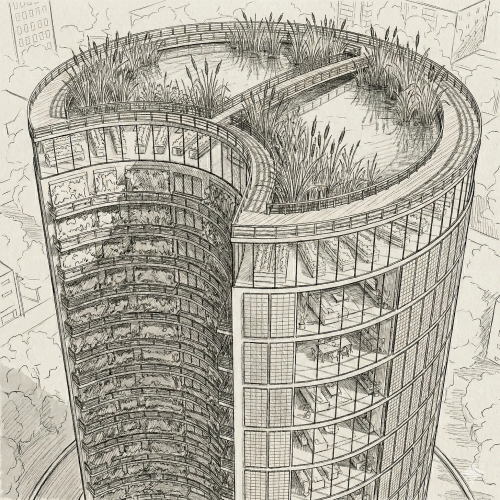
Gemini’s take on a croissant like shape, a balcony winding down and transparent solar panels. (Source: Gemini)
The Roof: An Ocean in the Sky
Perhaps the most beautiful aspect of Amatea’s farmscraper design is the roof. Here, the concept of the roof as a mechanical wasteland is rejected. Instead, Amatea crowns its towers with lakes.
Covering the entire top surface of the croissant shape is a deep fish pond. A walkway with a secure railing creates a promenade around the water, and a wooden bridge crosses the center. Standing there, thirty floors up, looking at the reflection of the clouds in the water, one feels a sense of peace rarely found in a city.
But in the Solarpunk philosophy of Amatea, beauty is always functional. This pond is a critical component of the building’s ecosystem. It is a thermal battery. The mass of water absorbs the summer heat, keeping the apartments below cool. In winter, it acts as an insulating blanket, releasing stored warmth.
Beneath the surface, the pond is teeming with fish. They provide a fresh source of protein for the community. But even more importantly, the nutrient-rich water from the fish — the “waste” — is the lifeblood of the building. Gravity feeds this water down to the aeroponic balconies and the indoor farm core. The plants extract the nutrients, effectively filtering the water, which is then pumped back up to the roof.
It is a perfect, closed loop. The fish feed the plants, the plants clean the water, and the residents live in harmony with both. It is a biological machine that mimics the elegance of a natural ecosystem.

Water defying gravity in Gemini’s urban croissant — still no farmscraper, but with some tweaks, this could actually work. Minus the gigantic fish. (Source: Gemini)
The Community: Access Over Ownership
The interior of the farmscraper is designed for human connection. With twenty to twenty-five units per floor, the scale is intimate. The hallways are not sterile corridors but social spaces with views of the indoor farm.
But the true social revolution takes place on the ground floor. In the old world, the ground floor was for retail — selling things people didn’t need. In the vision of Amatea, the ground floor is a Center of Supply and Care.
This area is the heart of the community’s resilience. It houses a “Library of Things.” True luxury is not owning a drill, a fancy mixer, or a carpet cleaner. True luxury is having access to the best possible version of those tools whenever you need them, without having them clutter your home.
Residents check out high-quality equipment from the library and return it when they are done. It is a system of radical efficiency that frees up living space and reduces waste. Why manufacture a thousand cheap tools when ten professional-grade ones can serve the whole building?
Next to this library is a modern medical center, a proactive health hub that keeps the community well, rather than just treating the sick. There is a gym where the kinetic energy of the workout contributes to the building’s grid. The ground floor is not a place of transaction; it is a place of interaction. This connectivity extends outward; the parks surrounding the farmscrapers ensure no citizen is ever more than a five-minute walk from a green lung.
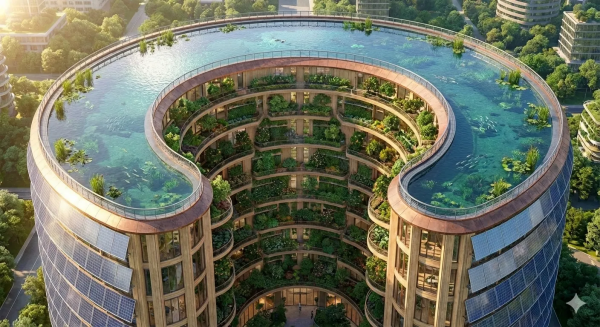
On of the closest that Gemini ever got. Transparent solarpanels are unheard of in the world of AI. No croissant shape, either. (Source: Gemini)
A Blueprint for Hope
The “Croissant” farmscraper of Amatea is more than just a setting in a novel. It is a challenge to our current imagination. It asks us to stop building dead boxes and start building living systems.
The city’s fictive design teaches us that we do not have to choose between high density and high quality of life. We do not have to choose between technology and nature. We can have both. We can have transparent solar panels that look like glass. We can have vertical farms that look like hanging gardens. We can have roofs that are lakes.
This is the promise of Solarpunk. It is not a naive dream. It is a highly technical, deeply rational, and incredibly beautiful response to the challenges of our time. The farmscraper is a vessel for a society that has learned to value resources, cherish community, and love the curve.
—
This post was previously published on Notes from the Anthropocene.
***
You Might Also Like These From The Good Men Project



If you believe in the work we are doing here at The Good Men Project, please join us as a Premium Member today.
All Premium Members get to view The Good Men Project with NO ADS.
Need more info? A complete list of benefits is here.
Photo credit: iStock

