



A few years ago I abandoned color.
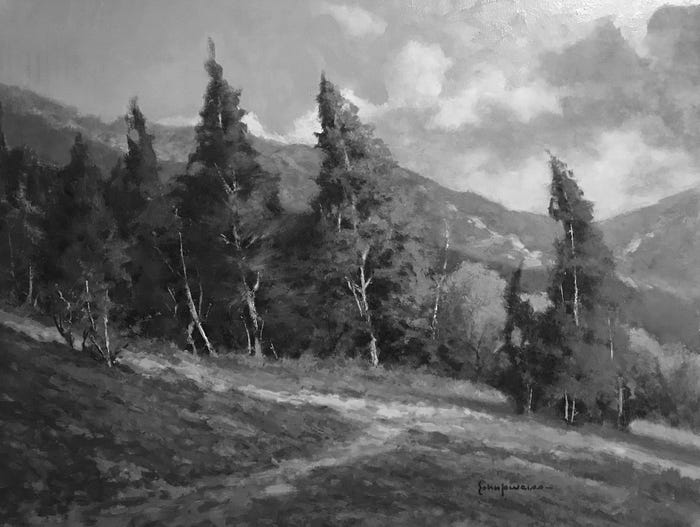
It started with my oil paintings. I moved to a limited palette. I found beauty and serenity in muted colors, and how they often unify a painting.
Garish, strikingly colorful paintings assault my eyes and aesthetic sensibility. They’re disquieting to my calm, internal landscape. Vibrant color, to me, is like the jarring interruption of a loud commercial when you’re watching an elegant, quiet movie.
My painting mentor, Scott L. Christensen, favors a limited palette in his work. Perhaps he influenced part of my color sensitivity?
Being a true colorist means demonstrating discipline by first assessing all the options laid out before you, and then giving equal regard to hues beyond the brightest in your quiver. —Scott L. Christensen
My paintings eventually became monochromatic. Something was shifting inside of me, and I found working with color unsatisfying and complicated.
I was recently retired after a long law enforcement career, and then the death of my parents, some friends, and even my beloved Maine Coon cat all contributed to my withdrawal into shadows and away from color.
Around this time I took up photography, bought a Fujifilm X-Pro3 rangefinder-style camera, and began experimenting.
I acquainted myself with the exposure triangle and fiddled with my camera’s ISO, shutter speed, and aperture. I shot various images and studied the work of other photographers.
The adventure of street photography appealed to me, and I began taking candid shots around town and when traveling.
Like with painting, I grew dissatisfied with color in my photographs and began shooting primarily in black and white. Something about the simplicity, contrast, and timeless elegance of monochromatic photography spoke to the minimalist in me.
Without color, I began seeing things in a new way. I saw shapes, angles, contrast, light, surfaces, and even people differently. Removing color exposed the simplicity and soul of people and things.
When you photograph people in colour you photograph their clothes. When you photograph people in black and white, you photograph their soul. —Ted Grant, Canadian photographer
My interest in street photography and monochromatic images opened my eyes to a world I never knew existed.
Prowling the streets of Las Vegas, piazzas of Italy, and quiet towns in Scotland to shoot my street photographs, I met interesting people I wouldn’t otherwise interact with.
One colorful character I met while exploring downtown Santa Cruz, California, was an artist named Blue.
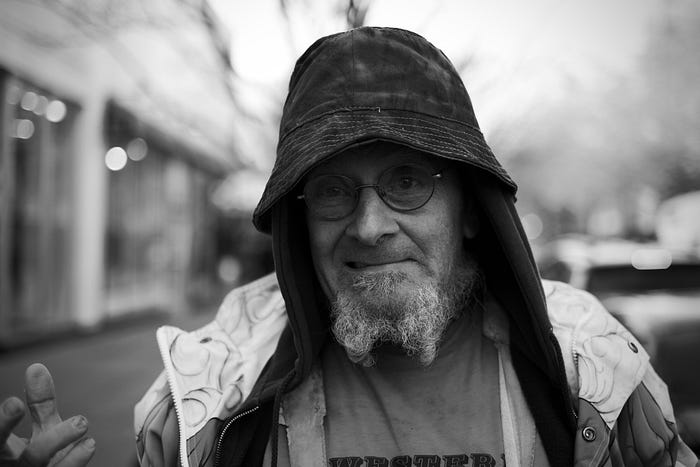
Blue was standing beside his colorful van, which he had completely covered with stickers and his brightly colored paintings. Even his self-designed clothing was full of vibrant colors.
Blue noticed my camera and said, “Go ahead, take all the photos you want.”
He told me he was a dishwasher to pay the bills, but clearly, his painting and colorfully designed clothing were his passion. The more I shot photos, the more he shared with me. He even pulled various, elaborately colored and self-designed clothing outfits from his van to proudly show me.
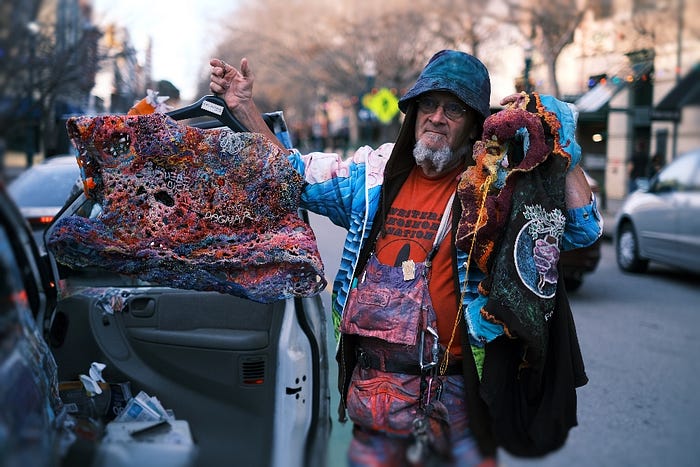
When you take an interest in someone’s passion, they’re usually excited to share it with you.
Blue’s over-the-top color aesthetic may not suit my monochromatic sensibility, but that doesn’t matter. What matters is that street photography exposes me to a world of people and things I would not otherwise experience.
Shooting in black and white allows me to see the essence of things, and street photography teaches me how to see what others miss.
Most of the pedestrians in town that day were busy shopping, chatting with friends, or staring at their phones. They might see someone like Blue in passing but not give him much thought. People get lost in their errands, shopping, and busy lives at the expense of truly seeing the world around them.
Street photography forces me to slow down and study everything.
Like the amazing, colorful people who used to be invisible to me. Or the design of a building. Perhaps the way light reflects off a windshield or the haunting gaze of a woman looking out of a coffee shop window.
Here’s the thing. You don’t need to abandon color or embrace street photography to learn how to see what others miss.
You just need to slow down and amplify your curiosity.
Decide to pursue your purpose fully
The paintings of artist Charlie Hunter are mostly monochromatic and tonal.
I met him during a plein-air painting conference in San Diego a few years ago, and I immediately fell in love with his work. He used to craft nearly photo-realistic paintings in pastel, but his style evolved. Now he paints with water-soluble oils, and his palette is mostly a monochromatic blend of ultramarine blue, viridian, yellow ochre (sometimes), and burnt sienna.
In an interview, Hunter explained how he arrived at his monochromatic style:
Painting well is not easy. Painting outdoors with highly variable light and weather is even harder. By not having to overly worry about chroma, it gives one more time to get the other components right. There is also an unexpected benefit — monochromatic painting triggers photographic comparisons in the mind of the viewer — so I can not only reference Monet, or Hopper, or whoever — I can also bring Cartier-Bresson or Walker Evans into the picture. I work with more color in the studio, but it basically comes down to the fact that, for whatever reason, I am more moved by the passage of light through a transparent paint film than an opaque one.
Like me, Hunter found that when we simplify our creative expression (be it black and white photography, limited palette painting, or even spare writing prose), we open up a new world of discovery and artwork.
In the interview, Hunter added:
The limited palette, near monochromatic nature of my paintings are, I hope, somewhat analogous to the stripped-down writing approach of a Raymond Carver or Hemingway, attempting to eschew extra verbiage for imagery that is pared down to sinew and bone.
Consider the minimalist who only wears interchangeable, similarly colored clothing. She doesn’t suffer the exhaustion of sartorial choices, thus freeing her to spend time on more important things.
Mark Twain has been credited as saying, ‘The two most important days in your life are the day you are born and the day you find out why.’ And I might add a third: the day you throw off any distraction and decide to pursue your purpose fully. ― Joshua Becker, The More of Less: Finding the Life You Want Under Everything You Own
When we strip away the inessential in our lives, be it color, excess clothing, or discretionary commitments, we open up more time and space to slow down and start seeing what others miss.
Try to strip away all the unnecessary stuff in your life.
Discard the things that weigh you down, distract you, and prevent you from seeing and experiencing what others miss. I did it by simplifying my wardrobe, limiting screen time, moving to a more affordable area, and creating more time for reading books, writing, and my creative life.
Stress, clutter, unnecessary distractions, overly complicated systems, and complexity all conspire against the part of you that longs to slow down and enjoy life’s unseen riches.
If you want to see what others fail to see, learn to embrace the philosophy of “less is more.”
Stop looking where everyone else is looking
Have you ever observed what’s behind the Mona Lisa?
I read an essay by Andy Kessler in which he shared some investing advice he received years ago from “an art major, of all people.” The art major told Kessler that investing “was all about the negative space—the unseen.”
Kessler went on to write:
We all know the Mona Lisa’s inscrutable smile and eyes that follow you as you walk past, but few notice the background of the painting, the negative space. Look again: There is a winding river through a valley and a bridge, perhaps Etruscan-Roman, a connection between ancient times and the Renaissance. Britannica says the background suggests a ‘cosmic link connecting humanity and nature.’ Cool.
So much of life becomes consensus thinking at the expense of treasures found in negative space. If the crowd is going one way, try going the other. You might find something more unique and rare.
Kessler argues that the “mysterious unknown is a gold mine for those who look, and it offers a way to outthink the crowd in investing, careers, sports, and more.”
If you want to see what others miss, stop looking where everyone else is looking.
Trapped as a society in the never-ending now
One person who sees what others miss is a young man named Sheehan. He used to work at a McDonald’s restaurant but quit to begin training for the British military. He was broke and still living with his parents (I read about this in the essay, “How David Perell Found and Hired The Cultural Tutor” in Paul Macko’s Deplatformable Newsletter).
Interestingly, Sheehan is a deep thinker and reader.
Sheehan started sharing his insights on X (formally Twitter). In only six weeks, he grew over 100,000 followers. Then writer, teacher, and podcaster David Perell discovered Sheehan and became his patron, paying him to continue writing online. Since then, Sheehan created The Cultural Tutor website and has grown his X following to over 1.6 million.
What’s Sheehan’s secret formula to amass such a vast following?
He stopped looking where everyone else was looking. How does he do that? He reads old books. If a book is less than fifty years old, he won’t read it.
In a YouTube video, David Perell explains why Sheehan only reads old books:
The simplest reason not to read something published in the last 50 years is that’s what everyone else is reading. The only books that most people read are books published in the last…not even the last six years, in the last two years.
Perell acknowledges that there are worthwhile contemporary authors, but if you read what everyone else is reading, you’re mostly thinking and possibly writing what everyone else is thinking and writing.
Perell argues that if, while everyone else is reading a popular new book like “Atomic Habits,” you read “The Consolation of Philosophy,” by Ancius Boethius, then chances are your thinking and writing will stand out from everyone else.
Also, it’s worth noting that “The Consolation of Philosophy” was the equivalent of a bestseller for about 1,200 years.
Sheehan’s writing is popular and distinctive because he feasts intellectually on a rich tapestry of old books. Thus, he can talk and write about the Greeks, Romans, Shakespeare, poetry, and more.
Perell argues that “…we are trapped as a society in the never-ending now.” The Internet ensnares all who bow to its blinking algorithms in “recency bias” that “plagues our information sphere.” The algorithms chase the latest, not the wisdom of the past.
Go read old books.
In general, old books were deeply and professionally edited. The best of them contain ancient wisdom, history, and perspectives ignored or forgotten in today’s endless treadmill of social media piffle.
How do you think the author Ryan Holiday became so successful? He read and studied the ancient Stoic philosophers, and built an entire book series and business around that.
If you want to see what others miss and escape the never-ending now of society, remember these points:
- Slow down and amplify your curiosity.
- Simplify, and strip away all the unnecessary stuff in your life (so you can see more).
- Less is more.
- Find the negative space. Stop looking where everyone else is looking.
- Read old books to escape recency bias.
I abandoned color, embraced simplicity, took up street photography, and looked for the negative space in life while everyone else was scrolling Instagram or transfixed on TikTok. I’m exploring my Dad’s ancient Harvard Classics book series and a bunch of other old books.
All because I want to see what others miss. I want to become a better writer and encourage others to escape the never-ending now and learn to swim in deeper, more intellectually satisfying waters.
Why don’t you join me?
Together we can inspire others to see the treasures found in those overlooked, negative spaces.
Before you go

I’m John P. Weiss. I write elegant stories and essays about life, which pair nicely with a cup of coffee and quiet weekend reflection. Learn more here.
—
This post was previously published on Medium.com.
—
The Good Men Project is a mission-driven men’s media platform. A major platform for stories about men, identity, fatherhood, and emotional intelligence—and a trusted home for the national conversation about masculinity.
The Good Men Project accepts paid guest posts and provides bulk guest post packages for SEO agencies and resellers.

If you believe in the work we are doing here at The Good Men Project, please join us as a Premium Member today.
All Premium Members get to view The Good Men Project with NO ADS.
Need more info? A complete list of benefits is here.
Photo credit: The artist “Blue.” Photo by John P. Weiss

