



Years ago, I took a few courses on Search Engine Optimization; SEO for short. You could say that I’m an expert on the subject.
You could, and you’d be wrong.
Not only have technological advancements changed the way SEO has worked over time, but I ran a blog a while ago without having more than a literal handful of readers over the course of a year. Clearly, I had no idea what I was doing. An expert? Hah! I might have known a thing or two about keywords, but I was ill-prepared for how to use them, let alone how to properly optimize my content.
But understanding SEO is so important as a writer that I ultimately had to learn it, and I’ll have to keep learning as the process shifts with the ever-changing technological tide. The bad news is that there’s so much to learn on the subject that it can be overwhelming. The good news?
We can break it down into easy, bite-sized tidbits that are easy to learn and remember. So let’s get to it and start ranking on Google’s first page.
What is SEO?
Before we dive into the step-by-step guide, let’s go over what SEO actually is.
SEO is an acronym for Search Engine Optimization. SEO is the process of optimizing websites to rank higher on search engines (like Google) through organic searches. That is essentially a fancy way of saying that more people will see your work when they search for particular keywords on their search engine, because there you’ll be — right there in plain sight on the first page.
Search engines have bots they use to “crawl” the internet to determine what kind of content webpages contain. They use all of the information they gather — text, code, images, and so on — and add all the relevant pages to an index for specific keyword searches.
Search engines will then determine which of these pages is best for their users’ searches, and the order in which these pages appear on the potentially millions of search results is what you need to get the hang of if you want to rank on that coveted first page, or SERP (Search Engine Results Page).
You could (and likely will) spend ages figuring this process out, and it will require a bit of patience as you navigate the ins and outs of writing for search engine optimization. But gaining a better understanding of SEO will get you miles ahead of the competition, and that’s good — there is an awful lot of competition.
Thankfully, SEO is not as complicated as you might think, and it’s even easier to master with these simple tips.
Find the right topics
Before you even begin, you have to research what your target audience is looking for, and generally, that means they want an answer to a question.
And in order to answer the question, you have to first ask the question.
Far beyond the reach of Quora, the internet is full of places that tell you exactly what questions your readership is asking. Pulling just one example for the sake of simplicity is a little gem I’ve talked about before: Answer The Public.

Author search results on AnswerThePublic to “potatoes” (everyone loves potatoes.)
The results above are what I received when I entered the very important topic of potatoes, and as you can see, the public has many questions about the starchy root vegetable. From “how to mash potatoes” to “who likes potatoes in Stardew Valley,” there are no shortage of questions that might be great topics for your potato-loving readers.
However you discover the questions you need to answer, topic research is the first and most vital piece of the puzzle in your SEO-centred writing process.
Conjure up your keywords
Now that you have your topics (and answers to your readers’ questions) you can start conjuring up some SEO-friendly keywords.
An okay place to start is Google Keyword Planner. I say it’s “okay” because if, for example, I want to see what is being searched for with regards to potatoes, I will get something like this:

image captured by author
The information above does give me an idea of the various things that people are searching for with regards to potatoes, but not much else. I don’t really see anything that points to additional keywords or suggestions, and it doesn’t show any potential competition.
Online tools are really helpful for this problem, especially those that you can use while searching for specific topics. Using our potato example: if I want my article to rank for the words “how to bake a potato,” I need to see what other articles are saying about baking potatoes and what the competition looks like. For this, I like to use a better tool (if you ask me) from the bright folks over at Ubersuggest.
It’s a Chrome extension that shows you a variety of things, but what I’ve found it most useful for is keyword research. Using our potato example, here’s what pops up alongside my “how to bake a potato” search results while using the Ubersuggest extension:

image captured by author
This gives you an idea of long tail keywords that might help you rank higher if you include those keywords in the right places within your fascinating potato article.
I could write an entire article on this subtopic alone, but for the sake of simplicity, let’s just say that the words you use matter more than you think, and strategically placing them within your writing will make a massive difference in your traffic.
But keywords aren’t everything!
SEO is more than keywords
Think bigger picture here.
There was a time when all you needed to do was pack your work with a bunch of keywords and call it a day, but the powers that be rightfully put a stop to that. Now, your content also has to deliver actual quality — it has to meet the demands of your readers’ search intent.
What is search intent? It’s exactly as it sounds! It shows that your keywords aren’t just crammed into your article to get your writing ranked, but that your piece on potatoes is exactly what your potato fan was looking for when they typed those words into the search bar.
In short, you give the people what they want!
To ensure your work matches the intent of your reader, you simply search for what you want to rank for (remember those potatoes? We want to rank for “how to bake a potato!”) Type that into your search bar and take a look at what pops up.
For my potato search, it became pretty evident pretty quickly that most people want to learn multiple ways of baking a potato, so when I write my article, I’ll make sure I include more than one way to bake a potato. The next step is to write a comprehensive article on your topic — long form articles rank higher in Google searches.
So do that and make sure you remember to make your writing high quality, accurate, and easy to read. Further to writing long form content, you can increase your chances of ranking if you also include pictures, video and other media (as long as it fits with your piece!)
But don’t forget about keywords!
This is not about “keyword density,” but keywords are still important.
Instead of amateurly cramming your writing with keywords, consider where they are best used. This is the part where you make sure to add in your keywords where needed, but don’t worry about the frequency too much — it’s all about location.
Ideally, you want your keywords to exist in places like:
- Your URL
- Your title tag (what appears in a Google search)
- The first 100 words of your page
- In a heading and subheading
As long as you cover those few bases, you’ll be just fine.
And don’t underestimate the power of Latent Semantic Indexing (LSI) keywords in your writing. Simply put, LSI keywords are really just words that relate to your topic, and while Google doesn’t actually use these keywords in their analysis, they do look at what your content covers on the whole, so using related keywords is still pretty vital to your chances of ranking.
Google is pretty smart. While you might write about potatoes, Google will scour your article looking for any other potential keywords related to potatoes. For our article on baking potatoes, Google will look for words that relate to the baking of potatoes, such as “oven.” The best part about LSI keywords is that they’re easy to come up with — all you have to do is let Google autocomplete your search and you’ll find a handful:
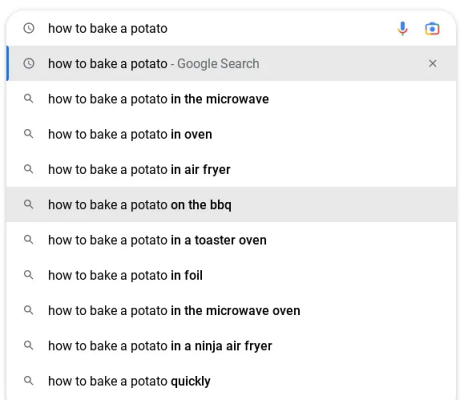
image captured by author
This is where we learn what people are searching for and if these are their questions, LSI keywords could lead them to their answers, which leaves your story on their first results page.
With that, your content is now optimized. Hooray! Celebrate! But wait two minutes because optimization extends beyond just your content.
SEO headlines and meta descriptions
You need to consider the value of a good headline when you’re writing for SEO. In fact, there’s never a good time not to have a good headline when you’re a writer.
When you’re getting your writing ready to send out into the world, you need to consider the SEO optimization of your headline. Personally, I’ve always liked the information found over at Capitalize My Title. They have some great tips about emotional words you can use and words that might boost your “clickability.”
Next up, it’s important to use your meta descriptions to your advantage. You can (and should) change them here on Medium under your story’s “more settings” section, and while meta descriptions don’t directly impact Google search rankings, they can help make your page link more attractive to searchers.
Use internal AND external links in your content
Try to include links to your other work or website (or your newsletter, if it’s relevant!) It helps more of your readers to find other pieces you’ve written on a topic they are interested in, too, and if they’re anything like me, they’ll follow you and your work once they see that you offer exactly the kind of content they are looking for.
External links are also great — in fact, using outbound links can increase your article’s chances of ranking.
Google wants its users to find all the content they are looking for, after all, not just what you offer in your one teeny tiny article. By including relevant links to authoritative content, you’re actually increasing your story’s SEO.
With that said, though, please make it make sense. Don’t just toss about links in the vain hope that you’ll boost your SEO, because you can’t fool the algorithms that way. Sorry.
Final thoughts
That’s the gist of search engine optimization, but there is so much more we could get into. There’s something to be said for marketing your work, of course, and the concept of topic research is one that I could write an entire book on (but I won’t; it’s boring stuff).
The goal of this article was to give you a simple overview of SEO and actionable, tangible advice to help you in your writing. We’re not here to become SEO masters, after all; we just need to know a few key pieces of optimization so that we can improve our chances of ranking.
A few simple planning strategies and some carefully placed, intentional keywords while you write your amazing content are all you really need to worry about. Becoming a successful online writer doesn’t mean you have to be an expert in search engine optimization, but understanding how to have your work discovered beyond your inner circle through SEO is vital to expanding your writing business.
And now you know how.
—
This post was previously published on The Writing Cooperative.
***
You may also like these posts on The Good Men Project:
 Escape the Act Like a Man Box Escape the Act Like a Man Box |
 |
 |
 |
Join The Good Men Project as a Premium Member today.
All Premium Members get to view The Good Men Project with NO ADS.
A $50 annual membership gives you an all access pass. You can be a part of every call, group, class and community.
A $25 annual membership gives you access to one class, one Social Interest group and our online communities.
A $12 annual membership gives you access to our Friday calls with the publisher, our online community.
Register New Account
Need more info? A complete list of benefits is here.
—
Photo credit: iStock

