



The little girl, Alison, followed the family dog off into the woods, where the underbrush was dense, and the approaching dusk conjured dark, foreboding shadows across the rugged forest landscape.
The dog returned to the campsite alone.
Alison’s parents, the Moores, called for her and then searched, to no avail. They placed a somewhat embarrassed phone call to 9–1–1. The Moore family are tourists here in the Maine woodlands and waters, on vacation from a large city in Massachusetts.
Soon, there are game wardens and other uniforms with guns, dogs, flashlights, and emergency vehicles. Boats and search planes are activated. Among all the professionals is Reverend Kate Braestrup.
Braestrup is not a church minister.
She’s one of the first chaplains ever appointed to the Maine Warden Service. And even when the Moores tell her that they’re “not churchgoers,” and “we’re atheists,” Braestrup simply says, “What a long, hard day you two have had,” and “I’m so sorry this has happened to you.”
It’s dark now, and the desperate hours click by.
The Moores feel increasingly anguished. Mr. Moore asks Reverend Braestrup to level with him. “Listen, I’m an engineer,” he says, “I work with statistics. You don’t have to bullshit me.”
He wants to know if his little girl is dead.
And now I will miss you every day
Money, fame, and status are not what matter in life.
The thing that matters, the only thing, is love. Ambition, greed, competition, and legacy may animate ambitions, but even wild success doesn’t replace love. And the thing about love is that it can be taken away from us.
Sometimes suddenly, without warning.
Once, when I was a young patrol officer, we got a missing person call. The wife of a local computer engineer phoned to say that her husband was late for dinner. He left the office around 5 PM on his mountain bike, with plans for a rigorous back road ride.
He never came home.
And so the search began. We drove the route through the periphery of town that his wife described. “He likes the workout he gets riding the back road hills and valleys,” she told us.
And then we noticed, about a mile from his office on a lonely stretch of roadway, a disturbed collection of leaves beside an embankment. As if something slid through them.
I got out of my patrol car, peered over the embankment, and there he was.
His body was wrapped around a tree, and his mountain bike was crumpled in a rocky ravine below. Dressed in a colorful Lycra cycling jersey, shorts, and helmet, he lay motionless around the base of the tree.
There was moss below the tree trunk, like a cushion to comfort him between this world and the next.
Accident deconstructionists were brought in, and even then, we don’t know whether he swerved to avoid a vehicle and simply lost control. Either way, his neck was no match for the solidity of an oak tree.
I love you every day. And now I will miss you every day. —Mitch Albom, For One More Day
Little did the cyclist’s wife know, when she began her day, that it would end with uniformed men knocking at her door. And that she’d collapse in one of their arms when the words, “I’m so sorry, but we found him, and he’s dead,” were uttered.
This is the fragility of life.
We think we’re immune. We have dreams, ambitions, and plans. Who has time for mortality? But life and death are bigger than us. And when the worst happens, and we lose the ones we love, we reach a seemingly unnavigable crossroad in our lives.
It’s what happened to Reverend Kate Braestrup.
Your heart is not a stone
Kate Braestrup’s husband, Drew, was a photographer, with a scraggly beard and long hair, before he became a Maine State trooper.
He was devoted to exercise and fitness and she, a writer, fancied herself an intellectual. They fit together beautifully. But even husband and wife, “…entwined, a caduceus of warm familiar flesh,” as Braestrup wrote in her stunning book “Here If You Need Me,” cannot escape life’s random, devastating tragedies.
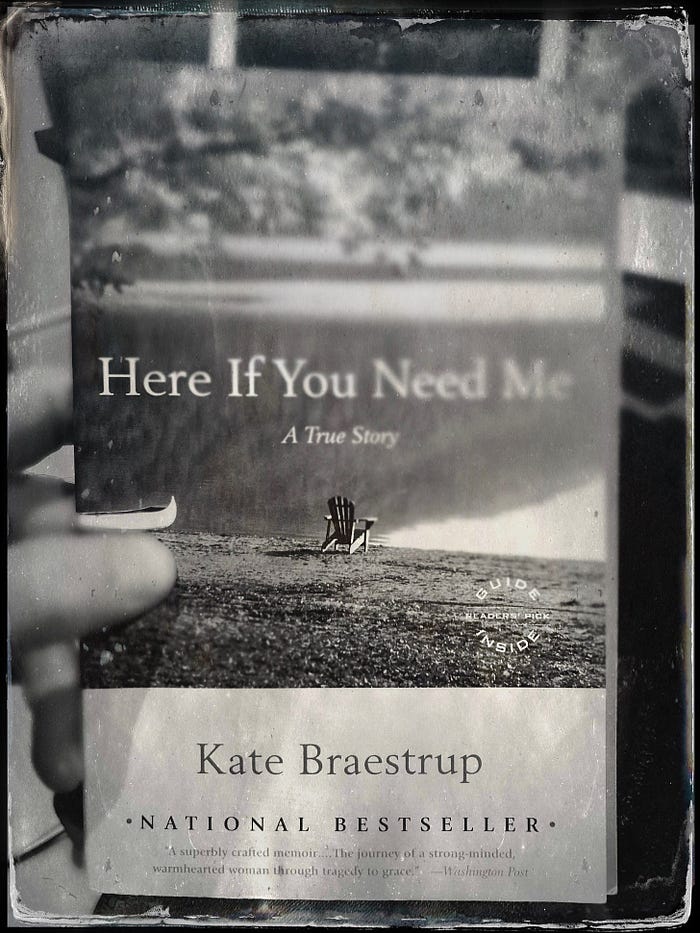
“The impact of a fully loaded box truck,” Braestrup wrote, “striking the driver’s side of a car carries a force that neither the car door nor the body behind it is designed to withstand. By any ordinary measure, Drew died instantly.”
Braestrup told the funeral director that she wished to be present for her husband’s cremation. Before cremation, she insisted that she bathe and dress his body and “be the one who closes his coffin for the last time.”
Where the universe steals everything, sometimes you have to fight for what little control you still have.
Then light your candles to the living. Say your prayers for the living. Leave the stones where they are, but take your heart with you. Your heart is not a stone. True love demands that, like a bride with her bouquet, you toss your fragile glass heart into the waiting crowd of living hands and trust that they will catch it. — Kate Braestrup, Here If You Need Me
The funeral director agreed, and Braestrup was able to say goodbye to her husband on her terms. She washed Drew’s face with a soft, damp cloth. “It’s what he would have done for me,” she wrote.
When she finished bathing Drew, it was harder to leave the room than it was to enter it.
The first is to know yourself
If your beloved asks you to bring them a peeled orange, will you?
According to a piece in the Wall Street Journal by Ann-Marie Alcántara, there’s an “orange peel test” making the rounds on social media. The point of the test is to see if your romantic partner is willing to perform little acts of service.
On social media videos, a woman (the tester is almost always female, according to Alcántara) asks her boyfriend for a peeled orange. The correct response from the boyfriend is to stop whatever he’s doing and go peel and deliver the orange.
Of course, these little tests are unscientific.
Sometimes a loved one is deeply immersed in a work project, or consumed with a problem. And then there’s the importance of reciprocity. The best relationships are about give and take, not little tests of devotion.
I remember a young couple I saw during a trip to Italy.
I was walking around the piazza shooting street photography, and this young couple stood out to me. At first, they were both busy with their cell phones, but then they put them away, snuggled close, whispered in one another’s ears, and began laughing.
They seemed so happy in that simple moment. Comfortable with themselves and one another.
Tennis star Andre Agassi was asked in an interview about the secret to a happy marriage, and he said:
The first is to know yourself. You can’t come to a relationship needing the other to feel complete, or else you’re fighting multiple battles.
Still, there is a lesson in the orange peel test.
It’s not the big things that matter in loving relationships. Sure, unexpected birthday gifts and amazing anniversary dinners are wonderful. But what sustains love are the tiny, random acts of affection and devotion.
I like to leave little cartoons and notes of encouragement in my wife’s car for her to discover early in the morning before work.
When we regularly do little, thoughtful things for the ones we love, we send an important message. Namely, that we love them, and that we’re “here if you need me.”
Because you never know when it all could end.
The gladness of the coming day
In Reverend Braestrup’s book, “Here If You Need Me,” she tells us what happens with little Alison, lost in the Maine woods.
Around three in the morning, Warden Ron Dunham’s search dog, Grace, found Alison curled up under a bush. Because that’s what lost children often do. They get tired and curl up for a nap.
Warden Dunham let Grace’s cold, wet, dog nose nudge and awaken the little girl.
Warden Dunham said, “Hey, honey, do you want to go home?” Little Alison sat up, rubbed her eyes, and said “Yes.” When asked if she’d like to be carried, she thought about it briefly and said, “No, thank you.”
It doesn’t matter how educated, moneyed, or smart you are: when your child’s footprints end at the river’s edge, when the one you love has gone into the woods with a bleak outlook and a loaded gun, when the chaplain is walking toward you with the bad news in her mouth, then only the cliches are true, and you will repeat them, unashamed. Your life, too, will swing suddenly and cruelly in a new direction with breathtaking speed, and if you are really wise — and it’s surprising and wondrous, Brother, how many people have this wisdom in them — you will know enough to look around for love. It will be there, standing right on the hinge, holding out its arms to you, If you are wise, whoever you are, you will let go, fall against the love, and be held. — Kate Braestrup, Here If You Need Me
And then Warden Dunham asked, “Want me to hold your hand?” and little Alison considered it and said, “Yes.”
Braestrup concluded the first chapter of her moving book with:
So Warden Dunham and Alison come walking out of the woods hand in hand, past the Salvation Army food wagon and into the parking lot, with K-9 Grace trotting proudly ahead. And my whole, lovely job at that moment was to bear witness to rejoicing and to join the gladness of the coming day.
As much as possible, make time for the ones you love.
Peel the orange. Leave those tiny love notes. Be consistent with your little acts of love and devotion. Because the small stuff matters more than you realize.
And when you make time for these little acts of love, what you’re saying is, “I love you,” and “I’m here if you need me.”
It’s how we invite the gladness of the coming day.
Before you go
—
This post was previously published on Medium.com.
—
The Good Men Project is a mission-driven men’s media platform. A major platform for stories about men, identity, fatherhood, and emotional intelligence—and a trusted home for the national conversation about masculinity.
The Good Men Project accepts paid guest posts and provides bulk guest post packages for SEO agencies and resellers.

If you believe in the work we are doing here at The Good Men Project, please join us as a Premium Member today.
All Premium Members get to view The Good Men Project with NO ADS.
Need more info? A complete list of benefits is here.
Photo credit: “Young couple in Italy.” Photo by John P. Weiss

