



Poetry is most often experienced unintentionally at private ceremonies such as weddings and funerals, with eighty percent of the potential audience and more than ninety percent of the current audience reporting that they’ve been exposed to poetry at one of these private occasions.
— Poetry in America Study commissioned by the Poetry Foundation

The Backstory
“There may not be a boy scout badge for poetry, Jimmy. But you’ll know, and I’ll know, that you have one.”
One of my favorite childhood memories is sitting on the floor with my baby sisters (then ages 2 & 3), listening to my father’s deep voice as he read to us from Winnie the Pooh and Charlotte’s Web. He had been a Lt. Col in the Army Corps of Engineers during WWII and the Korean War, and he loved the army, his family, golf, reading to his children and poetry.
Later, when I joined the Cub Scouts, Dad, ever the military leader, became the city Pack Cubmaster. I dutifully started my collection of merit badges. Astronomy, First Aid to Animals, and Knot Tying were my favorites. One evening — by this time, we’d graduated to Robert Frost and David Copperfield — I asked if there a merit badge for poetry.
Dad thought about it and said that there wasn’t, but there should be. He could recite Frost’s “Stopping by Woods on a Snowy Evening” by heart, along with selected stanzas from Shelley’s odes. (“Like ghosts from an enchanter fleeing” was a favorite when we raked leaves.)
He decided that, if I could memorize a Frost poem, we’d create our own badge. I chose “Nothing Gold Can Stay” — it was short, and I can still recite it, often without being requested to do so.
When Dad was satisfied that I knew it, he took my recently won knot-tying badge and, with his elegant fountain-pen, wrote “Poetry” on the back. We then stitched it onto my sash (knowing how to use a needle was at that time part of the Leatherwork badge). It was our secret, in retrospect the first of many.
As father/son relationships go, ours grew intermittently more rocky and the stuff of much future therapy. Among many other of my quirks, he despaired of my inability to do anything with a baseball other than chase it, pick it up and hand it to someone on the team who could throw.
But he was fiercely supportive when I became captain of my high school Latin team and demanded a captain’s letter jacket for leading a team that entered translating competitions. The school settled on a cheerleader’s jacket, which, for 1965, was considered borderline-progressive. I wasn’t thrilled, but Dad talked to me about Sun Tzu’s The Art of War, and the military strategies involved in choosing one’s battles, when to declare victory and when to walk away.
All through high school, I wrote poetry and regularly sent it into the New Yorker, my father’s favorite magazine — and I still think that the reason I got into a college known for producing poets and poetry was that I brought my collection of 18 rejection slips to the interview.
My eventual degree in English literature convinced me that there were other paths to follow in life that didn’t include sharing my poetry — and over the following 40 years, I stuck to my journals. But the birth of my alternative grandchild — a startling, delayed result of being a gay dad before there were any — changed all that. It became important to me that he see me as something other than a string of amusing anecdotes about that artist/writer guy who helped bring up his mother.
I started submitting work to online journals, and slowly began getting published. I started my own press, produced Everything Becomes a Poem and Jane Austen’s Pride and Prejudice in 61 Haiku (1,037 Syllables!). I’ve now moved onto — inspired by research indicating that the only time anyone reads or hears poetry these days is at one of those two life events. Here is a preview of what you can expect:
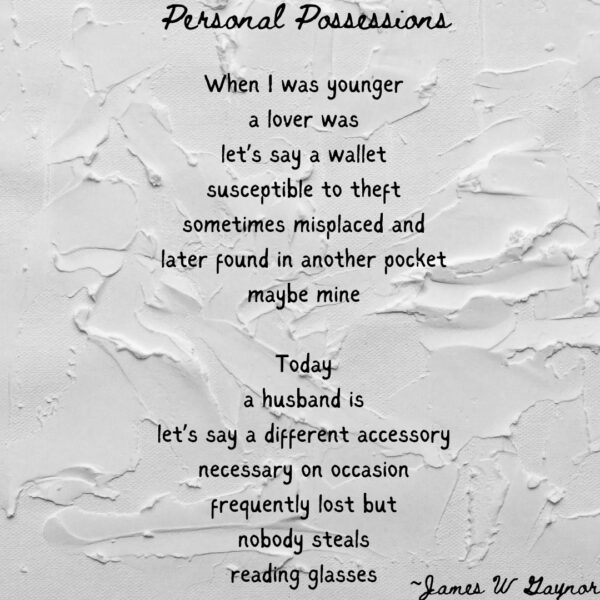
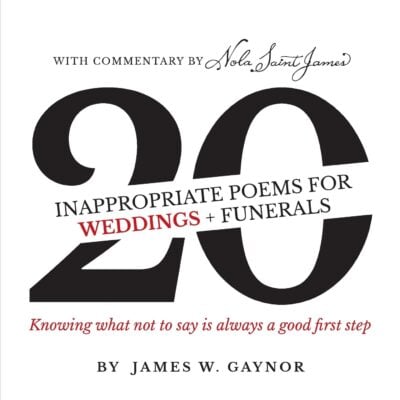 The choice of what to read at a ritual requiring poetry can be daunting. In recognition of that fact, this collection aspires to be helpful in identifying some poems best read before or after – but not actually at – the ceremony in question.
As the poet points out, “Knowing what not to say is always a good first step.”
With forewords written by Regency Romance author, Nola Saint James and Rabbi Dr. Jo David.
“Everyone deserves a happy ending, whether it’s at a wedding or a funeral. The problem is – life.
By night, I write Regency-era romances. By day, I officiate at weddings and funerals as a rabbi. The two parts of my life, like this book, are oddly compatible. The feelings evoked by both life cycle events – weddings and funerals -are oddly similar. Except that there are often more laughs at funerals and more tears at weddings.
My dear friend, James W. Gaynor, has brilliantly captured this paradox in his lovely collection of poems that reflect on the human condition at the best and worst times of our lives. (And don’t fall into the trap of thinking that weddings are the best!)”
–Nola Saint James and Rabbi Dr. Jo David
—
Cover Art by Kelly McKinley
Featured Photo: iStock
—
This post made possible by site sponsor Nemeton Press
Read James W. Gaynor also on:
Down in the Dirt http://scars.tv/
Fleas on the Dog https://fleasonthedog.com/
Dodging the Rain https://dodgingtherain.

