



Not less than two decades ago, dating apps were seen as for losers, but today, it has become the norm. Dating apps are now the churches, bars, or places we go to with the hopes of finding a partner.
Without looking at the stats, there is no doubt that more and more people meet their partners online. In 2009 it was 20%, 40% in 2017, and it’s probably over 50% by the time you read this article.
To put this in context, 72% of millennials have used dating apps, and a third of American marriages now begin online.
7 out of 10 relationships will start online by 2040 — estimated by eHarmony.
Dating apps are here to stay; if they are, then we should discuss their impact because they will likely be the foundation of future marriages and partnerships.
The following concerns with dating apps interest me:
What is some psychological truth about Dating apps?
The influence of algorithms on finding a love mate,
Impact of technology on relationships in a Monopolized industry, and
The shaping of societal norms and expectations.
The Psychological Truth about Dating Apps
Some may see technological development as an ease to find partners. Still, this ease has come with a psychological problem.
Using an app as a dating platform is quite similar to playing a game equipped with flashing lights and rewards. The “players” of these games quickly pick up on the concept and learn to present themselves as attractively as possible to showcase an idealized image of themselves to other players.
Dating app creators are hard at work “gamifying” the experience to make it more addicting and keep you coming back for more.
Your serotonin system is involved if an app on your phone continuously bestows rewards on you. High serotonin levels are correlated with happiness, which programmers need to stimulate to boost an app’s popularity.
The addictive qualities of applications like Tinder or Hinge are neurochemical in origin. They release endorphins, your body’s endogenous painkiller, which can reduce your anxiety levels or even spark a high feeling.
Additionally, a lot has been said about how playing video games causes dopamine to be released. When you use one of these applications, dopamine, a vital component of the brain’s reward system, produces positive sensations that disappear when you put the phone down, making you yearn to play the game again.
Furthermore, operant conditioning (Behaviorism) brings you back to these apps — getting a match with another person provides immediate validation. This good feeling of validation often brings people back to play again.
“I find myself not contacting or reaching out after a match on dating apps because sometimes I only want to know if they think I’m attractive and want to date me.”
These matches also occur often yet sporadically, precisely the pattern of “reinforcement” that rats, pigeons, or even humans are most likely to respond to as compulsive, recurrent behavior.
And it makes sense! Instead of helping you discover real love, dating services are in the business of having you swipe, look at their ads, and (often) pay monthly fees. And it doesn’t even begin to cover the falsehoods, obfuscations, and downright deceptions you’ll come across while attempting to meet someone in that manner.
Watch Out it’s a Monopolized Industry
As It’s increasingly becoming the default way to meet people, solving a problem of love seems to be a market. Most technical people have at some point thought to start a dating app. However, only some successful dating apps currently on the market are independent start-ups.
A typical example would be Tinder. More than 50 million people in the world use Tinder alone. Hatch Labs started Tinder, an incubator and captive fund building new mobile businesses from the ground up. They are also the company behind Match, PlentyOfFish, and also owns OkCupid and Hinge.
You might think there may be exceptions like Bumble. Whitney Wolfe Herd, who left Tinder, started Bumble and was contracted by a Russian billionaire who started a Russian dating company.
Every dating app is part of some original incumbent company. This makes you wonder why in every other consumer product, firm start-ups win, but in dating apps, all the old-school players are still there and succeeding.
Isn’t it scary to think that one company is setting up your marriages and relationships? Scary to think about the potential of these companies to have a significant influence on demographies and societal changes.
What percent of 2030 marriages will be set up by Match.com, Tinder, and Hinge? What do they know? Are they doing it right?
Modern Algorithms and their Impact on Finding a Partner
As long as people want to date, they have also understood how difficult it can be to find the right partner and that, occasionally, it might be helpful to seek out some assistance.
There is a tradition of romantic relationships arising not only from chance encounters between two people but also from the intentional intervention of third parties that dates back millennia, from the Jewish shadchan to the Khastegari customs of Iran to the arranged marriages that are still common in some parts of Southeast Asia.
Dating apps are third parties of this age, employing algorithms. A site uses a mathematical algorithm to identify potential partners, called “matches,” for their users. These matches are presented to the user, not as a random selection of potential partners in the local area but instead as potential partners with whom the user will be especially likely to experience positive romantic outcomes.
These algorithms are based on data points such as age, location, likes, and dislikes, but the algorithm system didn’t just start with the age of technology. The Jewish matchmakers also used the historic algorithms system.
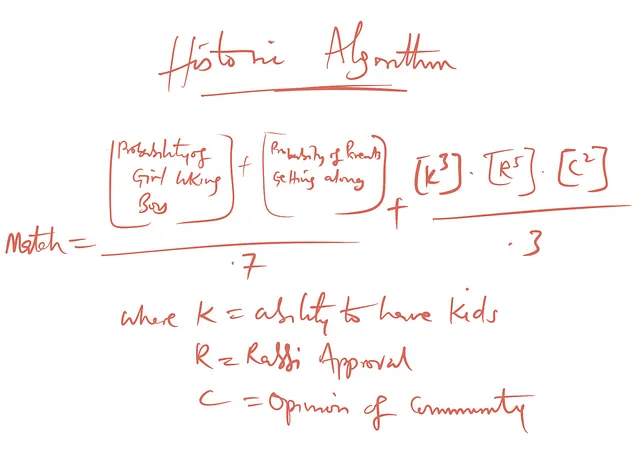
Screenshot & Handwritten by AlibsWrites(Author)
So, does online dating fundamentally alter the compatibility matching process, or does it simply represent a variant of the same matching procedures that professional and familial matchmakers have used for centuries?
Online dating has both altered and perpetuated the process of compatibility matching. On the one hand, the basic principles of compatibility matching remain the same, regardless of the medium used. The goal of online dating and traditional matchmaking is to find compatible individuals regarding shared values, interests, and personality traits. The critical difference is how this information is gathered and processed.
On the other hand, it has introduced new technologies and mainly data-driven approaches that allow for a more systematic and efficient evaluation of potential partners, but this comes with limitations in finding a partner.
One of the limitations is by relying on data and predetermined criteria to match individuals, and algorithms can overlook the unique qualities and experiences that make people who they are. This can lead to a lack of diversity in the types of individuals presented as potential partners, resulting in a narrow pool of options.
Another limitation is the inability to quantify critical factors that cannot be easily measured or captured through data. For example, personality, interpersonal dynamics, and chemistry are essential components of a successful relationship.
Nevertheless, these factors cannot be quantified or easily captured through data. Algorithms can overlook these critical aspects, leading to matches that may seem compatible on paper but may not work out in reality.
These algorithms were doing precisely what they were designed to do: to take our user-generated information and match it up with other people’s information. The real problem here is that while the algorithms work just fine, you and I don’t when confronted with blank windows where we’re supposed to input our information online.
Very few of us can be totally and brutally honest with ourselves. The other problem is that these websites ask us questions like, are you a dog or a cat person? Do you like horror films or romance films? So, there’s a certain amount of superficiality in the data.
Given these limitations, it is important to approach online dating with caution. While algorithms can help generate potential matches, they should not be relied upon as the sole determinant of compatibility.
Instead, individuals should use online dating as one tool in their search for a partner and take the time to engage in real-life interactions and get to know potential partners before committing to a relationship. This will help ensure a more comprehensive and accurate assessment of compatibility.
There is an Algorithm for love, but not just the one you are being presented. It is the algorithm you write yourself — Amy Webb.
The Shaping of Societal Norm and Expectations
Not so long ago, most relationships would start with a handshake and a smile instead of a click or a swipe, which connect people to a seemingly endless pool of potential dates and make it seem as though there is always someone out there who is better for you than the person you are dating or even just meeting.
Giving any person actual importance is not reasonable when so many options are available. It has made the practice of “ghosting,” in which someone ceases all contact with another person and withdraws from their life, the norm.
“One-fourth of the respondents said they had been ghosted in the past, while one-fifth said they have ghosted another individual.” — Gili Freedman at Dartmouth College.
Because people you meet online tend to be total strangers and could be viewed as disposable, there is a significant increase in the number of options to find mates and a notable drop in the danger of reputation harm due to poor behavior patterns in your real-life social circle.
Before online dating, you were much more likely to date partners from similar social circles — meaning if you acted like a jerk, your friends, family, or rabbi would find out.
Another new norm of immediate satisfaction brought about by online dating is the expectation that relationships would develop quickly and successfully. We have been trained to demand more from less and move on at the first sign of difficulty since it is so easy to swiftly “swipe left” or reject a possible mate with the touch of a button.
This lack of patience has shifted our entire interpersonal dynamic; it’s become common for people to spend time together without investing in each other’s interests or getting to know each other in a meaningful way.
In addition, online dating has blurred the lines between offline and online relationships. People often find themselves in situations where they are simultaneously talking to multiple partners, leading to ambiguity and confusion about intentions and expectations. This can create an atmosphere of distrust and uncertainty, making it difficult for people to form real, lasting connections.
The ease of access and convenience that online dating provides can also lead to disinterest in the process. It becomes easy to give up if a match doesn’t seem perfect immediately. This is damaging because it encourages people to move on too quickly and prevents them from seeing potential matches through to get to know them better.
Even if the rate of success on dating apps isn’t fantastic, as only about 10 percent of online matches ever result in a meetup in the real world, users often feel discouraged at the difficulty of finding genuine relationships, but never goes away totally without the impulsive thoughts of getting back on the apps.
Online dating is here to stay, despite its drawbacks and how discouraging it often may be.
A broad view is the ideal one. Recognize that it is a complex system that encourages users to use the services more and more without necessarily forming genuine connections. If you decide to join, optimize your profile, but remember that the gamification and rapid accessibility of online dating might make it more challenging to create an authentic connection.
So there you have it, friends: the era of online dating and marriages is dominated by algorithms. And guess what? These numbers will only rise as we get more comfortable letting computers make our decisions.
But here’s the good news: if you know how these algorithms work, you can use them to your advantage!
—
This post was previously published on medium.com.
***
You may also like these posts on The Good Men Project:
 White Fragility: Talking to White People About Racism White Fragility: Talking to White People About Racism |
 Escape the “Act Like a Man” Box Escape the “Act Like a Man” Box |
 The Lack of Gentle Platonic Touch in Men’s Lives is a Killer The Lack of Gentle Platonic Touch in Men’s Lives is a Killer |
 |
—
Photo credit: AlibsWrites

